Saturday, December 3, 2011

If there were a Mt. Rushmore for Campaign Managers, Mark Block could now Apply to be the Janitor there

Cain out:
“That Cain’s candidacy was taken seriously for longer than a nano-second in a time of genuine crisis for the country raises fundamental questions about the health of the political process and the Republican party,” Schmidt said.
MORE: Sweet Jesus, this is insane:
After the smoking ad briefly made Block well known in the political world, he asked his staff to inquire about securing him a live spot on NBC'S comedy show "Saturday Night Live" where he could self-parody the ad, the former campaign official said.
There are no words ... except that it only gets worse:
Once Cain surged to the top of the polls in the early fall, his campaign began to burn through the $9.4 million third-quarter fund-raising haul that legitimized Cain as a contender for the nomination.

Cain's camp rented a G4 private plane to accommodate the candidate's entourage that included Block, spokesman J.D. Gordon, a videographer and two historians Cain was paying to document his campaign for a book, according to the former official.
G4s run about $7500 per flying hour.

Friday, December 2, 2011

Badger State Polarization

A couple of weeks ago, we mentioned race as being one of the ongoing factors effecting the concept of "good government." Here's a more concise explanation of that phenomenon:
[W]hy all this excitement in Wisconsin? I suspect what we're seeing is a manifestation of the remarkable mix of political traditions that has long defined that state, with on the one hand, its deep progressive, even socialist, roots going back to the transplanted Yankees and northern European immigrants who settled it; and on the other hand, its nearly as well-established strain of deep conservatism that has at moments strayed into nativism and demagoguery, most notably in the person of Joe McCarthy. Jason DeParle's superb history of welfare reform, "American Dream," set in Milwaukee, notes another feature of the state that surely helps explain its polarized politics: the Great Migration got to Wisconsin later than anywhere else. While Southern blacks were pouring into othern northern cities at midcentury, Milwaukee was still overwhelmingly white in the 1950s; it was only later, in the 1970s and 1980s, that a second wave of migration carried African-Americans to Milwaukee, mostly from Chicago. This means that metro Milwaukee is further behind in the cycle one has seen in other cities, where, after an initial white flight, the suburbs are now themselves growing increasingly diverse and Democratic. Milwaukee hasn't moved as far from its initial white flight phase, and its suburbs -- not all, but most -- remain a hotbed of Republican votes (and, not incidentally, home to some virulently conservative talk show radio shows.)

The Haplessness of the Indianapolis Colts

Yikes:
On top of all of their other woes, the Colts have the worst special teams in the N.F.L. Their punt returners average just 2.2 yards per return; factor in 14 fair catches, and that average drops to 1.3 yards. The primary return man, Blair White, is 2.06 yards tall, so he would be better off catching punts and falling straight forward than doing whatever he currently does.

Sunday, November 27, 2011

Does United Wisconsin Already have Half the Signatures Required to Recall Scott Walker?

So says Nelson Goodson (via DW):
After the Black Friday statewide signature petition drive, recall organizers projected that most likely they have surpassed the halfway mark of the 270,000 signatures needed or will reach the halfway target total within days to force an election recall against Governor Walker.

Within the first week of the Walker recall, organizers and volunteers collected at least 105,000 to 107,000 petition signatures within four days of the initial start date (Nov. 15).
Incidentally, the second week of the signature collection period this spring was the most bountiful week of the whole 60 days. Back in March, the Dems were able to collect 45% of their target in 12 days. However, they needed 11 more days to break the 50% threshold. Once they were over the hump, the signatures rolled in at a much slower trickle.

That's probably not going to happen this time around. Last spring, Dems were collecting in reliably GOP districts. This time they can mine Democratic strongholds too. This brings up an interesting dilemma for the Dems: if they have reached the halfway point, then at the current pace they will collect the required signatures on December 9th or 10th, giving them a month to continue to collect signatures. The Dems might want to continue to gather signatures, if for no other reason then to identify their voters.

1,128,159 people voted for Scott Walker in 2010. At the current collection rate Dems will reach 1,350,000 signatures by January 15th. If those people are guaranteed votes against Walker, then he will recalled. That kind of opposition is just too much for anyone to overcome in Wisconsin. That's probably not going to happen, since there will likely be a drop-off in the collection rate as the effort continues, but it goes to show that there's real benefit to collecting names.

Just as an aside: the anti-recall TV spots Walker's people are running make no sense to me at all. They're not converting anyone, they are reminding opponents that the recall is on and the two women who are featured in them come off as almost whining. I'm not sure how they're effective -- particularly the "sour grapes" spot -- and it just goes to prove that Scott Walker seems incapable of doing anything without pissing off the opposition unnecessarily.

Wednesday, November 23, 2011

Looking Back on Scott Walker's Childish Campaign to Convince Illinois Businesses to come to Wisconsin

Shortly after Scott Walker took office last January he embarked on an aggressive campaign, not against state employee unions, but against an entire state itself: the state of Illinois. Now, hating on the Land of Lincoln is not rare thing among Wisconsinites, but Walker had a particularly public venue to air his grievences and he took full advantage of them.

Walker had been in office just over a week when Walker started to stick his foot in his mouth:
Madison, Wis. - Gov. Scott Walker tried to take full advantage of Illinois lawmakers passing dramatic tax increases Wednesday, saying Wisconsin would welcome any businesses from its neighboring state that care to relocate.

Absent from Walker's sales pitch was the fact that Wisconsin's top income tax rates remain higher than Illinois even under the increase.

Even so, the Republican Walker was reveling in drawing a comparison between Illinois, which has a Democratic governor, and his agenda to cut taxes.

"Years ago Wisconsin had a tourism advertising campaign targeted to Illinois with the motto, 'Escape to Wisconsin,"' Walker said in a statement. "Today we renew that call to Illinois businesses, 'Escape to Wisconsin.' You are welcome here."

Walker referenced Illinois' problem in a speech to business leaders on Tuesday, issued a statement hours after the tax increase vote on Wednesday and then called a news conference to talk about it as well.

Wisconsin lawmakers were picking up on it as well. Rep. Robin Vos, R-Caledonia, said he welcomed any chance to "kind of stick it to them" in Illinois. He said lawmakers there raising taxes played right into Walker's hands.
It was an early show of the tact and skill with which Walker and his comrades would hand seemingly all of their business. It also didn't take long for Walker's strategy of arrogance to backfire spectacularly. But that didn't stop Walker from continuing his campaign on idiocy against Illinois one more time in May.

Almost a year later, the employment figures for the two states couldn't be more different. From yesterday's MJS:
Wisconsin posted the nation's biggest payroll losses, with employment dropping by 9,700 jobs in October compared with September, according to a U.S. Bureau of Labor Statistics report released Tuesday.

The bureau said Wisconsin was the only state with a statistically significant decline in employment, dropping from 2,757,200 jobs in September to 2,747,500 jobs in October. However, the state unemployment rate, which doesn't include jobless people no longer actively searching for new work, dropped to 7.7% from 7.8%.

Wisconsin saw a job increase in the leisure and hospitality sector, according to the bureau's seasonally
adjusted data.

But there were declines in several other sectors: construction; manufacturing; trade, transportation and utilities; financial activities; professional and business services; education and health services, and government.

New York had the second-largest payroll loss, at 8,300 jobs. That might reflect cutbacks in the financial services industry, which is "in a very tough cost-conscious mode right now," said Steve Cochrane, director of regional economics at Moody's Analytics Inc.

Illinois led the nation with a 30,000 gain in jobs...
It's worth looking again at the two paragraphs in the middle of that story:
Wisconsin saw a job increase in the leisure and hospitality sector, according to the bureau's seasonally adjusted data.

But there were declines in several other sectors: construction; manufacturing; trade, transportation and utilities; financial activities; professional and business services; education and health services, and government.
It's worth pointing out that Walker's jihad against light rail, wind power, public education and all forms of government account directly for the loses in those sectors and it's more than likely that the political chaos that Wisconsin has become famous for during his term has made the state a less than desirable place for other businesses to relocate.

Monday, November 21, 2011

Paul Ryan's "American Idea" in neither very American nor much of an Idea

Last week Rep. Paul Ryan returned to one of his favorite haunts, the Heritage Foundation, to give a speech on "Saving the American Idea." If Ryan's track record is any indication, the speech outlines a new phase in the rhetoric Ryan will be deploying to promote his extreme budget policies.

During the last few years, Ryan has looked to the future and painted a dreary, almost apocalyptic, picture of an imminent "tipping point" just over the horizon, a moment of financial reckoning that will expose the social safety net as an inherently unaffordable enterprise. This undertaking is little more worthwhile than carrying around a sandwich board that reads "The end is nigh!" around Capitol Hill, so it probably should come as no surprise to Ryan that his budget has gotten as much traction as, say, the budget policies of any other doomsday crier wandering the streets. That's not an accident: people are inherently distrustful of those who claim to see the future.

But we absolutely love people who can look into the past.

There comes a point in the promotion of an radical or extremist ideology when the evangelist realizes that audiences are scared of change, but are not so afraid of change to reconsider the past. That's why there's been a concerted effort in the last generation to promote the idea that America was founded as a "Christian nation" according to principles that look remarkably similar to a 21st Century Evangelical fundamentalism that simply did not exist 220+ years ago. This transforms the proposed change from an alteration of a familiar routine into an agent of redemption. Just as fundamentalists insist America was founded on religious precepts, Paul Ryan will likely spend the coming months telling America that it was founded on the kind of extreme economic policies that, just coincidentally, he happens to be promoting. It's an argument from authority riddled with absurdities.

Perhaps nowhere are these absurdities more evident than in the glimmering catch phrase Ryan will no doubt be thumping at all his upcoming speeches to think tanks: the American Idea. It''s not an entirely new phrase, to be sure, but we don't generally speak of America as having an "idea" as we do speak of it having a "dream." (The difference is stark: 3 million Google hits for "idea" versus 16 million hits for "dream," for example.) There is, however, a Wisconsin Idea, which is something that Ryan would be familiar with as a Congressman from that state.

This Wisconsin Idea is antithetical to Ryan's worldview:
The Wisconsin Idea is the political philosophy developed in the American state of Wisconsin that fosters public universities' contributions to the state: "to the government in the forms of serving in office, offering advice about public policy, providing information and exercising technical skill, and to the citizens in the forms of doing research directed at solving problems that are important to the state and conducting outreach activities." A second facet of the philosophy is the effort "to ensure well-constructed legislation aimed at benefitting the greatest number of people."
To put it another way: the Wisconsin Idea is the gospel of technocracy: good government works best when it creates policies through the systematic evaluation of data and empirical evidence. Ryan's "American Idea" is that policies should be made according to ideology, namely the radical economic agenda he's become famous for thumping during the last decade. (I encourage you to devote particular attention to the section Ryan hilariously calls "the Brick Wall of Math," where he accuses the President's policies of failing the laws of basic arithmetic when, time after time, Ryan's own proposals seem to defy those very same laws.)

That Ryan should be conflating the Wisconsin Idea for what he claims is the American one is not a rhetorical coincidence. Ryan very clearly wants to replace the Wisconsin Idea for what he calls the American one, which is really nothing but the Paul Ryan Idea (which is actually the Ayn Rand Idea). It's a rather audacious slight of hand.

Ryan's American Idea is, of course, the product of the contemporary Republican concept of American Exceptionalism: 
[T]he principles of free enterprise, limited government, individual freedom, traditional American values, and a strong national defense. These are the principles that define the American Idea, and this mission has never been timelier because these principles are very much under threat from policies here in Washington.

The American Idea belongs to all of us—inherited from our nation’s Founders, preserved by the countless sacrifices of our veterans, and advanced by visionary leaders, past and present. What makes America exceptional—what gives life to the American Idea—is our dedication to the self-evident truth that we are all created equal, giving us equal rights to life, liberty, and the pursuit of happiness. And that means opportunity.
Except this is, at it's very heart, a speech about economics, and no one -- not even the craziest right wing loon -- looks to the Founding Fathers for advice on how to negotiate a 21st globally-integrated economy. Not yet, at least (though one can reasonably assume that the Right's fetishization of the Founders will inevitably lead them in that direction). Ryan's speech is actually just an extended critique of Obama's tax policies and some finger-wagging at the "tone" in Washington and the Congressman is now claiming that his answers are the very solutions the Founding Fathers themselves would have prescribed.

Except this is manifestly not true. In fact, Ryan's extremism would have been rejected by his own party as recently as a decade ago. Here's David Frum reflecting on the rightward lurch the GOP has succumbed to in this week's New York:
It was not so long ago that Texas governor Bush denounced attempts to cut the earned-income tax credit as “balancing the budget on the backs of the poor.” By 2011, Republican commentators were noisily complaining that the poorer half of society are “lucky duckies” because the EITC offsets their federal tax obligations—or because the recession had left them with such meager incomes that they had no tax to pay in the first place. In 2000, candidate Bush routinely invoked “churches, synagogues, and mosques.” By 2010, prominent Republicans were denouncing the construction of a mosque in lower Manhattan as an outrageous insult. In 2003, President Bush and a Republican majority in Congress enacted a new ­prescription-drug program in Medicare. By 2011, all but four Republicans in the House and five in the Senate were voting to withdraw the Medicare guarantee from everybody under age 55. Today, the Fed’s pushing down interest rates in hopes of igniting economic growth is close to treason, according to Governor Rick Perry, coyly seconded by The Wall Street Journal. In 2000, the same policy qualified Alan Greenspan as the “greatest central banker in the history of the world,” according to Perry’s mentor, Senator Phil Gramm. Today, health reform that combines regulation of private insurance, individual mandates, and subsidies for those who need them is considered unconstitutional and an open invitation to “death panels.” A dozen years ago, a very similar reform was the Senate Republican alternative to Hillarycare. Today, stimulative fiscal policy that includes tax cuts for almost every American is “socialism.” In 2001, stimulative fiscal policy that included tax cuts for rather fewer Americans was an economic­-recovery program.
Pretending that Ryanomics has been an immutable truth of the American Experience since 1776 is complete bullshit. It hasn't even part of GOP dogma at the beginning of this century, let alone the 18th. There are good political reasons for leaning on the American Exceptionalism crutch, but no honest intellectual ones. It should call to mind the adage coined by Samuel Johnson that "Patriotism is the last refuge of scoundrels." When it comes to crafting policy, which has a nasty habit of ignoring sentiments of nationalist pride, this seems especially true.

Be prepared to start hearing a lot more about this so-called "American Idea." Ryan ran with the "tipping point" theme for what seemed like ages. Ryan's reputation for being a thinker is vastly over-rated. He's a marketer, someone who develops a catchy jingle or a lovely catch phrase and the only "idea" anyone should be ascribing to Ryan is that he is out of them.

Tuesday, November 15, 2011

Is Scott Walker's Support among Republicans Declining?

This poll has to be an outlier:
The Wisconsin Public Radio/St. Norbert College Survey was released the same day that Democrats, labor unions and others, angry over his moves to curb union rights, began circulating petitions to get the 540,000 signatures needed to force a recall election next year.

The poll showed that 58 percent of respondents believe Walker should be recalled from office. That compares with 47 percent who said in April that he should be recalled.

The growth in support for a recall came, surprisingly, from Republicans. In the spring, only 7 percent of Republicans supported recalling Walker but that grew to 24 percent in the fall. Support among Democrats held mainly steady at 88 percent in the spring and 92 percent in the fall.

Pollster Wendy Scattergood said Republicans who support recalling Walker are younger, have a lower income and are less educated than the rest of the sample in the poll. They also describe themselves as less conservative than other Republicans, she said.
But if it's not, if it is instead a harbinger of things to come, this recall just got a whole lot more interesting. 24% of Republicans seems awfully high to me, but maybe we've been looking at the Wisconsin electorate all wrong over the last year. Maybe, instead of there being a highly polarized environment exasperated by a razor-thin bloc of independents the center-right has had enough. They've reached their breaking point and now want out. If that's the case then it likely has little to do with opinions on collective bargaining, but rather with the disastrous tone that's dominated discussion in Wisconsin since January.

Those are some big ifs and I'm going to reserve judgment until I see another poll with similar figures. These are the kind of numbers that get potential Dem candidates' attention.


Only 5% of Ron Johnon's $1.4 Trillion in Federal Budget Cuts actually came from Ron Johnson

Ron Johnson took to the pages of Journal Sentinel on Tuesday to discuss the federal budget deficit. Now, in the past we've criticized the Senator for omitting data from his missives to the masses and Johnson seems to have taken this criticism to heart. Unfortunately, he's basically compensating for all the prior lack of data with an overload in this op-ed.

Johnson spends the first 4/5ths of the essay explaining the current budget deficit using numerous facts, figures and statistics before arriving at the crux of his argument:
What I have described above is a problem of spending too much, not taxing too little. So the solution lies in finding ways to limit the growth in government, not figuring out how to take more from hardworking Americans. Recent reports out of the supercommittee are not encouraging. Even though there have been hundreds of suggestions for common-sense ways to restrain spending and limiting the growth of government - including $1.4 trillion in reductions that I have recommended - it appears Democrats are insisting on tax increases as the price for any meaningful spending restraint.

I realize that it might be politically popular to insist on tax increases for the "rich." But I hope Americans - and supercommittee members - ask a simple question regarding any proposed tax increase: How many jobs will that tax increase create and how will it help our economy grow?
Answering this question for his readers seems to have escaped Johnson. It's only the massively important detail upon which his entire argument hinges, but let's save that for another day.

In the previous paragraph Johnson plugs his $1.4 trillion spending reduction pan. The problem with Johnson's plan is that it doesn't cut the budget deficit at all.

Johnson's proposed cuts are over ten years and apply only to non-discretionary spending. He doesn't include any cuts into mandatory spending programs like Medicare, Medicaid or Social Security -- the Holy Trinity of on entitlement programs -- which cost an additional $4.796 trillion between 2012-2020 on top
$1.568 trillion we'll be spending on those programs this year. So even if all of Johnson's cuts gutted the budget, we'd still be -- at the very minimum -- $18.4 trillion in the red. The deficit would likely be in even worse shape since Johnson also wants slash revenue, according to the Congressional Budget Office.

Johnson's thumbing his chest over a plan that would make the very problem he's trying to address worse.

Making matters even more ridiculous, Ron Johnson's plan isn't even Ron Johnson's.

First of all, here's the report which details the proposed $1,383,044,000,000. Don't feel like you need to do anything more than skim it for the time being.

Sen Johnson Report                                                           

Johnson's "report" is really just a list of 58 ways to reduce federal non-discretionary spending. Most of the proposals, like "eliminate redundant information technology at the Dept of Interior," sound inoccuous. Other, like "Repeal the Davis-Bacon Act," are most certainly not. But what most striking about the report is just how little Johnson's contribution to it is.

The report is largely based on recommendations from only nine previously published sources, three of which are only mentioned once (a trick every high schooler knows is the best way to pad a bibliography), and relies heavily on a similar report published by Sen. Tom Coburn's office. In fact, Coburn's recommendations account for a whopping 45.8% of the value of the suggested cuts (about $632 billion). Johnson's staff's contribution to his own report accounts for only 5.4% of the report's total recommendations (just over $74 billion). No wonder Vicki Mckenna said "it wasn't even hard" to find so much savings -- someone else had already done the hard work.

Or, to put it in the lingo of Ayn Rand: Ron Johnson is policy looter.

Johnson has been guilty this kind of policy plagiarism before. During his 2010 run for office his campaign repeatedly used a "report" from Sens. John McCain and -- you guessed it! -- Tom Coburn which outlined supposedly wasteful projects. Why Coburn? Probably because he's serving as Johnson's mentor during his first year in the Senate.

It's not necessarily a bad thing to draw heavily from the works of others or to wander through the cafeteria of ideas picking freely from an a la carte menu, but this "report" betrays an intellectual laziness and dependence that's tantamount to trying to get the answers to the test from the kid sitting next to you. In his Journal Sentinel op-ed Johnson claims that some of the "common-sense ways to restrain spending and limiting the growth of government" includes the "$1.4 trillion in reductions that I have recommended." He's done no such thing and  be called out for it.

The Scott Walker Recall & the "Ron Johnson Strategy"

He claims not to have used it:
Gov. Scott Walker said he didn't take advantage of the early period for unlimited fundraising triggered more than a week ago and was waiting until tomorrow to start his official push against the recalls.

A early recall filing from "Close Friends to Recall Walker" allowed Walker to begin raising unlimited dollars prior to the official Nov. 15 start planned by the Democratic Party of Wisconsin.

"I've made it clear our focus is on the 15th," Walker said in a press conference. "We haven't done anything in response to the early recall paperwork."
Walker did cancel a fundraiser in Kansas this weekend, so that statement might be technically true, but the fact is that no one will be able to know until the campaign finance reports are filed.

But that still doesn't explain why his team opened the fundraising window in the first place.

The next few months are going to be nothing short of a fucking nightmare, a nightly six o'clock news headache. The recall hasn't even begun and we're already talking about sham candidates, fake petitioners destroying papers and now DDS attacks (which are in many ways the digital equivalent to phone-jamming). God only knows what other tricks are in store.

I have no idea whether the Walker recall is a good idea or not. A few weeks ago, I thought the numbers against Walker just aren't bad enough to warrant the time and energy needed to wage a scorched Earth campaign against him. Then again, that just might be the political reality we're all living with these days.

Today, I think it's, at best, a 50/50 proposition. Let me reiterate that again: at best. Walker's special jobs session was a disaster. His clown car of Workforce Development Secretaries is embarrassing. There's been no negligible measurable decline in unemployment despite unspeakably divisive policies. Basically, Walker's mouth wrote (unemployment) checks during the campaign that his ass can't cash while governor.

Nevertheless, no matter how flawed the Dem strategy may (or may not) be, the Wisconsin GOP's may be worse. Right now, I would think that the GOP's best game plan would be to get the recall over with as soon as possible, but doing this would suggest that they think otherwise:
Fitzgerald says Republicans will wait until after Democrats turn in their recall petitions in January to decide whether to launch any recall efforts of their own.
Any court challenge could possibly delay election day. Whether that's a good thing for Republicans is debatable. Personally, I would think they would just want to get it over with as soon as possible and before any further developments in the ongoing John Doe investigation, which may very will be the X-factor in this entire equation. Also, the last thing Walker needs is 3-6 months of bad economic numbers.

Honestly, who knows what's going to happen. Recalling legislators has not gotten any easier (regardless of what editorial boards may think). The final results will likely be razor thin. But this isn't just a "no confidence" vote for Walker. The Dems need to find a candidate. Walker is much better with an opponent than he is doing pretty much anything else. I would personally find it hilarious if the Dems could find a blank slate who had a very small paper trail and just decided to keep a low profile during the entire campaign. Someone who hid out and avoided any pretense of answering tough questions or developing a coherent program for his term in office.

An empty suit who took advantage of voter rage alone.

That would be pretty amusing.

Sunday, November 13, 2011

What does Herman Cain Gain by going to Tonight's Packer Game?

The decisions Mark Block has been making as Herman Cain's campaign manager are nothing short of astonishing, and today is a perfect example of just how far this guy is in over his head.

For starters, Cain is spending the day in Wisconsin. There aren't really many good reasons why Cain should be doing this, since Wisconsin has moved its presidential primary make to April and will not likely play much of a role in deciding the GOP nomination. Nevertheless, fund-raising is a good reason. From the MJS:
Republican presidential candidate Herman Cain is coming to Milwaukee for a lunch fundraiser Monday at the Milwaukee Athletic Club.

People can attend a VIP reception with Cain at the club at 758 N. Broadway from 11:30 a.m. to noon for $999. The general reception from noon to 1:30 p.m. is $500.
OK, fine: that makes sense. Mark Block is from Wisconsin and it would only be reasonable that Block taps into his own local network of donors for his candidate. This seems to me to be a perfectly reasonable use of time and campaign resources ... but then Block scheduled an editorial meeting with the Journal-Sentinel that, predictably, did not go well:
With his basic challenge convincing sympathetic Republicans that he's a plausible president, this doesn't help:

Journal Sentinel: So you agree with President Obama on Libya or not?
Cain: Libya. President Obama supported the uprising, correct? President Obama called for the removal of Qadhafi. Just want to make sure we’re talking about the same thing before I say, yes I agree, I know I didn’t agree. I do not agree with the way he handled it for the following reason – no, that’s a different one. I gotta go back to … Got all this stuff twirling around in my head. Specifically, what are you asking me, did I agree or not disagree with on what? … Here’s what I would have – I would have done a better job of determining who the opposition is and I’m sure that our intelligence people have some of that information. Based upon who made up that opposition – based upon who made up that opposition, might have caused me to make some different decisions about how we participated. Secondly, no, I did not agree with Qadhafi killing his citizens. Absolutely not. So something would have had to be – I would have supported many of the things they did in order to help stop that. It’s not a simple yes-no, because there are different pieces and I would have gone about assessing the situation differently, which might have caused us to end up in the same place. But where I think more could have been done was, what’s the nature of the opposition?
Check out Smith's link for the video.

So what's Cain going to do the rest of the day? Fly down to Iowa and shake some hands? Nope. Move on to New Hampshire to cover his bases there? Negative. He's going to Green Bay to watch the Packers game.
After the lunch, Cain is traveling to Green Bay to attend a Green Bay Packers tailgate party at 1141 Lombardi Access Road, two blocks west of Lambeau Field, in Green Bay from 5 p.m. to 7 p.m.
Both events are hosted by Friends of Herman Cain Inc.
Unless I'm missing something, doesn't hosting a tailgate party for a bunch of people who will not likely have any impact on the election seem like a poor use of a candidate's time and resources? Why would Block arrange a meeting with the Journal-Sentinel, which is primarily a regional newspaper that only people in Wisconsin read, people that, again, will not likely play much of a role in deciding the GOP nomination? The only only thing that will turn anything Cain says to the MJS into national news is if he screws up. The risk is exponentially higher than the potential reward.

To make matters worse, Cain came out in support of collective bargaining for public employees, which isn't going to win him any new conservative fans, especially doing so on the eve that Democrats launch their recall of Scott Walker.

I'm half expecting Block and Cain to one day to look at each other and nod during a televised interview before one of them says, "And ... scene!" Then they would sit in director's chairs and explain to the country how the whole campaign was some kind of deconstruction of the modern American political blah blah blah. But I don't think that moment's coming.

Sunday Afternoon Link Orgy

Packers play tomorrow and the weather sucks outside, the perfect recipe for wiling away the afternoon with some reading. Enjoy:

If you live in Wisconsin, you absolutely must read today's Journal-Sentinel cover story on the economic causes of Milwaukee's increase in infant mortality.

On the cover of the Times is the interesting history of Bain Capital's -- and Mitt Romney's -- involvement with Dade International. If that gets you going, be sure to read New York's cover story of Romney's career as a private equity pioneer, but be sure read the Economist's take on the piece for more context.

David Frum makes the case that German should bailout Greece because the Eurocrisis is basically a consequence of Germany creating the Euro in the first place (sorta -- just read it.)

Is the McRib an enormous arbitrage scheme?

The rise of ultra-Orthodox Judaism in Israel. Brings to mind Peter Bienart's essay on the growing ideological divide in Israel last year.

Friday, November 11, 2011

Dick Wheeler, Wisconsin's First Blogger, Passes on

I never met the man, but Dick Wheeler's newsletter was essentially the state's first blog, only in analog form and without the superfluous commentary (of which we at the Chief still have much to learn from his example).

Wednesday, November 9, 2011

The 2011 Mustached American of the Year is ... John Axford

Of course it is.

The story/press release/blog post or whatever it is may have the best subtitle ever written:
Controversy Erupts As Canadian Wins Award Named for Canadian, But Not Supposed to be Won by Foreigner

What Ever Happened to Good Government in Wisconsin? And How Can We Fix It?

I didn't make it to the "What Ever Happened to Good Government in Wisconsin? And How Can We Fix It?" panel discussion at UW-O on Monday, so I really can't speak to what ground was covered during the discussion. The only write-up of the event I could find came courtesy of Jonathan Krause, who provided a characteristically insipid account of the affair. (Can anyone make sense of his incompressible Mark Cuban analogy?) So at the risk of rehashing arguments that have already been made, here's our answer in order of importance.
  • 1.) The Globalized Economy.
The US is not the economic juggernaut it was during the generation following WWII. There are many good reasons for this, one of which was it took about that long for Europe and Japan to rebuild themselves after the war, and about twice as long for China to propel itself into modernity. Everyone is now working on a level playing field (or "flat world," as Thomas Friedman would say), and that now includes India, Latin America and Russia. There is more competition for goods and services Americans excelled at supplying during the 20th Century and this has led to stagnant wages, income inequality, a decline in social mobility and a whole lot of resentment. Since there is little use in assigning blame to sweat shop workers half a world away, we tend to point fingers at our neighbors. Wisconsin has been particularly hit hard by this phenomenon given the central place of manufacturing in our economy, historically speaking.
  • 2.) Lingering Racial Divisions
For a state that is well over 90% white we sure do have a lot of hang-ups regarding race that date back to white settlers' relationships with Native Americans and extend all the way to tensions involving Hmong refugees that settled in the area after Vietnam and the current crop of Hispanic migrant workers who come to the state to work on our farms. If you don't think this is an issue, just recall the shitstorm that broke out over removing race as a factor for awarding college scholarships recently.

Nearly a third of all voters in Wisconsin live in the six counties that make up the Milwaukee metro area in the southeast corner of the state. It's the most segregated area of the country and it didn't get that way by accident. The conservative stronghold that is Waukesha County largely got that way thanks to white flight and stays that way thanks to a variety of housing discrimination practices. The effects of this lingering racial resentment stretch well beyond hot button issues like school vouchers, affirmative action and voter ID and impact matters that should be colorblind all together, like transportation. The proposed high speed rail stimulus project was shut down largely to appease voters in Waukesha County who don't want to give minorities or poor people easy access to their gated community. The emphasis in highway spending in the Milwaukee area serves to provide a buffer between suburbanites and the poor/minorities who can't afford a car to get to a possible job outside the city.

The recent passage of concealed carry and the castle doctrine? Largely sold using language specifically designed to evoke some of the worst racial prejudices, like "street thug" and "home invasion." The bills weren't lobbied for because of an increase in crime, but to appease gun owners who were once banded together to preserve Wisconsin's hunting culture, but now do so out of fear of minorities with ... guns.

It's not just a legislative issue or one confined to the major minority population centers of the state. An event like Black Thursday in Oshkosh in the late 1960s has caused damage between the community here and African-Americans that UW-O is still trying to mend decades after the fact.

We could go on and on and on...

Race was the issue that began redefining the two major political parties from regional entities to ideological ones, a process that's almost complete on the national level, but is still evolving slowly here in Wisconsin. It was something of a prelude to the Culture War, which to date has been a rather lop-sided affair that has caused tremendous resentment among conservatives. It's an enormous deal that we all too frequently don't even realize we're discussing in Wisconsin.
  • 3.) The Epistemological Relativism of the Information Age
The absolute deluge of information that individuals are subjected to every day makes it nearly impossible for ideas to break through the white noise and has provided media personalities with every incentive for crass, but eye-catching, behavior to connect with an audience. This is how talk radio has devolved into a cesspool of entertainment and misinformation masquerading as "news." It's really no better than eavesdropping in on a conversation in a high school locker room: just as prurient as it is exaggerated. And this is now the same business plan used by cable TV and most web sites on both side of the ideological divide (but, let's face it, more so among conservatives).

This isn't exactly a new problem. Media in the 18th and 19th centuries were very partisan, but were always limited by the amount of content that could be created and mass-produced in a given period of time. Today the sheer volume of content one has to choose from could keep a person occupied on their own little ideological island for the rest of their lives. And it turns out there's a large segment of news consumers that are perfectly happy occupying that island. This has proven to be a very profitable business for some media outlets and so long as that's the case, there's little incentive for them to change their business models.

This is a huge problem because the increase in media options results in a larger onus being placed on the individual to discern what is fact and what is bullshit. The good news is that there are more tools available to help individuals to make that decision. Unfortunately, its a time-consuming and laborious process that most people over the age of 40 have relied on other outlets to do for them for most of their lives.
  • 4.) The Expanding Power of Interest Groups
We're not just talking about PACs or 527s or even SuperPACs -- but also about trade associations, unions and even non-profit lobbies. These groups, with their ability to draw from a state- or nation-wide donor bases have an out-sized influence over law-makers and if they don't already have more influence then a legislator's constituents, they soon will.

That's not good. The folks who operate these groups are completely unaccountable to voters, frequently ignored by the media and increasingly free from transparency. Running for office in America is expensive. I once heard on the radio that it costs more to run for city council in San Antonio than it does to run for Parliament in England, and as long as these groups can direct large streams of money to candidates, they will get what they ask for, and frequently at the expense or a legislator's constituents.

But it's not just the money they offer, it's also the services they provide. A vast majority of negative campaigning that occurs during election comes from these groups. They have now made themselves an indispensable part of many legislator's election program, even though they are forbidden to coordinate (wink, wink). The third parties do the dirty work for the candidate, and candidate rewards them once in office.

An absolutely fascinating experiment would be for three small business owners who each wanted legislation crafted that might help their respective businesses. The first would  meet with his local state legislators and present his argument. The second would do the same, but also contribute the maximum to their re-election campaign. The third would by-pass his legislators all together and work exclusively with his trade organization or lobbying group. There is little doubt in my mind the third person would achieve his goal faster and with more certainty than the other two. It may cost him much much, more but lobbying is one of the best investments anyone can make: the rest in government largess almost always dwarfs the initial investment by several orders of magnitude.

Aside from this being bad public policy, it also has the effect of inverting the purpose of government. Law-makers are supposed to make for the entire state or country, but all too frequently they are being asked to assist individuals or very small groups of people. It's no wonder we hear very little about the common good these days and are more likely to hear paeans to mythical Randian overlords.
  • 5.) The Erosion of Privacy
Most voters now expect public officials to be damn near saints in their private lives. With regards to how they carry out their jobs, that's a good impulse, but where that line is drawn is increasing vague.

We're not just talking about extramarital affairs, DUIs and other standard skeletons in the closet, but in an age of cell phone cameras otherwise private moments are now fodder for gaffes that are guaranteed to get blown out of proportion. This means being a law-maker is a 24-hour-a-day job with a high risk for public embarrassment. This keeps good people out of public service and creates an attractive environment for the shameless or the exhibitionists who get off on that looming sense of peril, both of whom make better partisans than policy-makers. They're also people who are more likely to be taken by the trappings of power and thereby abuse it.

But not only are good people discouraged from running for office, they're frequently discouraged from speaking out in public about an issue important to them for fear of earning the wrath of someone or group that disagrees with them. We're always astonished at how often this sentiment is expressed by people and to be honest, we can see the time quickly approaching where the politics of personal destruction trickles down to even the local level, wherein the sins of letters-to-the-editor writers are aired publicly in an effort to discredit their arguments.

* * * * *
None of these factors have easy "solutions." In fact, just about all of them are more permanent conditions that we now must all live with rather than problems than can be solved. They exist and effect every state in the union, so why has Wisconsin been hit particularly hard? Wisconsin's been a consistent swing state for decades now and since the Caucus Scandal broke about 10 years ago the political environment has festered with discord, cynicism and frequent recriminations. This is an issue we've discussed before.

We genuinely don't know if the current troubles in Wisconsin can be fixed. It may take an extremely gifted politician who can work on both sides of the aisle before that can happen. That man was, not too long ago, Tommy Thompson. But today Thompson's party, which is disproportionately held captive by the forces noted above, would never allow that to happen. This should say a lot about who is to blame for the current mess.

Which brings us to our final point: while solutions may continue to be elusive, it should be obvious to anyone when the situation continues to deteriorate and under Scott Walker the situation has definitely deteriorated. Coming in to office Walker had so much power and so much control over state government that there was utter no need to use the aggressive tactics he used to pass his legislation, which made a polarized climate even worse. This strategy of governing for the 50+1 of the people who voted for you, and to hell with everyone else, may be politically savvy (see Rove, Karl), but it's not a leadership style that people remember fondly in the long run.

MORE: Here's the Advance-Titan's story on the event.

Mark Block needs his own Verb

MARK BLOCK, v.
Pronunciation:  Brit. /mɑːk blɒk/ , U.S. /mɑrk blɒk/
Etymology:  Cognate with Old Frisian merkia   to notice, Middle Dutch marken   to put a mark on, notice, Old Saxon markon   to design, destine (also gimarkon   to direct, command, discern), Old High German marchōn   to limit, determine (German marken   to put a mark on (now rare), German regional (Tyrol) marchen   to set up a markstone), Old Icelandic marka   to draw the outline of, put a mark on, observe, heed, Old Swedish marka   (Swedish regional marka  ) to put a mark on < a Germanic verb derived from one of the bases of mark n.1 Some senses of the English verb are probably directly from corresponding senses of the noun; sense 29 is perhaps reinforced by Old French marchier  march v.2
Etymology:  In sense 1, apparently < Middle English adoption of French bloc  , of same meaning; but in senses 17 20 taken directly < block v.Old French bloc   is, according to Diez and Littré, < Old High German bloh   (Middle High German bloch  , mod.German block  ) in same sense (Middle Dutch bloc  , Dutch blok  , Middle Low German block  , Swedish block  , Danish blok  ), the origin of which is uncertain. Grimm and others identify it with Middle High German bloch  , Old High German biloh   (Middle Dutch beloc  , beloke  ) ‘closure, obstruction, shut place,’ referred to bi-lûkan  , < lûkan   to close, shut. Kluge considers it a distinct word, and possibly related farther back to balk  balk n.1
Etymology: Joined together to represent the proper name of an American politician active between c.1980-2011.
I. To fail spectacularly.
1. trans.
a. To be utterly incapable of completing the required task. 
b. To make a fool of one's self in the process of failing to complete a task. 
c. To be exposed as a fraud amid the execution of a scam. 
2011 The campaign manager really Mark Blocked his boss when he appeared clueless on a nationally televised interview. 

* * * * * 
This should be the last straw. It won't be, but then again, I love watching a train wreck in progress:
Herman Cain campaign manager Mark Block, in an appearance with Sean Hannity on Fox News just now, insisted that a relative of the second woman to publicly accuse the candidate of sexual harassment in the 1990s works at POLITICO.

"Her son works at POLITICO," Block said of Karen Kraushaar, whose name POLITICO printed earlier today after other media outlets made her identity public.


"I've been hearing that all day - you've confirmed that now?" Hannity asked.

"We've confirmed that he does indeed work at POLITICO and that's his mother, yes," said Block.

Block appeared to be referring to former POLITICO reporter Josh Kraushaar, who left for another outlet, National Journal, in 2010.
Bonus fun fact: Josh Kraushaar isn't even related to the woman who settled with Cain in the 1990s.

Not that this should surprise anyone, but the fact that Hannity and his crack research team  didn't take a few minutes to pick up the phone and call either Politico and/or Josh Kraushaar -- something that Hannity himself claims to have "been hearing all day" is pretty extraordinary in term of journalism best practices. Not at all surprising for the kind of incit-ainment that goes on at FOX, but still pretty extraordinary.


MORE: I will settle for a "Mark Block Rule."

Wednesday, November 2, 2011

Just in Case You didn't Already Think Mark Block was the Stupidest Person on the Face of the Earth

Well, then, this should probably confirm it:

In a cryptic comment made at National Journal’s Election 2012 Preview event Tuesday, Mark Block, Herman Cain’s campaign manager, made reference to an incident involving Cain and a receptionist for a radio talk show host.

Asked by panel moderator Beth Reinhard whether he could guarantee that there’s not more information forthcoming about his past, Block began his answer with a blanket denial, followed by what seemed to be a description of an unreported recent incident involving Cain.

“Mr. Cain has never sexually harassed anybody. Period. End of story,” he said. “As the hours go by, it’s interesting that we even hear from a radio talk show host of Iowa that a receptionist thought that Mr. Cain’s comments were inappropriate.”
Wow. It's like Block said: "Well, if that one chick didn't take offense at that terrible thing Cain said that you all know nothing about yet, then there really isn't any reason to worry about anyone ever taking offense to what Cain says ... because, man, that shit was bad!"

A Quasi-Pessimists Guide to this Week's Packers Game

A couple of reasons to be worried about this weekend's Packers game:
  • The SI Jinx: 
The Packers made the cover with a headline that just screams "This headline is only days away from being irrelevant!" That's apparently the national edition too, not just the regional cover.

Don't not read the story, of course. There's some great details about Rodgers' demeanor in the locker room and his practice regimen.

Also a good sign: the story is almost entirely about Rodgers, but the cover clearly is not. There's a subtext to the story that suggests Rodgers may have had a big part in making that happen.
  • Bye Week Blues:
If you happened to have caught the Pats-Steelers game last week you may have heard Jim Nance and Phil Simms talk about Bill Belichick's analysis for why teams coming off their bye weeks were an awful 3-9 going into week 8: the short version was that they were gun shy -- they didn't tackle or hit very well and seemed too cautious bout making contact. Week 8 changed some of that, since teams coming off their bye weeks went 5-1 last week (that one loss going to, oddly enough, the Pats).

Perhaps anticipating this, Coach McCarthy had the team practicing in pads on Monday.
  • The Chargers are a Notoriously Late-blooming Team under Norv Turner:
They have terrible first halves of the season and then usually get hot in the second half. They're playing the defending champs at home, which would seem like no better catalyst to jump start a play-off run.
  • The Chargers Really Screwed the Proverbial Pooch last Week:
On an overtime fumbled snap deep in Chief's territory, no less. That's usually one of those things that gets good teams motivated to bounce back. I don't know if the Chargers are a good team this year, but it would suck if this was the week everyone found out that they are.

Neurotic worries aside, the Packers still look amazing. When the Packers have fell behind to Atlanta and Minnesota (both games on the road) it was because of fluke plays and not systemic deficiencies or massive performance gaps among the players. More importantly, they treated playing from behind more like a minor inconvenience rather than reason to panic. The Pack are clearly the superior team, but I wouldn't be surprised if they get off to a sluggish start in the first half and then blow the game wide open in the third quarter. So far this season no team has been better at adjusting it's game plan after halftime.

Monday, October 31, 2011

The Population Bubble

Stephen Hawking once told Larry King "My biggest worry is population growth. If it continues at the current rate, we will be standing shoulder to shoulder by 2600." It's a very colorful description, one whose claustrophobia makes a distant future of 600 years feel all the more immediate. It was also 11 years and a billion people ago and uttered at a time when the human population had doubled in just 40 years.

Since the world's 7 billionth child is apparently to be born today, there is a deluge of Malthusian dead horse-beating. Malthus was actually a far more interesting thinker than most people give him credit for being. His tale has been told countless times in science fiction during the last 150 years, and in some ways his theories were the beginning of speculative fiction and dystopian near futures. If you've every nerded out to books by William Gibson, PD James, HG Wells, George Orwell, Aldous Huxley, Ray Bradbury, Phillip K. Dick, Robert Heinlein, Anthony Burgess, Franz Kafka, Kurt Vonnegut, William Golding or Stephen King -- all are direct decedents of Thomas Malthus. (For a more nuanced appreciation of Malthus work, listen to this interview.)

But that still doesn't excuse the fact that Malthus missed the mark. Most people like to criticize him for underestimating food production and the ability of technology to increase the productivity of agriculture, but Malthus may have also been wrong about the human species' capacity to continue to reproduce exponentially:

What demographers call the Total Fertility Rate is the average number of live births per woman over her lifetime. In the long run, a population is said to be stable if the TFR is at the replacement rate, which is a little above 2.3 for the world as a whole, and somewhat lower, at 2.1, for developed countries, reflecting their lower infant-mortality rates.

The TFR for most developed countries now stands well below replacement levels. The OECD average is at around 1.74, but some countries, including Germany and Japan, produce less than 1.4 children per woman. However, the biggest TFR declines in recent years have been in developing countries. The TFR in China and India was 6.1 and 5.9, respectively, in 1950. It now stands at 1.8 in China, owing to the authorities’ aggressive one-child policy, while rapid urbanization and changing social attitudes have brought down India’s TFR to 2.6.
This is absolutely fascinating. All these years we've been bracing ourselves for an over-populated Earth with scarce natural resources when, in fact, the real scare resource might soon be humanity itself.

Much of this decline in birth rate will probably be attributed to technological improvements that enhance quality of life, which was essentially the same principle that doomed Malthus' hypothesis with regard to agriculture. But the ability for humanity to suddenly collectively curb its growth could also be a part of some shared evolutionary social psychology -- an aggregate that would include variables like attitudes on child-birth, government policies, enhanced medical science, etc. -- that encourages us to shoot for some kind of population sweet spot that allows for both individual well-being and the ongoing propagation of the species.

That's a profound concept that would have immense implications on our attitudes about everything from sex, marriage and child birth to religion, immigration, national identity, labor and public health policy:
[T]he labor force has peaked or is close to peaking in most major economies. Germany, Japan, and Russia already have declining workforces. The United States is one of a handful of advanced countries with a growing workforce, owing to its relative openness to immigration. But this may change as the source countries become richer and undergo rapid declines in birth rates. Thus, many developed countries will have to consider how to keep people working productively well into their seventies.

India, the only large economy whose workforce will grow in sufficient scale over the next three decades, may partly balance the declines expected in other major economies. But, with birth rates declining there, too, current trends suggest that its population will probably stabilize at 1.55 billion in the early 2050’s, a full decade ahead of – and 170 million people below – the UN’s forecast.

Given this, it is likely that world population will peak at nine billion in the 2050’s, a half-century sooner than generally anticipated, followed a sharp decline. One could argue that this is a good thing, in view of the planet’s limited carrying capacity. But, when demographic dynamics turn, the world will have to confront a different set of problems.
That would mean our policy-makers and dystopian science fiction novelists would have to completely re-orientate their focus in the coming decades and examine a world with a shrinking population instead of an exploding one -- more Children of Men and less Soylent Green. Oddly enough, there's a tinge of Malthusian pessimism to that proposition.

How that future looks to individuals is probably little more than a cultural Rorschach test, but for the sake of leaving the reader with something provocative, let me just suggest that a future wherein the human population has plateaued or is declining is a very bad one for conservatives. If people need to live longer, health policy becomes collective issue, likely through some national health care program. If workers need to stay employed longer in life, there will likely be laws limiting the work week and provide ample vacation time during the year. (Conversely, employers will justifiably expect more productive work days.) When unemployment is low, unions suddenly have more bargaining power. Public education become critical because it would likely occur twice in many people's lives: first as a child, then again in middle age as blue collar workers transition into jobs that don't require strain on their bodies. Immigration is open and encouraged.

It's a world where individuals don't necessarily claw their ways above the unwashed masses, but one where society as a whole must care for each individual. That's not always a good thing. Devoting too much time and energy to sustaining a population means there are fewer resources left over for the development of technology and less competition to push innovation. That's how societies and their qualities of life stagnate.

So who wins in the end? Probably nobody. There's a reason why human beings look into the future and tend to see see doom and gloom. I've always thought this phenomenon was somehow connected to old people's innate hatred of all things new and that we somehow can't get over a subconscious imperative to include our own selves in any future we ponder -- a version of ourselves that is by necessity frail and weak and decaying. It seems only reasonable that that reality should influence our outlook on the rest of the world and make it a very scary place to consider.

Happy Halloween!

Sunday, October 30, 2011

Well, Who didn't See this Coming?

This was only a matter of time:
During Herman Cain’s tenure as the head of the National Restaurant Association in the 1990s, at least two female employees complained to colleagues and senior association officials about inappropriate behavior by Cain, ultimately leaving their jobs at the trade group, multiple sources confirm to POLITICO.

The women complained of sexually suggestive behavior by Cain that made them angry and uncomfortable, the sources said, and they signed agreements with the restaurant group that gave them financial payouts to leave the association. The agreements also included language that bars the women from talking about their departures.
Make no mistake about this one: this wasn't a news outlet doing due diligence, this was an opposition research leak. Politico says they've been working on the story for 10 days now, which is right around the time Cain cemented himself in the top tier of a number of polls. The awesome question now is who dropped the dime?

Was it Perry, who has the resources to fund a top-notch oppo research team and who wants to steal from Evangelical Iowans that may have converted to Cain following the Texas governor's disappointing roll out? Was it Romney, who seems just a little too blase about his Iowa campaign? Was Gingrich jealous that Cain's book tour was doing better than his own? Was it Ron Paul, whose campaign came out with a suspiciously rapid press release vowing to take the high road on the matter? Was it Colonel Mustard in the library with the candle stick?

My money's on Team Perry precisely for the reasons stated above.

Anyway, we here at The Chief started to suspect Cain may have a few skeleton's in his closet when noticed a couple of weeks ago that we've never seen his wife or children out on the campaign trail. If you're running for President, you're family has to be on board, front and center (the Huntsman girls know the drill). Keeping your wife on the sidelines is bad form, just ask Judith Dean. We weren't quite sure if that meant that Cain kept women on the side or just believed his wife's place was in the kitchen or, most likely, that his campaign was such an amateur operation that they simply didn't know how to incorporate her into the program. When we read this article in the Times that essentially accused him of being a dick to subordinates, well, we probably should have put two and two together.

This is not something that will go away quietly. It's way too reminiscent of the Clearance Thomas confirmation hearings -- a black conservative and accusations of sexual harassment -- and who wouldn't want to rehash that shit show?

Saturday, October 29, 2011

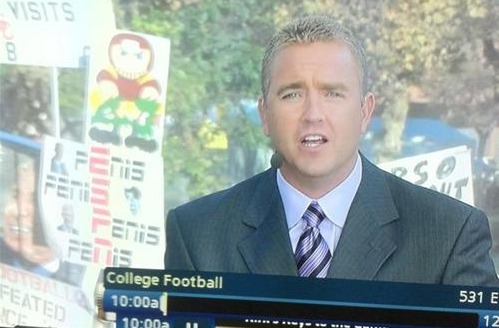
The Reason We all Watch College Gameday

Take a bow, good sign-maker. Take a bow.

Thursday, October 27, 2011

The Disquieting Symbolism of Allowing Guns in the Capitol

Let's just get the perfunctory caveats out of the way first: We here at The Chief are aggressively ambivalent about concealed carry. Ultimately, we find the hand-wringing on the left about the potential dangers of the policy to be just as over-stated as the right's arguments that try to justify the measure on public safety or philosophical grounds. At the end of the day we think there are far more important matters that will directly effect far more people in Wisconsin that legislators should be working on.

This, however, worries us:
The public will be able to carry guns into most parts of the state Capitol, under a policy being developed by Gov. Scott Walker.

Lawmakers are developing their own policies that would allow individual lawmakers to decide whether to allow guns into their offices.

Under rules planned for one chamber, guns would be allowed on the Assembly floor and in the Assembly viewing galleries, said sources who have been briefed on the plans. That would mean the public could bring guns into the viewing galleries but would still have to adhere to other existing rules, including one that bars the use of still cameras and video cameras.
Allowing guns into a place where men and women meet to discuss the direction of the state is essentially an abdication of the promise of democracy. It says that the peaceful exchange of ideas cannot occur without the threat of violence from the very people we send to exchange those ideas. It's a capitulation of the notion that we can all act like human beings endowed with logical faculties and not animals butting heads to determine the leader of the herd. It's an admission that we really are not all that far removed from the "might makes right" mentality that led to countless duels, jousts and the occasional Thunderdome death match.

In other words, it's an enormous step backwards.

There is no question that there's a certain degree of security risk to legislators, but when they are in session and conducting business on the Assembly floor they are protected by strict rules that govern who can access the floor, decorum in the viewing areas and, most importantly, an armed security detail with full law enforcement powers in the Capitol Police.

There is no legitimate reason to carry a gun onto the Assembly floor. At best, the symbolism of the act says "I don't trust my colleagues to even regard my personal well-being as their own." At worst, it's an act of intimidation. It's an act that cannot say "I will protect my colleagues in the event of danger" because there already is an armed force -- the Capitol Police -- designated for that job. If legislators are so worried about their safety from visitors to the Assembly chambers, then they should consider closing the viewing areas and providing guests to the Capitol with the closed circuit feed of events on Wisconsin Eye.

This shouldn't be a partisan issue. It's one that should reflect the larger view we as a state consider to be the the goals of Democracy; namely, the development of the rule of law through peaceful discourse. One of the reasons the legislature holds sessions in ornate and gilded chambers is to remind members and visitors alike that the proceedings are the very highest form of human social interaction possible -- that laws are made using reason and debate and not under the threat, concealed or open, of intimidation.

Now is probably a good time to note that the whole point of concealed carry is rendered moot in a place like the Assembly floor, where a confined physical space makes it difficult to hide a firearm for a long period of time. Also, there's a good chance that one newspaper or another will check public records to determine who has applied/received a license. Outside the Capitol, where even most constituents are likely to have a hard time identifying their elected officials, it's a different story; but these rules are being made about a specific work place environment.

Concealed weapons in the rest of the Capitol is another matter altogether, one that is complicated by a variety of nuances that are not easily reconciled. For example: if concealed carry makes everyone safer by making firearms possession universally ambiguous, how do offices that advertise a "no guns allowed" policy, which some will do for political reasons, retain their protection from those that don't? The Capitol should be a place where no one is afraid to communicate their ideas or those of their constituents, but in this instance the office that puts a sign in it's window becomes less safe than one that invites (or more likely celebrates) carrying visitors.

There is also the issue of how visiting constituents might be intimidated when soliciting their legislators, who are already very powerful people even without the possibility that they might also be packing heat during a meeting. These tend to be very private meetings behind closed doors, where body language is scrutinized obsessively and frequently misinterpreted and where a dissenting visitor's account of potential intimidation will almost certainly not stand up to a legislator's insistence that any sudden moves he or she made during the discussion were not intended to be seen as reaching for his or her revolver.

It will not surprise me that no one considers the typical constituent engaging in the already intimidating task of appealing to a legislator when thinking about concealed carry rules in the Capitol. Putting more distance between legislator and constituent then there already is should not be seen a move in the right direction. This is a problem that will only be exasperated by the following prediction: by January 1, 2013 -- a little over a year after concealed carry goes into place -- there will be considerably more concealed carry permits among legislators than there will be permits issued to the general population on a per capita basis. The only question will be how large the multiplier will be.

All in all, the fact fact that we have to devote all this time and effort to this discussion is absurd when there are already extensive public safety measures in place at the Capitol that could be easily enhanced for the benefit of everyone. The rules, as they are described above by the MJS, create a situation where where some offices enjoy enjoy more power and safety than others, when through minimal sacrifice on their part, every office could enjoy the exact same degree of safety and power (with respect to carrying firearms).

This speaks to a larger issue: the fact that conservative policies are increasingly degrading the community by fetishizing the individual. It's not a good idea to allow concealed firearms into the Capitol. Any public safety expert will tell you as much and then give you dozens of better alternatives, but because conservatives say it can happen, well, then by golly, it must ... regardless of practical consequences. This inequality among legislators is just another example of policies that have promoted vast gulfs of inequity between all kinds of people over the last 30 years.

One of the great things about America is that it's historically been a place where individuals not only have the freedom to achieve, but also the tools to do so at their disposal thanks to collective effort among all Americans. That's how national identities are made and large concepts like the American Dream are fostered. If anything, this "every man for himself" philosophy that leaves major matters like personal security up to each individual, regardless of whether that person can fend for himself or not, is what ultimately rips any community apart and this has become the guiding principle of one of the two major political parties in this country.

That's not healthy for any democracy. In the end, we doubt concealed carry in the Capitol will ever become a serious issue. To the best of our knowledge, there has been only one instance of gun violence in a state capitol building (albeit an incident so infamous that it's stunning no one seems to have brought it up during the "debate" over the matter). Statistically speaking, it's far more likely that someone with a concealed carry permit will accidentally discharge their weapon while visiting the Capitol. But if someone should ever be injured by a firearm in the Capitol, it will be difficult for conceal carry advocates to argue that the victim's sacrifice is merely the cost we all must collectively pay for freedom.

Wednesday, October 26, 2011

Paul Ryan kicks off the GOP Vice Presidential Nomination Campaign Season

Just in case you were wondering what this is all about:

Ryan accused Obama of using “class-based rhetoric” in his re-election campaign. Obama’s tactics, he said, make “America weaker, not stronger.”
“Instead of appealing to the hope and optimism that were the hallmarks of his first campaign, he has launched his second campaign by preying on the emotions of fear, envy, and resentment,” Ryan said.
Translation: Why, yes, I happen to be available to run for Vice President next fall.

Friday, October 14, 2011

Paul Ryan vs. Vermont (the Winner gets to Craft America's 21st Century Health Care Policy)

I was going to let Paul Ryan's big health care speech at the Hoover Institute pass without further comment, but his comments about Herman Cain's 9-9-9 plan made me want to revisit the talk.

One thing that is important to keep in mind is that Ryan always approaches health care reform from a budgetary perspective. There's usually very little consideration paid to details like public health and the economic consequences thereof. That's not necessarily a bad thing since there are many aspects to the issue that need attention, but this method of problem solving has a tendency to cause a new problem for every old one that gets "solved." For example, what happens to economic productivity when tens of thousands of old people are forced to move back in with their children to be cared for in their twilight years because the bulk of their fixed income is devoted to treating a pre-existing condition that no private insurer will cover? That's an important question, but one Ryan never really anticipates during his thought experiments.

As we've noted in the past, Ryan knows a good buzzword or catch phrase when he sees one. In the Hoover speech Ryan promotes a concept he calls "patient-centered health care reform" without ever really defining what that exactly means. To be sure, he elaborates on the concept, but never really fleshes it out satisfactorily. This is no small matter since it appears to be the goal his plan aspires to reach.

Regardless, Ryan seems to think that this goal is within reach. The speech is divided into three segments. In the first, Ryan provides us with his assessment of the current political conditions that will make his reform possible. In the second, he provides the details of his plan for reform. Ryan uses the final part as a sort of pep talk to his audience. Obviously, it's the second part that's the most interesting and the one we're going to focus on.

The principles of Ryan's plan seem to be conveniently summed up in two words: choice and competition. In the speech's preamble he summarizes his proposed reforms by saying:
Thanks to the tireless work of health-policy scholars here at Hoover and elsewhere, we know what works and what doesn’t. Simply put, badly designed government policies are to blame for much of what is wrong with health care today, and the solution is clear: We need to transition from the open-ended, defined-benefit approach of the past… to market-oriented, defined-contribution reforms that promote choice and competition.
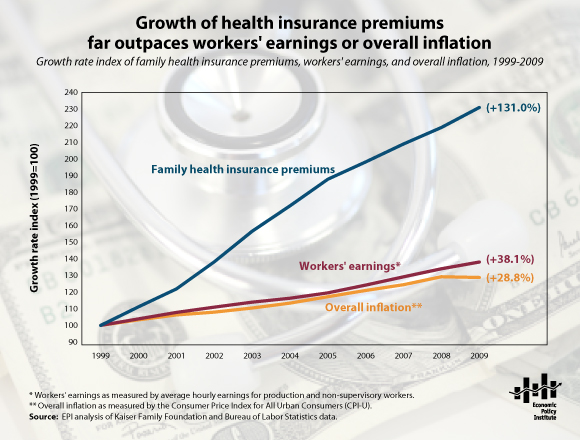
Ryan's assumption that Government lies at the core of rising medical costs is dubious. Health care costs have exploded since 2000 and now far outpace inflation or wages:


If Government was the problem, they would have begun exploded shortly after Uncle Sam got into the insurance business in the 1960s, but that's not exactly what happened. Medical costs kept pace with the consumer price index until about 1980 then only really began to diverge in the early 1990s:

So what Ryan is essentially say is that it took doctors about 25 years before they finally figured out how to gouge Uncle Sam. Something tells me that with all those advanced degrees it wouldn't have taken so long. Neverthless, Ryan attributes this disparity to Medicare:
In Medicare, the government reimburses all providers of care according to a one-size-fits-all formula, even if the quality of the care they provide is poor and the cost is high. This top-down delivery system exacerbates waste, because none of the primary stakeholders has a strong incentive to deliver the best-quality care for the lowest cost.

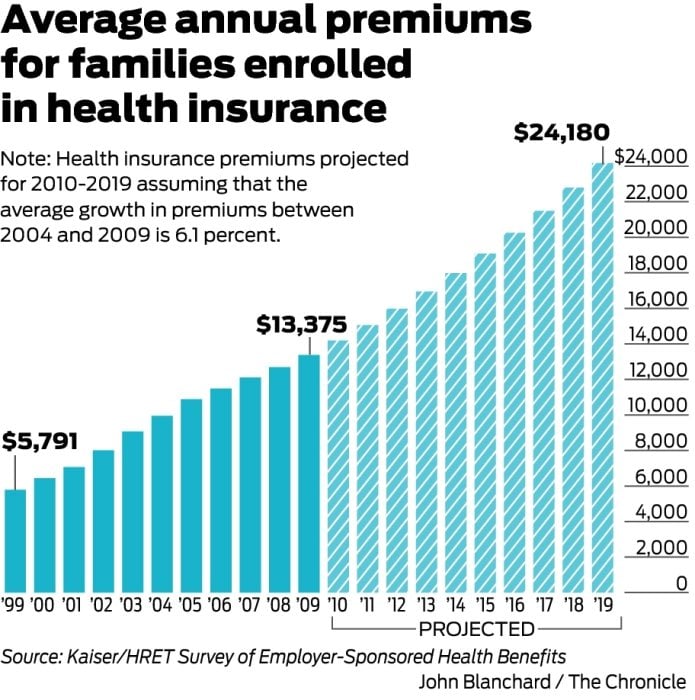
Using Ryan's reasoning, private health care insurance should remain stable, or even decline, since there is no government interference and all three stake-holders are directly involved in the decision-making that goes into a patient's care, but even private insurance premiums have sky-rocketed:


This shouldn't be happening in Ryan's world. But it is. Was there some kind of law passed in the late 1990s that granted the government massive intrusive powers into the health care industry. Nope. (But there is an argument to be made attributing the ongoing increase in costs during the early 2000s to the Medicare Part D bill, which Ryan voted for.)

The conundrum posed by the cost of health is that while it is not only a problem, but also one of the great human success stories of the 20th century. Medicine currently is capable of doing things that were unimaginable just decade ago and while that's great for our overall quality of life, it doesn't come cheap. The expensive role of technology in modern medicine is a huge factor in escalating costs. Along the same line are the research and development costs that eventually get built into the cost of a treatment. For uncommon ailments, these costs can be considerable. And that's not a small issue because sick people are living longer thanks to some very expensive treatments. These are good development, but expensive ones.

Medicare is certainly going to be a burdensome expense, but it's just a small part of the problem compared to the projected costs of all health care costs in the near future:

So Ryan's diagnosis ignores the fundamental causes that result in more expensive care. It should be surprising that his proposed solutions do the same.
The solution in each of these areas is to move away from defined-benefit models and toward defined-contribution systems. Under a reformed approach, the government would make a defined contribution to the health-care security of every American, rather than continue to offer open-ended, well-intentioned, but ultimately empty promises.
This is another way of saying vouchers. This has been discussed elsewhere at great length.There are inherent problems with a voucher plan that replaced Medicare with partially subsidized private insurance plans. The most obvious is the likely unwillingness of private insurers to take on elderly customers, many of whom will likely have previously diagnosed conditions.

The growth of these defined contributions should be capped, to reduce the inefficiencies that have led health-care costs to spiral out of control. But they should be adjustable so that more help goes to the poor and the sick, while less financial support goes to those who are fortunate enough to need it the least.

That sounds nice, but all Ryan's plan does is move a pile of money from one hand to another without addressing the inherent costs that make health care so expensive.

Ryan then goes on to contradict himself when discussing the high cost of private insurance, which he blames on taxes:
[O]ur current tax code provides additional fuel for runway health care inflation. Under current law, employer-sponsored health insurance plans are entirely exempt from taxation, regardless of how much an individual contributes to their policy.

This tilts the compensation scale toward benefits, which are tax-free, and away from higher wages, which are taxable. It also provides ways for high-income earners to artificially reduce their tax-able income by purchasing high-cost health coverage – which in turn can fuel the overuse of health services.

So overuse of health services isn't just a problem that results from Medicare, but happens with private insurance as well. Blaming this phenomenon on taxes strains credulity. It's the supply-sider equivalent of the equant.

The most frustrating thing about this brief detour into reality is that Ryan actually touches on the fundamental problem with health care today: the incentive structure for health care providers is out of whack. Health care providers have every reason to run expensive, unnecessary tests when they charge by the x-ray and not the complete treatment.  That would put the onus on the private sector to change, though -- a concept abhorrent to Ryan's Randian worldview.

The problem with just about anything Paul Ryan policy is that it evolves from an Utopian ideology and not a critical look at the circumstances as they actually exist. Ryan frequently peppers his speech with the phrase "cost-effective," but if this was actually a goal it would be nearly impossible to not look at other countries that provide comparable universal health care at a significantly reduced cost. Ryan wants a world in which the free market actually works efficiently and rationally and  maybe even morally ... and if that world doesn't exist, he'll just have to create it.

Part of the Ryan mystique has resulted from a confusion between substantive ideas and effective marketing. Ryan never misses a chance to supply his plans with web sites, YouTube videos, cable interviews or roll-outs at think tanks and that's a large part of the reason why he enjoys such a highfalutin reputation among his colleagues. The Hoover speech is remarkably free of data and heavy on ideology -- that's never a good sign -- and it wouldn't be the first time Ryan has tried to mold a world to his own specifications.

Unlike Ryan's health care reform, which is still very theoretical and will likely never leave Conference Room C of the Hoover Institute, there is a more radical (by American standards, at any rate), though much less publicized, plan that will actually begin covering patients:
Vermont governor Peter Shumlin [has] signed into law a plan meant to transform the private-run health insurance industry into a the nation's first government-funded, government-run health care system that offers a uniform benefit package to every eligible resident. The first phase of the law will extend coverage to all 620,000 Vermonters through the option to participate in the state health benefits exchange called Green Mountain Care, which Reuters reports, "will set reimbursement rates for health care providers and streamline administration into a single, unified system." Per a federal mandate (read: Obamacare) the exchange will offer coverage from private insurers as well as state-sponsored and multi-state plans. The plan also calls for tax credits to make coverage affordable for low-income residents.
This is actually happening. Slowly, but it's happening. The American health care system is becoming far too expensive to be feasible for much longer and countries that have public health care coverage are far more adept at reigning in costs:


As we mentioned earlier Ryan devotes a lot of his speech to surveying the political landscape and discovering that it's a good foundation on which to build. Not once does he mention Vermont. In five or ten years time Vermont will begin to feel the effects of its experiment. If the results are positive, other states will might follow suit (think Minnesota or Oregon). Ryan's plan is all or nothing, which is usually how plans described as being "bold" work, and the closer you look at it the easier it is to see that there's not much there to begin with.