Perhaps the most interesting aspect of the line-up of next week's Tea Party for Scott Walker wank-a-thon is one glaring
omission: Sen. Ron Johnson. The party is right in his back yard and this
is the kind of pliant and doting crowd to which he usually restricts his public appearances. Not making an appearance would be stunningly dumb. He'd get statewide media attention for next to no effort
and little gestures like this go a long way toward keeping in the good
graces of activists and colleagues alike. I guess he's got better things
to do, but it still looks like a snub.
It's another in a series of puzzling scheduling moves
that really demonstrate just how adept Johnson is at alienating people
he is supposed to be accommodating. Last month Johnson gave the keynote
speech at the New York GOP
annual convention, but the question remains: why? Usually a Senator
does something like that as a favor to a colleague that can be cashed in
for one of his own at a later date or to increase his national stature,
but in this case there really was nothing to be gained. New York is a
solidly blue state. There are no GOP Senators from the Empire State. The
New York GOP is famously dysfunctional. It's one thing to make a
weekend of it in Manhattan, but the convention was in Rochester. The
speech won him no media exposure back here in Wisconsin. Johnson would
have been better served doing just about anything else.
I have a sneaking suspicion that Johnson will find time in his schedule to make a drop-in. After all, the secretary of the Rally in the Fox Valley PAC is also the receptionist of Johnson's Oshkosh office. If he doesn't, then it really will feel like slap in the face.
Saturday, April 28, 2012

The "Rally in the Valley" will be Emceed by (Possible) Fraud Jake Jacobs

So the local Tea party is having a little shindig next weekend and all the big guns are going to be there. Just look at that line up: it's only a lunatic radio talk show host away from inducing a pulmonary embolisms in every last one of the elderly folks who will spend the afternoon in their lawn chairs. If you're like, you probably looked through the list and and asked yourself, "Who is this Jake Jacobs fellow?" Well, funny you should mention that...
Jacobs is an evangelical zealot who recently a teacher at Winneconne High School before deciding to pursue a life as a professional asshole, by which I mean someone who sells himself as an authority on pretty much everything. Unfortunately, there are all sorts of strange inconsistencies with Jacobs story. Here's how he describes his education:
Concerned about the ACLU & NEA’s attempt to revise America’s Judeo-Christian Foundation Jake earned a Ph.D. in Early American History from North-West University with his Dissertation titled; The Influence of Biblical Ideas on Early American Republicanism and History.OK, but there isn't a "North-West University" in the United States. There's one in South Africa. There's a "Northwest University" in Washington state, but it seems strange that someone would misspell the name of his alma mater. And if you think that's a typo on the part of the web site, think again: it appears on his LinkedIn page too, which one assumes Jacobs had more editorial control over.
More to the point is the little matter of his dissertation: "The Influence of Biblical Ideas on Early American Republicanism and History." I couldn't find a record of it in ProQuest database of Dissertation and Theses. It's possible that I was searching incorrectly or that it's just not listed, so if I'm wrong, do please correct me in the comments. It's also possible that Northwest U. doesn't make it's dissertations available, since I couldn't seem to find any theses available from the school. Some schools do this and it's bullshit. Even for-profit online schools like Northcentral University include their dissertations in various databases.
Jacob's "book" Mobocracy doesn't exactly lend itself to be the kind of serious scholarly work that a PhD would produce. It's really just a long, shrill blog post written by a partisan lunatic. We would know: we write them all the time. Making matter worse are all the strange inconsistencies the make up the marketing of the "book." Here Jacobs ends his description of the book with the cri de coeur "Semper Fi to the Republic!" Yes, that sounds extravagantly melodramatic, but Semper Fi is usually something of shibboleth uttered among veterans of the Marine Corps. There's nothing in Jacobs resume suggesting military service, but he clearly wants his readers to believe as much. The "reviews" of his book feature three dead people, a word of thanks from former governor Jim Doyle completely unrelated to the book and the kind words of a former student. (Before he took his song and dance to Marquette, Ethan Hollenberger was active in the UW-O college Republicans where he won a well-deserved reputation for using public displays of shallow jackassery to advance his causes. Now we know where that came from.)
Jacobs says he teaches at Lakeland College, but there's no record of him in the faculty directory. Then again, the directory is rather open about the fact that it might not include every staff member. There's also the possibility that Jacobs did teach their (or one of their satellite campuses) some time in the past
Then there's the issue of how long he's been teaching. On LinkedIn, he says it's 23 years and just in Winneconne. On MeetUp, he says it's 25 in both Wisconsin and Arizona. This begs the question, well, which one is it?
There's question about why Jacobs is no longer teaching. On his MeetUp page, Jacobs claims to have "been teaching Conservative Values for 25 years in AZ/WI Public Schools," which is a no-no. 23 or 25 years is also an odd time to leave the teaching profession voluntarily. Usually teachers ride out another 5-10 years before retirement, but that's not a word that appears anywhere in Jacobs various CVs, which leads one to believe he just quit.
Jacobs also calls himself a "historian," thought he does seem to have produced any academic works of history to back that claim up. I'm not even talking about peer-reviewed history, I mean any history. What few writing that appear online are all polemic works of opinion. Aside from his idiotic book, Jacobs seems to have authored three articles, only one of which has anything remotely to do with anything historical.
He claims to be the "president of founder" of something called the Politically Incorrect Institute, which doesn't seem to have a web site, a brick and mortar HQ or staff of any kind. In other words, it seems to exist only in Jacobs' mind.
On Mobocracy's Facebook page (at least his "book" has a web page) Jacobs claims to have been "awarded the MOST politically incorrect public school teacher in Wisconsin and America," but doesn't say by whom. He might as well claim to be the world's greatest juggler.
Basically, Jake Jacobs appears to be a fraud. There might be answers that clear these inconsistencies up, but they don't seem to be available online. Not that this will stop him from peddling his tripe in front of tea party circle jerks. Nor will end his frequent appearances on VCY radio, the batshit insane zealot shitshow from Milwaukee. Jacobs seems to be going out of his way
Jacobs will be joined by a whole slew of compatriots with similar creditability problems. There's Kim Simac, the nutcase birther who ran one of the most incompetent campaigns in recent memory for state senate last year. Her acquaintance with the facts is famously tenuous. Then there's Mark Block, who's back running the state chapter of AFP after running Herman Cain's circus into the ground earlier this year. Cain Himself might make a cameo too. There will also be a couple of fringe candidates for U.S. Senate and perennial congressional also-ran Dan Sebring.
It sounds like it's going to be a wonderful time.
Friday, April 27, 2012
Ron Johnson's Crass Vote Aginst the Violence Against Women Act
Yesterday the Senate passed an extension of the Violence Against Women Act. Ron Johnson voted against the extension and here's his explanation as to why:
It's very tempting to dismiss the omissions from the bill Johnson cites above as being little more than rhetoric to cover his vote against what should be a no-brainer. Each of the provisions Johnson notes above cost money and are expansions of the federal government, so at least according to one of the guiding principles of his governing philosophy, Johnson appears to be contradicting himself.
What's more likely is that Johnson voted against the bill for the same reasons every other Republican who voted against it did:
Or maybe it's fear, which is usually a much stronger motivator. It frequently seems that Johnson only seeks to appease the core elements of his support, the revanchist wing of the conservative movement. because if he loses their support he has none. That's the corner Johnson's painted himself into and he's apparently so afraid of drawing their ire that he's willing to lay abused women on their alter. That's pretty discomforting.
To be sure, Johnson is not mistaken by believing that the vote on VAWA was politicized. Then again, the votes of every bill are politicized. This is politics, after all.
Luckily, should Johnson choose to run for re-election he will certainly hear about this vote.
“I believe it’s critical to ensure that laws are in place to prevent and deter crime – against both women and men. Regrettably, the debate over the Violence Against Women Reauthorization Act was completely politicized by the Senate Democratic leadership.The vote and was anything but partisan and passed 68-31. That's 15 Republicans voting in favor of the extension.
“Republicans offered very reasonable alternatives to extend the Violence Against Women Act. Senate Democrats today defeated proposals to provide U.S. Marshalls the tools they need to track sex offenders across state lines. They voted against legislation to establish an interstate database for DNA evidence, to ensure sex offenders are brought to justice regardless or the jurisdiction in which they commit their crimes. And they rejected legislation to provide additional funds to allow law enforcement to pursue justice for hundreds of thousands of women – women whose cases may depend on the results of DNA tests from rape evidence kits currently caught in a backlog that stretches to the hundreds of thousands.
“The partisan bill pushed through by Senate Democrats today does nothing to address these.”
It's very tempting to dismiss the omissions from the bill Johnson cites above as being little more than rhetoric to cover his vote against what should be a no-brainer. Each of the provisions Johnson notes above cost money and are expansions of the federal government, so at least according to one of the guiding principles of his governing philosophy, Johnson appears to be contradicting himself.
What's more likely is that Johnson voted against the bill for the same reasons every other Republican who voted against it did:
But other Republicans objected to a number of the measure’s new provisions. One would add language barring discrimination on the basis of sexual orientation and gender identity in programs funded through the measure.It's this last area that is of particular relevance to Wisconsin. Wisconsin has one of the largest Native populations in the country; by this measure it's #9 at about 41,000. The Domestic violence epidemic among Native Americans isn't a well-kept secret and it's further complicated by the byzantine nuances between the intersections of tribal, state and federal law:
Another would let law enforcement issue up to 5,000 more visas each year to battered illegal immigrants who agree to participate in the prosecution of serious crimes. The 2000 update of the bill set aside 10,000 visas annually for that purpose, which advocates believe encourages victims to report crime. All 10,000 are being issued each year, and advocates say more are needed.
A final area of contention would provide the government new authority to prosecute non-Indian men who abuse Indian women on tribal reservations.
There is an epidemic of domestic violence on Native American reservations. According to the National Congress of American Indians, a Native American rights advocacy group, about 40 percent of Native American women will face domestic violence. But more than half of Native American women are married to non-Native American men, which means that when cases of abuse arise, the local tribal authorities can do very little because they don't have jurisdiction over non-tribe members.This is a problem that disproportionately effects Wisconsin, but that doesn't seem to matter to Johnson whose only motivation for voting on bigger issues in the Senate seems to be spite.
State and federal prosecutors have the authority to prosecute domestic violence on reservations, but for geographic and logistical reasons, it often goes unaddressed. "A federal prosecutor is not going to be able to expend the kind of energy on misdemeanors that local police officers would spend energy on," says Paulette Moore, vice president for public policy at the National Network to End Domestic Violence.
As Mother Jones reported last year, local authorities' inability or unwillingness to deal with domestic violence cases in Native American communities has contributed to an underground industry of vigilantes for hire who take matters into their own hands. The current version of the Violence Against Women Act would allow tribal authorities to prosecute non-Indians for domestic violence cases on Indian reservations, but Republicans are opposing it because they don't like the idea of Native American law applying to non-tribe members.
"For the first time, the Committee would extend tribal criminal jurisdiction over non-Indians," Grassley said in his floor speech. "I do not believe the Committee has a good understanding of what the consequences would be of doing so." The bill contains language that affirms non-tribe members prosecuted receive the same due process protections they would be entitled to under the US Constitution.
The bill's supporters expressed confusion at Grassley's logic. "Suppose your sister was with you in Washington, DC, and her husband beat her up," Moore says, "but because he was from Virginia, Washington couldn't do anything about it."
Or maybe it's fear, which is usually a much stronger motivator. It frequently seems that Johnson only seeks to appease the core elements of his support, the revanchist wing of the conservative movement. because if he loses their support he has none. That's the corner Johnson's painted himself into and he's apparently so afraid of drawing their ire that he's willing to lay abused women on their alter. That's pretty discomforting.
To be sure, Johnson is not mistaken by believing that the vote on VAWA was politicized. Then again, the votes of every bill are politicized. This is politics, after all.
Luckily, should Johnson choose to run for re-election he will certainly hear about this vote.
Friday, April 20, 2012
Don't Call it a Comeback (No, Seriously, Please Don't)
So the big local news this afternoon is that Paul Esslinger will be running for state assembly.
Esslinger spent eleven years on the city council, the last two as mayor, and during that time he provided voters with countless examples of just how uniquely unqualified he is to conduct public affairs. Here are just a few examples from his disastrous first year as mayor. The only real aspiration, plan or vision for the city he ever stated publicly was the creation of a Bay Beach-like amusement park at Menominee Park. His only accomplishment of note was his small role in the renovation of Pollock Pool.
More often than not Esslinger used his office to air personal grievances. He will campaign as a small government conservative on a mission to cut spending, but this is the same guy who demanded the city pay his legal bills when he got into a scuffle, and was subsequently investigated by the DOJ, with a fellow council member. He pretty much demanded the city pay for the fire truck he bought as a "donation." Then there was the Great Sidewalk Debate of 2007 in which Esslinger basically forced the residents of a subdivision in Oshkosh to install sidewalks in their neighborhood and pay for it too. We could go on, but suffice it to say that ideological consistency usually plays second fiddle to his own sense of entitlement. Here are a couple examples: 1.) Esslinger changed his tune on various "pub fees" once he started running his own tavern. 2.) At the around the same time, Esslinger flip-flopped on a proposed downtown parking lot from which several competing pubs down the street from his own establishment stood to benefit. These are indicative someone who lacks the ability to thinks about the ramifications of his actions beyond himself.
Esslinger has a habit of even screwing up good-natured gestures, like the time he gave his friend and council member Dennis McHugh an envelope full of cash as a "retirement gift" during a council meeting and provided a very poor explanation as to why. Even McHugh looked a bit uncomfortable accepting the gift at the time. This wasn't just an instance of Esslinger being very oblivious. The cash was the leftover money collected by McHugh's friends to pay for a full-page ad in the local paper thanking McHugh for his years of service. There are very serious and legitimate questions as to the legality of the gift. There was no question that the whole episode looked sketchy.
He has a habit of watching opportunities to provide leadership pass him by. At times he's misused his office for political purposes. He has an inability to choose his battles. His relationship with the local media is abysmal. He has a habit of executing political duties vindictively and without class.
But Esslinger's most troubling quality is his almost pathological craving for acceptance. It's his defining characteristic. Rarely did a meeting go by during the decade he was on the council when Esslinger did not give a speech or cast a vote that appeared to beg for the approval of his friend and political mentor Dennis McHugh. People with business before knew that the quickest way to win Esslinger's support was to flatter, stroke his ego and, above all else, make him feel important. A lot politicians suffer from this desire, and in some this appetite for validation can be an asset that motivates them to do big things. But in others, and Esslinger definitely falls into this camp, it's a liability that leaves them susceptible to manipulation from folks like lobbyists and party leaders.
McHugh retired at the end of Esslinger's first year as mayor and in the second half of his only term Esslinger actually showed signs of maturity. There were far fewer distractions, much less grandstanding, and actual moments of genuine reflection and courage. Take, for example, his vote to approve a use permit for Oshkosh's first mosque. Even though the council meeting at which the vote took place was packed with very vocal supporters of the measure, it's hard to image those who did not voicing their opinions to any other council member. A lot of people attribute this evolution to Esslinger becoming a small business owner, and that may have certainly had a lot to do with it, but don't underestimate the impact McHugh's absence had on someone who is so impressionable. (Just to be clear: I'm not necessarily suggesting McHugh wouldn't have supported the mosque permit had he been on the council at the time. It's just a rare example of Esslinger not giving in to some of the more lamentable instincts of his base.)
Instead of continuing his evolution after leaving office, Esslinger went back to the Well of Bad Influences when he teamed up with his friend Ben Schneider to create Oshkosh Area Politics, their execrable public access TV show. The conversations on OAP offer little insight except into the minds of two recovering politicians who were marginalized to the point of impotence and now blame everyone but themselves for their own failures in office.
Schneider now serves as McHugh's surrogate. It's not a step in the right direction. McHugh was more of a curmudgeon than an ideologically driven conservative, and not without his charm (recall the touching story he told about visiting the Grand Opera House with his wife before vote to authorize renovation funds). Schneider treats anyone who is not in perfect lockstep with him ideologically with condescension and derision. His inability to work with people he disagrees with is the stuff of local legend. Watching Esslinger and Schneider work themselves into a Berserker rage frenzy on OAP it's easy to see just how much of Schneider is rubbing off on Esslinger.
Needless to say, Paul Esslinger is the last thing Madison needs right now.
Esslinger spent eleven years on the city council, the last two as mayor, and during that time he provided voters with countless examples of just how uniquely unqualified he is to conduct public affairs. Here are just a few examples from his disastrous first year as mayor. The only real aspiration, plan or vision for the city he ever stated publicly was the creation of a Bay Beach-like amusement park at Menominee Park. His only accomplishment of note was his small role in the renovation of Pollock Pool.
More often than not Esslinger used his office to air personal grievances. He will campaign as a small government conservative on a mission to cut spending, but this is the same guy who demanded the city pay his legal bills when he got into a scuffle, and was subsequently investigated by the DOJ, with a fellow council member. He pretty much demanded the city pay for the fire truck he bought as a "donation." Then there was the Great Sidewalk Debate of 2007 in which Esslinger basically forced the residents of a subdivision in Oshkosh to install sidewalks in their neighborhood and pay for it too. We could go on, but suffice it to say that ideological consistency usually plays second fiddle to his own sense of entitlement. Here are a couple examples: 1.) Esslinger changed his tune on various "pub fees" once he started running his own tavern. 2.) At the around the same time, Esslinger flip-flopped on a proposed downtown parking lot from which several competing pubs down the street from his own establishment stood to benefit. These are indicative someone who lacks the ability to thinks about the ramifications of his actions beyond himself.
Esslinger has a habit of even screwing up good-natured gestures, like the time he gave his friend and council member Dennis McHugh an envelope full of cash as a "retirement gift" during a council meeting and provided a very poor explanation as to why. Even McHugh looked a bit uncomfortable accepting the gift at the time. This wasn't just an instance of Esslinger being very oblivious. The cash was the leftover money collected by McHugh's friends to pay for a full-page ad in the local paper thanking McHugh for his years of service. There are very serious and legitimate questions as to the legality of the gift. There was no question that the whole episode looked sketchy.
He has a habit of watching opportunities to provide leadership pass him by. At times he's misused his office for political purposes. He has an inability to choose his battles. His relationship with the local media is abysmal. He has a habit of executing political duties vindictively and without class.
But Esslinger's most troubling quality is his almost pathological craving for acceptance. It's his defining characteristic. Rarely did a meeting go by during the decade he was on the council when Esslinger did not give a speech or cast a vote that appeared to beg for the approval of his friend and political mentor Dennis McHugh. People with business before knew that the quickest way to win Esslinger's support was to flatter, stroke his ego and, above all else, make him feel important. A lot politicians suffer from this desire, and in some this appetite for validation can be an asset that motivates them to do big things. But in others, and Esslinger definitely falls into this camp, it's a liability that leaves them susceptible to manipulation from folks like lobbyists and party leaders.
McHugh retired at the end of Esslinger's first year as mayor and in the second half of his only term Esslinger actually showed signs of maturity. There were far fewer distractions, much less grandstanding, and actual moments of genuine reflection and courage. Take, for example, his vote to approve a use permit for Oshkosh's first mosque. Even though the council meeting at which the vote took place was packed with very vocal supporters of the measure, it's hard to image those who did not voicing their opinions to any other council member. A lot of people attribute this evolution to Esslinger becoming a small business owner, and that may have certainly had a lot to do with it, but don't underestimate the impact McHugh's absence had on someone who is so impressionable. (Just to be clear: I'm not necessarily suggesting McHugh wouldn't have supported the mosque permit had he been on the council at the time. It's just a rare example of Esslinger not giving in to some of the more lamentable instincts of his base.)
Instead of continuing his evolution after leaving office, Esslinger went back to the Well of Bad Influences when he teamed up with his friend Ben Schneider to create Oshkosh Area Politics, their execrable public access TV show. The conversations on OAP offer little insight except into the minds of two recovering politicians who were marginalized to the point of impotence and now blame everyone but themselves for their own failures in office.
Schneider now serves as McHugh's surrogate. It's not a step in the right direction. McHugh was more of a curmudgeon than an ideologically driven conservative, and not without his charm (recall the touching story he told about visiting the Grand Opera House with his wife before vote to authorize renovation funds). Schneider treats anyone who is not in perfect lockstep with him ideologically with condescension and derision. His inability to work with people he disagrees with is the stuff of local legend. Watching Esslinger and Schneider work themselves into a Berserker rage frenzy on OAP it's easy to see just how much of Schneider is rubbing off on Esslinger.
Needless to say, Paul Esslinger is the last thing Madison needs right now.
Thursday, April 12, 2012
Ron Johnson's Political Career is Over
If you haven't read the damning Roll Call article on the dysfunction plaguing Ron Johnson's Washington Senate office, here you go. It's a masterpiece of the process genre of political reportage, which is a highfaluting way of saying it's juicy as hell.
A couple of thoughts on the implications:
1.) Ron Johnson's staff doesn't respect him.
The "big picture," over-aching theme that ties all the details of the Roll Call piece together is that Johnson's office is a terrible place to work. A legislator who gets pinned with that label enters into a slow motion death spiral: the good talent flees in the opposite direction and all that's left to hire is the marginal and/or inexperienced staffers. The Leftovers don't get the job done, which leads to more intra-office strife, more resignations/terminations, further damage to an office's reputation, etc. Wash. Rinse. Lather. Repeat.
2.) It's clear that word on Capitol Hill is that Johnson's office is a dead end career-wise:
Just look at Robert Duncan, who plays a supporting role in the drama:
Why would he jump ship? Because Johnson has no interest in crafting or advancing any legislation at all. Johnson spent his entire first year in the Senate drifting shiftlessly from one issue to the next, trying to find something to latch on to only to discover that doing requires substantial expertise which both the Senator and his office lack. There are usually two ways to remedy this situation. The first is putting in the work to become an expert on a given issue. Johnson's done nothing to show he's capable of this. The second is to use one's interpersonal talents to develop allies who do the dense policy work for you. This is usually called "basic workplace etiquette." Stunningly, Johnson seems incapable of even this:
3.) Johnson is not respected by his colleagues:
And coordinate strategy...? There's a meaningless phrase if ever there was one! And yet it sounds important because it involves the GOP nominee. No one who has any clue how Washington really works would be bragging about this non-assignment to a reporter.
If Johnson thinks he's going to have a seat at the Romney strategy table this fall, he's in for a big surprise. In presidential election years, even Senators are nothing more than surrogates who either follow orders or don't get a ticket to the party. Shhhhhh! Don't tell Johnson this: it'll be much more fun when he finds this out the hard way this fall.
4.) Why the hell is Johnson answering these questions himself?
The playbook for stories about office dysfunction is pretty easy to run: the press secretary simply issues a statement dismissing the rumors as spurious and says that will be the last comment on the matter. The end. Johnson actually goes on the record here, which means if he does end up sacking any of his staffers in the near future he gets caught lying ... about firing people. That's a pretty silly thing to do when part of your messaging strategy is tying the President to unemployment.
Johnson's insistence on taking questions can mean one of two things: The first is that his staff thinks so little of him that they're willing to put him in a potentially damaging situation just to screw with him. The second is that Johnson thinks so little of his staff that he doesn't think they're competent enough to handle even the simplest of damage control chores. Either way, the office looks bad, and since no one's apparently leaving any time soon the problem is likely to persist.
5.) Johnson's delusional about his messaging skills. Johnson claims he wants to focus more of his office's attention on messaging, but that's really all he did last year in lieu of actual legislative activity:
The problem is that Johnson is terrible at messaging. Just look at some of his greatest hits from last year. The very first thing Johnson did in January was take to the pages of the Wall Street Journal and announce his America's Choice program. Any idea what that was all about? No? Exactly. It was a substance-free messaging strategy designed to drive the national conversation during an election year. Did it work? Well, if you're just learning about it from this web site, then no, of course it didn't work.
Successful messengers are able to connect with media folk. If Johnson can't connect with his GOP colleagues, who are naturally disposed to sympathize with him, then he will have no prayer with the media, who are naturally disposed to treat men in power, like himself, with deep skepticism.
Johnson's desire to get more pub shouldn't come as a surprise to any Wisconsin voter. This is precisely what he was referring to during the 2010 campaign when he "committed himself to a 're-education of America.'" But Johnson confuses "messaging" (or possibly "re-education") with the rote recitation of talking points that demonstrate his depth of understanding on any issue is shallow at best. (See, for example, his "debate" over Obamacare with Zeke Emmanuel on Morning Joe in which he seems convinced that the length alone is an a priori proof that its absurdity.)
6.) Johnson is making the wrong friends.
So what's it all mean? It means that Ron Johnson is being marginalized by his own party and doesn't even realize it. He's being pushed aside by the party leadership where his voice will only be heard by the GOP fringe. Oh, he'll still get these silly puff pieces in conservative rags, and jokes like Freisse will talk him up like he's the Second Coming, but the reality is that Johnson is rapidly becoming one of the least effective members of the Senate.
It means his political career is essentially over. His awful first year has given him a well-earned reputation as someone who just doesn't understand how to play the game and is unwilling or unable to learn. Sooner or later, even the sycophants will stop kissing his ring and start ignoring him all together because they'll understand one important thing:
Ron Johnson is a lame duck Senator, effective today.
Johnson has no hope of winning a second term. Eventually, even he will realize this and just opt out of re-election. Or, and what's more likely, he'll just grow tired of being a Senator and choose not to bother.
But here's a third option: Johnson has essentially staked his career on the failure of Obamacare, though he's done little more, so far as we can tell, than a segment on Morning Joe denouncing it. If the Supreme Court does strike down ACA, there's little reason for him to hang around the U.S. Senate. Don't be surprised if Johnson resigns before the end of his term, especially if there's an opportunity for a Republican governor to appoint another Republican to fill the remainder of his term. It would be a fitting end to what's proving to be a completely wasted Senate term.
A couple of thoughts on the implications:
1.) Ron Johnson's staff doesn't respect him.
The "big picture," over-aching theme that ties all the details of the Roll Call piece together is that Johnson's office is a terrible place to work. A legislator who gets pinned with that label enters into a slow motion death spiral: the good talent flees in the opposite direction and all that's left to hire is the marginal and/or inexperienced staffers. The Leftovers don't get the job done, which leads to more intra-office strife, more resignations/terminations, further damage to an office's reputation, etc. Wash. Rinse. Lather. Repeat.
2.) It's clear that word on Capitol Hill is that Johnson's office is a dead end career-wise:
Though candidates don’t necessarily bring their entire campaign staffs with them once elected, it is very rare to have no carryover from the campaign, sources said. GOP sources not affiliated with the campaign or Johnson’s office said former staffers had indicated the Wisconsin Senator was frustrated with his operation in the days following the election and informed his staffers they would not be coming with him to D.C.Actually, all of them are based here in Oshkosh ... and it's safe to say that none of them were part of the brain trust that navigated Johnson to victory. Either Johnson chose only to reward his close friends with jobs or he grew an ego and thought the hard part was over. Neither makes him look good and sends a message to potential staffers that career advancement is not based on merit, but Johnson's arbitrary whims.
According to a Roll Call review of Federal Election Commission disclosure filings and the staff salary database LegiStorm, only four of the 42 salaried campaign staffers working in the last quarter of Johnson’s 2010 Senate campaign got jobs with the Senator. Johnson retained his state director, deputy state director, a caseworker and a receptionist from the campaign — all of whom are based in Wisconsin.
Just look at Robert Duncan, who plays a supporting role in the drama:
[T]he situation in Johnson’s office has escalated in recent weeks. The top brass of the Senate Republican Steering Committee — the Conference’s conservative hub — have connected at least one Johnson legislative aide with another GOP Senate office, and sources indicated they may be helping others find jobs before they are asked to permanently clear their desks.It's implied later in the piece that that staffer was Robert Duncan, who got a a $30,000+ raise when he jumped ship from the Senate GOP Secretary's office to become Johnson's legislative director. Where's he working now? Back at the Senate GOP' Secretary's office as a floor assistant, and not likely at the same salary he had as a senior staffer with Johnson.
Why would he jump ship? Because Johnson has no interest in crafting or advancing any legislation at all. Johnson spent his entire first year in the Senate drifting shiftlessly from one issue to the next, trying to find something to latch on to only to discover that doing requires substantial expertise which both the Senator and his office lack. There are usually two ways to remedy this situation. The first is putting in the work to become an expert on a given issue. Johnson's done nothing to show he's capable of this. The second is to use one's interpersonal talents to develop allies who do the dense policy work for you. This is usually called "basic workplace etiquette." Stunningly, Johnson seems incapable of even this:
While top Republican sources expressed exasperation at the internal turmoil in Johnson’s office, they also noted that the Wisconsin freshman has not been diligent in building relationships with other Senators within the Conference and has alienated himself by not reaching out more frequently to colleagues.
“He’s an interesting case study of someone who has talked more than he has listened, lectured more than he has developed relationships with his colleagues, and now he’s having a tough time because of that behavior in advancing his policy goals,” one senior GOP aide said. “It’s kind of like watching a temper tantrum by a 2-year-old in the middle of the grocery store.”
“The Senate is still about relationships, and he doesn’t seem to get that,” the aide continued.Now that's a pull quote. From this we can infer:
3.) Johnson is not respected by his colleagues:
The Wisconsin Senator said recently that he would like to refocus his efforts on political messaging, and Minority Leader Mitch McConnell (Ky.) has asked him to help coordinate strategy with the eventual GOP presidential nominee.Translation: Go over to the kids table and leave the heavy lifting to the pros. It's as tactful a dressing down as you're ever going to read. It's polite and it excludes Johnson from real leadership responsibilities by including him in something much less important. What's even better, it gives Johnson a gig that he actually wants to do (see nos. 4 and 5).
And coordinate strategy...? There's a meaningless phrase if ever there was one! And yet it sounds important because it involves the GOP nominee. No one who has any clue how Washington really works would be bragging about this non-assignment to a reporter.
If Johnson thinks he's going to have a seat at the Romney strategy table this fall, he's in for a big surprise. In presidential election years, even Senators are nothing more than surrogates who either follow orders or don't get a ticket to the party. Shhhhhh! Don't tell Johnson this: it'll be much more fun when he finds this out the hard way this fall.
4.) Why the hell is Johnson answering these questions himself?
The playbook for stories about office dysfunction is pretty easy to run: the press secretary simply issues a statement dismissing the rumors as spurious and says that will be the last comment on the matter. The end. Johnson actually goes on the record here, which means if he does end up sacking any of his staffers in the near future he gets caught lying ... about firing people. That's a pretty silly thing to do when part of your messaging strategy is tying the President to unemployment.
Johnson's insistence on taking questions can mean one of two things: The first is that his staff thinks so little of him that they're willing to put him in a potentially damaging situation just to screw with him. The second is that Johnson thinks so little of his staff that he doesn't think they're competent enough to handle even the simplest of damage control chores. Either way, the office looks bad, and since no one's apparently leaving any time soon the problem is likely to persist.
5.) Johnson's delusional about his messaging skills. Johnson claims he wants to focus more of his office's attention on messaging, but that's really all he did last year in lieu of actual legislative activity:
Sources indicated that when Johnson came to Washington, he put a staff together like “any other Senator” but quickly realized that the day-to-day grind of legislating was not his forte. Johnson said last week that he wanted more of his office’s focus to be on building an effective messaging operation. Johnson’s legislative director, Robert Duncan, has already left the office.Jesus, that's a damning indictment.
The problem is that Johnson is terrible at messaging. Just look at some of his greatest hits from last year. The very first thing Johnson did in January was take to the pages of the Wall Street Journal and announce his America's Choice program. Any idea what that was all about? No? Exactly. It was a substance-free messaging strategy designed to drive the national conversation during an election year. Did it work? Well, if you're just learning about it from this web site, then no, of course it didn't work.
Successful messengers are able to connect with media folk. If Johnson can't connect with his GOP colleagues, who are naturally disposed to sympathize with him, then he will have no prayer with the media, who are naturally disposed to treat men in power, like himself, with deep skepticism.
Johnson's desire to get more pub shouldn't come as a surprise to any Wisconsin voter. This is precisely what he was referring to during the 2010 campaign when he "committed himself to a 're-education of America.'" But Johnson confuses "messaging" (or possibly "re-education") with the rote recitation of talking points that demonstrate his depth of understanding on any issue is shallow at best. (See, for example, his "debate" over Obamacare with Zeke Emmanuel on Morning Joe in which he seems convinced that the length alone is an a priori proof that its absurdity.)
6.) Johnson is making the wrong friends.
Still, Johnson also has high-profile backers in GOP campaign circles. Foster Friess, the billionaire who until recently was a major backer of the presidential campaign of former Sen. Rick Santorum (R-Pa.), told FOX News on Wednesday that Johnson should be on GOP presidential frontrunner Mitt Romney’s short list of vice presidential candidates.Now this graph is an example of how something's absurdity is self-evident.
===
So what's it all mean? It means that Ron Johnson is being marginalized by his own party and doesn't even realize it. He's being pushed aside by the party leadership where his voice will only be heard by the GOP fringe. Oh, he'll still get these silly puff pieces in conservative rags, and jokes like Freisse will talk him up like he's the Second Coming, but the reality is that Johnson is rapidly becoming one of the least effective members of the Senate.
It means his political career is essentially over. His awful first year has given him a well-earned reputation as someone who just doesn't understand how to play the game and is unwilling or unable to learn. Sooner or later, even the sycophants will stop kissing his ring and start ignoring him all together because they'll understand one important thing:
Ron Johnson is a lame duck Senator, effective today.
Johnson has no hope of winning a second term. Eventually, even he will realize this and just opt out of re-election. Or, and what's more likely, he'll just grow tired of being a Senator and choose not to bother.
But here's a third option: Johnson has essentially staked his career on the failure of Obamacare, though he's done little more, so far as we can tell, than a segment on Morning Joe denouncing it. If the Supreme Court does strike down ACA, there's little reason for him to hang around the U.S. Senate. Don't be surprised if Johnson resigns before the end of his term, especially if there's an opportunity for a Republican governor to appoint another Republican to fill the remainder of his term. It would be a fitting end to what's proving to be a completely wasted Senate term.
Saturday, March 3, 2012
Wednesday, February 22, 2012
The Imminent Paywall coming to the Oshkosh Northwestern
And the Fondy Reporter, Wausau Herald, GB Press-Gazette and every other Gannett newspaper in Wisconsin:
Those in range of Gannett's community newspapers will be sad to learn the publisher will soon erect a paywall around the websites of its 80 small-town titles, while keeping USA Today free online."We will begin to restrict some access to non-subscribers," Bob Dickey, Gannett's president of community publishing told Forbes' Jeff Bercovici on Wednesday. "The model is similar to the metered system adopted by The New York Times a year ago, in which online readers are able to view a limited number of pages for free each month." The company expects to gain 25 percent boost more revenue -- or, $100 million per year -- thanks to the new payment system, but might expect to see a drop in profits at first though, if The Times is any model.
Haven't seen any related announcement from any of the local Gannett papers, but this seems to follow a trend started by the above mentioned NY Times, and later adopted by the Milwaukee JS, which will presumably become standard industry practice in the near future.
I really don't have anything to add to this and don't feel all that strongly about the matter, one way or another. Just thought I'd kick off another round local media hyperventilating.
Tuesday, February 14, 2012
Walker and Jobs
The Recess Supervisor has a rather elegant explanation of why he disagrees with Scott Walker's economic policies:
Compounding this is Walker's actual strategy for bringing jobs to Wisconsin: the "Wisconsin is Open for Business"plan -- which really isn't anything more than a marketing strategy -- relies entirely on importing jobs from out-of-state and completely ignores native jobs creation. Job importing should definitely be part of any strategy, but Walker's budget, economic policies and leadership tone have made Wisconsin completely unattractive to companies who might otherwise be interested in relocating or expanding into the state. Why would anyone want to build a workforce here when there's so much labor strife that seems waiting to spill over into the private sector? How can Wisconsin promote an educated workforce when we're slashing school budgets? What about potential infrastructure issues? etc. Businesses aren't just going to to listen to what Walker promises them, they'll want to know what the long-term prognosis for the state is and right now it's completely debatable.
Right now the company that is being held up as a model of Wisconsin's potential economic prowess is Epic Systems in Madison, which every elected official in the state seems eager to label as the Microsoft of the Midwest or the Dell of Dairyland -- and for good reason. Epic really should be a model that Wisconsin follows: they were founded in Wisconsin, currently employ 5000+ people (and have something like 150,000 resumes on file), are investing in Wisconsin with an enormous campus outside of Madison, and are feeding the growth of local suppliers and vendors. What more could we ask from a business? Epic is no more likely to leave Wisconsin than Apple is to leave Silicon Valley. That's largely because they were founded here and businesses generally don't leave the places where they were created. Yet these are the very businesses that are being neglected when Walker concentrates all of his energy on importing jobs -- that may or may not come here in the first place ad are increasingly not likely to do so now -- at the expense of cultivating them here, which is exactly what's happening with his slash and burn budgeting.
I do disagree with the Recess Supervisor on one point: that Walker's job pledge was unrealistic. It certainly was a gimmick, but one that even his opponents thought plausible early in the campaign, yet also one that was made before the financial meltdown of September 2008 when the prospects for achieving such a goal declined precipitously. At that point it was nearly impossible to remove the central tent-pole of his entire campaign. Walker has since has numerous opportunities to adjust his goal to a new economic reality and not doing so make him look ridiculous. 250,000 may have been possible at one point, but Walker's agenda has clearly proven to be no way of getting to that goal.
In my mind, the failure is simple. When an economy is weak, don't take spending out of it and don't severely diminish the spending capacity of many of its participants.The RS goes on:
Walker's proposals are failing for the same reason that Obama's Making Work Pay tax credit bombed. The theory behind Making Work Pay was that people would be more inclined to spend their additional money if they got it a little bit at a time instead of in one lump sum. But what behavioral economists found is that if the money received on an incremental basis is relatively insignificant, it doesn't get spent at all.
So while some conservatives are wildly rejoicing at a $20 or $30 savings on their property tax bills courtesy of Governor Walker, the reality is that their $20-30 came at the expense of many public employees losing their jobs, or the tens of thousands of public employees who are now taking home thousands of dollars less each year as the result of higher health insurance and pension costs.
In other words, less economic activity is generated in Wisconsin by 200 people with 20 extra dollars than is generated by one person in Wisconsin with 4,000 extra dollars. Not really rocket science, but we should note that the Obama administration got this one wrong as well.Or we could put it another way: more economic activity is generated by one entity spending $1-3 billion (i.e. the state) than by 2 million people not doing anything with $20. (I'm going to assume that this is not the extension of that argument that the Supervisor had in mind when he made it, but it seems to me like one that could follow.)
Compounding this is Walker's actual strategy for bringing jobs to Wisconsin: the "Wisconsin is Open for Business"plan -- which really isn't anything more than a marketing strategy -- relies entirely on importing jobs from out-of-state and completely ignores native jobs creation. Job importing should definitely be part of any strategy, but Walker's budget, economic policies and leadership tone have made Wisconsin completely unattractive to companies who might otherwise be interested in relocating or expanding into the state. Why would anyone want to build a workforce here when there's so much labor strife that seems waiting to spill over into the private sector? How can Wisconsin promote an educated workforce when we're slashing school budgets? What about potential infrastructure issues? etc. Businesses aren't just going to to listen to what Walker promises them, they'll want to know what the long-term prognosis for the state is and right now it's completely debatable.
Right now the company that is being held up as a model of Wisconsin's potential economic prowess is Epic Systems in Madison, which every elected official in the state seems eager to label as the Microsoft of the Midwest or the Dell of Dairyland -- and for good reason. Epic really should be a model that Wisconsin follows: they were founded in Wisconsin, currently employ 5000+ people (and have something like 150,000 resumes on file), are investing in Wisconsin with an enormous campus outside of Madison, and are feeding the growth of local suppliers and vendors. What more could we ask from a business? Epic is no more likely to leave Wisconsin than Apple is to leave Silicon Valley. That's largely because they were founded here and businesses generally don't leave the places where they were created. Yet these are the very businesses that are being neglected when Walker concentrates all of his energy on importing jobs -- that may or may not come here in the first place ad are increasingly not likely to do so now -- at the expense of cultivating them here, which is exactly what's happening with his slash and burn budgeting.
I do disagree with the Recess Supervisor on one point: that Walker's job pledge was unrealistic. It certainly was a gimmick, but one that even his opponents thought plausible early in the campaign, yet also one that was made before the financial meltdown of September 2008 when the prospects for achieving such a goal declined precipitously. At that point it was nearly impossible to remove the central tent-pole of his entire campaign. Walker has since has numerous opportunities to adjust his goal to a new economic reality and not doing so make him look ridiculous. 250,000 may have been possible at one point, but Walker's agenda has clearly proven to be no way of getting to that goal.
Saturday, February 11, 2012
Adventures in Headache-inducing Foreign Policies, Starring Tim Nerenz, PhD*
Tim Nerenz, erstwhile Libertarian Party candidate for congress, has a mind-melting blog post advocating a Ron Paul/Allen West presidential ticket. The suggestion alone is enough to send neural synapses misfiring into a sea of liquefied gray matter, but it's Nerenz's solipsistic defense of the suggestion that really betrays the lazy, Manichean foundations of what passes for libertarianism these days.
I'd go through the text line by line, but really there are only two aspects of the argument worth worrying about. The first is the flagrant way is which Nerenz throws any pretense of principle overboard with his selection of West as a VP candidate. "Which ever faction’s favorite son wins should pick a running mate that the losing factions absolutely adore," he writes, because "the only purpose of choosing a running mate is to win, and winning back rivals' supporters alienated in this primary fight is the most important decision the GOP nominee will make."
I suppose the question of whether or not a running mate would actually be able to assume the office of the Presidency is immaterial to Nerenz. He certainly makes no effort whatsoever to argue that West is fit to do so. (West is not, by the way; and in all likelihood he'll find out this fall that voters made a mistake to think he's fit to hold office in Congress.) And just in case there were any doubt about where Nerenz's priorities are, here's his blanket abdication of principles:
Fitness for office aside (as if there were any other issue), what's makes a Paul/West ticket inherently absurd is that they are ideologically incompatible, and in no place is this more evident than in their views on foreign policy. Paul is an extreme isolationist, whereas West sees the justification of military intervention toward any country that so much as looks at the United States cross-eyed. Even Nerenz seems to acknowledge:
Clearly, Nerenz doesn't understand that a Vice President is supposed to advance a President's agenda, not contradict it. Off the top of my head, I can only think of one example of there ever being a sort of White House odd couple like the one Nerenz proposes, but that was during the Civil War and it did not end well.
If this is the future of conservatism, then Republicans are in trouble. The problem is that this year's crop of GOP primaries seem to suggest that Paul's 30+ crusade is paying odd dividends. Just take a look at the gains he's made in the last four years:
RON PAUL VOTERS
Iowa:
2008: 11,841 (9.93%) .... 2012: 26,036 (21.43%)
Turnout: + 1.9%
Paul Raw Vote Improvement: +120%
New Hampshire:
2008: 18,308 (7.9%) .... 2012: 56,848 (22.9)%
Turnout: + 5.8%
Paul Raw Vote Improvement: +211%
South Carolina:
2008: 16,155 (3.62%) .... 2012: 78,000 (13%)
Turnout: +34.72%
Paul Raw Vote Improvement: +383%
Florida:
2008: 62,887 (3.23%) .... 2012: 117,032 (7%)
Turnout: -15%
Paul Raw Vote Improvement: +86%
Nevada:
2008: 6,087 (13.73%) .... 2012: 6,175 (19%)
Turnout: -26%
Paul Raw Vote Improvement: +1%
Colorado:
2008: 5,910 (8.42%) .... 2012: 7,759 (11.7%)
Turnout: -7%
Paul Raw Vote Improvement: +31%
Missouri:
2008: 26,464 (4.50%) .... 2012: 30,641 (11.3%)
Turnout: -57%
Paul Raw Vote Improvement: +16%
Minnesota:
2008: 9,852 (15.68%) .... 2012: 13,228 (27.0%)
Turnout: -24%
Paul Raw Vote Improvement: +34%
Those might not be staggering numbers of support, but they are signs of astonishing growth. Unfortunately, they belong to a movement that unacceptable to the American mainstream. It's a spectacular liability waiting to explode in the GOP's face. The ability of Mitt Romney to effectively compete against Barack Obama should be a mere secondary concern to expansion of the party's lunatic wing.
I'd go through the text line by line, but really there are only two aspects of the argument worth worrying about. The first is the flagrant way is which Nerenz throws any pretense of principle overboard with his selection of West as a VP candidate. "Which ever faction’s favorite son wins should pick a running mate that the losing factions absolutely adore," he writes, because "the only purpose of choosing a running mate is to win, and winning back rivals' supporters alienated in this primary fight is the most important decision the GOP nominee will make."
I suppose the question of whether or not a running mate would actually be able to assume the office of the Presidency is immaterial to Nerenz. He certainly makes no effort whatsoever to argue that West is fit to do so. (West is not, by the way; and in all likelihood he'll find out this fall that voters made a mistake to think he's fit to hold office in Congress.) And just in case there were any doubt about where Nerenz's priorities are, here's his blanket abdication of principles:
And to all my libertarian friends who are still breathing into a bag at the thought of Col. West standing next to our icon, I say that I, too, could list a dozen policy disagreements with the conservative Rep. West. But if conservative Vice President Allen West is what it takes to elect libertarian President Ron Paul, then the Colonel overcomes my lesser objections by the score of 1-12. As an MOC reader comment recently reminded us – politics isn’t religion, and compromise is not a mortal sin.We here at The Chief like compromise. We encourage it. This isn't compromise. It's a rather transparent and pathetic Hail Mary. We would hope that conservatives would have learned an important lesson about elevating unproven leaders to exalted positions from the lat time they made this mistake. Evidently, libertarians have not.
Fitness for office aside (as if there were any other issue), what's makes a Paul/West ticket inherently absurd is that they are ideologically incompatible, and in no place is this more evident than in their views on foreign policy. Paul is an extreme isolationist, whereas West sees the justification of military intervention toward any country that so much as looks at the United States cross-eyed. Even Nerenz seems to acknowledge:
What’s your problem with Ron Paul – that he’s supposedly racist? Hello, Allen West. Anti-Israel? Shalom, Allen West. Soft on Defense? Make that Col. West, pal. Too old? Allen West, youngster. Meandering answers? Allen-get-the-hell-out-West. Appeaser? Allen-obliterate-them-West. Too Muslim-tolerant? Allen-pee-on-‘em-twice-West. You get the picture.We do, indeed, and it's not a pretty one.
Clearly, Nerenz doesn't understand that a Vice President is supposed to advance a President's agenda, not contradict it. Off the top of my head, I can only think of one example of there ever being a sort of White House odd couple like the one Nerenz proposes, but that was during the Civil War and it did not end well.
If this is the future of conservatism, then Republicans are in trouble. The problem is that this year's crop of GOP primaries seem to suggest that Paul's 30+ crusade is paying odd dividends. Just take a look at the gains he's made in the last four years:
RON PAUL VOTERS
Iowa:
2008: 11,841 (9.93%) .... 2012: 26,036 (21.43%)
Turnout: + 1.9%
Paul Raw Vote Improvement: +120%
New Hampshire:
2008: 18,308 (7.9%) .... 2012: 56,848 (22.9)%
Turnout: + 5.8%
Paul Raw Vote Improvement: +211%
South Carolina:
2008: 16,155 (3.62%) .... 2012: 78,000 (13%)
Turnout: +34.72%
Paul Raw Vote Improvement: +383%
Florida:
2008: 62,887 (3.23%) .... 2012: 117,032 (7%)
Turnout: -15%
Paul Raw Vote Improvement: +86%
Nevada:
2008: 6,087 (13.73%) .... 2012: 6,175 (19%)
Turnout: -26%
Paul Raw Vote Improvement: +1%
Colorado:
2008: 5,910 (8.42%) .... 2012: 7,759 (11.7%)
Turnout: -7%
Paul Raw Vote Improvement: +31%
Missouri:
2008: 26,464 (4.50%) .... 2012: 30,641 (11.3%)
Turnout: -57%
Paul Raw Vote Improvement: +16%
Minnesota:
2008: 9,852 (15.68%) .... 2012: 13,228 (27.0%)
Turnout: -24%
Paul Raw Vote Improvement: +34%
Those might not be staggering numbers of support, but they are signs of astonishing growth. Unfortunately, they belong to a movement that unacceptable to the American mainstream. It's a spectacular liability waiting to explode in the GOP's face. The ability of Mitt Romney to effectively compete against Barack Obama should be a mere secondary concern to expansion of the party's lunatic wing.
Wednesday, February 8, 2012
The Effortlessness of being Mitt Romney
He really just makes it so easy on his opponents, doesn't he?
 This could very well be the caption:
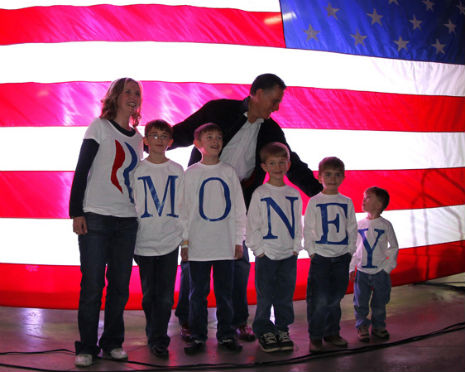
Never mind that some of these events are taken out of context or distorted beyond recognition. Romney’s an easy figure for mockery, simple to tag as an out-of-touch rich guy – a caricature even simpler to sketch than the one Republicans made of John Kerry in 2004, and in 2012, potentially even more devastating.More here.
At a time when Democrats are prepared to stoke a little class resentment, they may well be able to pigeonhole the odds-on favorite for the Republican nomination into the narrative President Barack Obama laid out in his State of the Union address: the rich versus rest of us.
And the reality is, Romney himself is helping them do it.
Thursday, February 2, 2012
How to Implode Your Brand in 24 Hours
You have to hand to the Susan G. Komen folks--they certainly know piss away a reputation in an incredibly efficient manner. For the life of me, I can't understand why they've adopted this new ideology-based strategy. Normally I would give an organization the benefit of the doubt and figure that they ran the numbers and believed this to be the best strategy, but the unspeakably shoddy way they've handled the PR for the decision makes that impossible to believe. I honestly don't know how it walks away from this fiasco without the resignations of the people behind the policy change and tougher institutional controls that prevent ideology from trumping the core mission of providing for women's health. Charities live and die by their reputations and right now SGK's is imploding.
But this isn't going to stop with Komen. Like most other successful charities, SGK has dozens of prominent corporate sponsors, like:
3M, American Airlines, Bank of America, Bic, Caribou Coffee, Caterpiller, Crayola, the Dallas Cowboys, Energizer, Evite, Ford Motors, Forever 21, Guess, Hewlett-Packard, LPGA, Lowe's, Major League Baseball, The Preakness Stakes, Merck, Microsoft, New Balance, Old Navy, Oracle, Pepperidge Farms, REMAX, Samsung, SELF Magazine, Stanley Black & Decker, Walgreen's, Yoplait.
Those are some huge brand names and all of them are about to be inundated with a deluge of requests to end their sponsorships or face a boycott. Some will do so before they receive the first angry email. Komen is handling this so poorly that it's brand is going to start to weigh others down with it.
But this isn't going to stop with Komen. Like most other successful charities, SGK has dozens of prominent corporate sponsors, like:
3M, American Airlines, Bank of America, Bic, Caribou Coffee, Caterpiller, Crayola, the Dallas Cowboys, Energizer, Evite, Ford Motors, Forever 21, Guess, Hewlett-Packard, LPGA, Lowe's, Major League Baseball, The Preakness Stakes, Merck, Microsoft, New Balance, Old Navy, Oracle, Pepperidge Farms, REMAX, Samsung, SELF Magazine, Stanley Black & Decker, Walgreen's, Yoplait.
Those are some huge brand names and all of them are about to be inundated with a deluge of requests to end their sponsorships or face a boycott. Some will do so before they receive the first angry email. Komen is handling this so poorly that it's brand is going to start to weigh others down with it.
Friday, January 27, 2012
Scott Walker's Non-Denial Denial in the John Doe Investigation
Here's Scott Walker answering questions about the John Doe investigation today. Note the carefully chosen language:
You know what words I didn't read? I did not participate in any illegal campaigning on taxpayer time, or I did not coordinate any illegal campaign activities while county executive, or I unequivocally reject as false any accusations that I abused my previous office, etc. Instead, Walker answers with a response that was obviously clearly by his counsel.
There are some other gems in the piece, at least one of which is obscured by the secretive nature inherent to John Doe investigations. Like this one:
Seeing as his closest associates are the one being served with subpoenas these days, it should be clear by now that Walker is a possible, if not probable, target of the investigation. It's a Little Big Horn strategy that can only really point to one individual. Walker's words today are the first public sigh that I've seen that he knows he's in a ton of legal trouble. It's usually the first sign of someone who is going to be in a lot of trouble in the near future. Maybe that has something to do with Darlene Wink's agreement to cooperate in the investigation.
As for Brett Davis -- his words today seem to have marked himself as impending roadkill. He gave the only answer worse than a non-denial denial: he gave a "no comment." That's never a good sign.
"I think it's very clear when all of this is done, no matter how much time it takes, and again my campaign has been involved with cooperating with them for more than a year, I have every confidence that when this is completed, people will see that our integrity remains intact," Walker said.Emphasis added, of course.
You know what words I didn't read? I did not participate in any illegal campaigning on taxpayer time, or I did not coordinate any illegal campaign activities while county executive, or I unequivocally reject as false any accusations that I abused my previous office, etc. Instead, Walker answers with a response that was obviously clearly by his counsel.
There are some other gems in the piece, at least one of which is obscured by the secretive nature inherent to John Doe investigations. Like this one:
Walker declined to answer a question about whether he or his attorney had been contacted by investigators. By contrast, he said last week that he had not yet talked with anyone in Milwaukee County District Attorney John Chisholm's office.If Walker hasn't been contacted by the investigators, then I don't think he is necessarily bound by the same gag order that prevents those involved in the proceeding to keep quiet. I'm not sure about that, but it does seem to follow. If it is true, he's either lying about not being contacted by the investigators or really doesn't want to have to answer any questions about Rindfleisch at all.
"I have not, and I certainly would be willing if they asked me to in the future," Walker told the Journal Sentinel last week.
[...]
Walker said if he had been aware of any other county employees doing political work with county resources on county time, he would have acted the same way he acted in the Wink matter.
"If we had known about anyone else, we would have taken the same action," Walker said.
Asked about the proximity of his office to space occupied by Kelly Rindfleisch, his then-deputy chief of staff in 2010, and whether he knew what Rindfleisch was doing, Walker declined to comment, saying he wanted to abide by the rules of the John Doe probe and not provide details publicly.
Seeing as his closest associates are the one being served with subpoenas these days, it should be clear by now that Walker is a possible, if not probable, target of the investigation. It's a Little Big Horn strategy that can only really point to one individual. Walker's words today are the first public sigh that I've seen that he knows he's in a ton of legal trouble. It's usually the first sign of someone who is going to be in a lot of trouble in the near future. Maybe that has something to do with Darlene Wink's agreement to cooperate in the investigation.
As for Brett Davis -- his words today seem to have marked himself as impending roadkill. He gave the only answer worse than a non-denial denial: he gave a "no comment." That's never a good sign.
Thursday, January 26, 2012
The Attacks on Charles Franklin are Baseless and Need to Stop
The recent attacks against Charles Franklin's poll for Marquette Law School are beyond idiotic. They're so stupid that I'm actually embarrassed for the people making them as they have revealed themselves to be so filled with rage at Scott Walker that any deviation from their own worldview appears to be reason enough to lash out at the messenger.
Perhaps the silliest attack is that Franklin is himself a conservative, and thus has a motive to skew his polls as such, based solely on two pieces of evidence: he conducted the poll for Marquette Law School (an institution so conservative that it employs noted reactionary Russ Feingold) and that he once conducted a poll for WPRI. If this were true, then Franklin would also be a flaming liberal because he sold Pollster.com, of which he was a co-founder, to the Huffington Post. He can't be both.
The second criticism has been about the ideological weights of the sample used for the poll, which runs something like this:
Conservative = 41.6%
Moderate = 32.5%
Liberal = 20.7%
Liberals are whining -- and there really is no other word for it -- that this weighing system is unfair. It's not just fair, it's reality. The most recent Gallup poll of American ideological identity ran this way:
Conservative = 41%
Moderate = 36%
Liberal = 21%
Which looks an awful lot like the sample Franklin took. Last October, when Public Policy Polling, a Democratic firm, surveyed the state it used the following sample:
Very/Somewhat Conservative = 42%
Moderate = 30%
Very/Somewhat Liberal = 19%
There was no outcry then. You can find four other recent polls conducted by PPP in Wisconsin with the exact same weights here, here, here, and here. In fact, it appears that PPP always uses those weights when polling Wisconsin. I would post the ideological breakdown of the St. Norbert's poll from November that concluded 58% of Wisconsinites wanted to recall Walker, but they didn't even publish how they weighed their sample. We could go on and on and on like this, pulling out examples from just about every pollster whose done work in Wisconsin in recent years, but the the weights really aren't going to change all that much because they're consistent with industry practice.
Charles Franklin's academic credentials are damn near unimpeachable. He's one of the world's foremost authorities on polling and he didn't get that reputation by being a partisan hack -- he earned it by being a scientist and as such he's all about the data. In recent years he's gone out of his way to explain the science in terms the public can understand. Franklin is exactly what the creators of the Wisconsin Idea had in mind when they came up with the concept. Accusing him of slanting his polls to conform with the supposed ideology of his temporary employer strain credulity and betrays the fact that the accuser doesn't understand much about polling.
Polls are both tools and weapons. The folks who are criticizing Franklin only seem to understand the latter. It's one thing to rip on a poll like Rasumussen for it's consistent "house effect," but to essentially accuse Charles Franklin of fraud -- which is exactly what his detractors are doing -- is asinine. If Wisconsin progressives want any prayer of recalling Scott Walker they are going to have accept uncomfortable realities on occasion. Franklin's poll has one simple findings: there's still a lot of work to do. If the left is going to attack any messenger who brings them this news in the future, they should give up right now because they will fail.
Perhaps the silliest attack is that Franklin is himself a conservative, and thus has a motive to skew his polls as such, based solely on two pieces of evidence: he conducted the poll for Marquette Law School (an institution so conservative that it employs noted reactionary Russ Feingold) and that he once conducted a poll for WPRI. If this were true, then Franklin would also be a flaming liberal because he sold Pollster.com, of which he was a co-founder, to the Huffington Post. He can't be both.
The second criticism has been about the ideological weights of the sample used for the poll, which runs something like this:
Conservative = 41.6%
Moderate = 32.5%
Liberal = 20.7%
Liberals are whining -- and there really is no other word for it -- that this weighing system is unfair. It's not just fair, it's reality. The most recent Gallup poll of American ideological identity ran this way:
Conservative = 41%
Moderate = 36%
Liberal = 21%
Which looks an awful lot like the sample Franklin took. Last October, when Public Policy Polling, a Democratic firm, surveyed the state it used the following sample:
Very/Somewhat Conservative = 42%
Moderate = 30%
Very/Somewhat Liberal = 19%
There was no outcry then. You can find four other recent polls conducted by PPP in Wisconsin with the exact same weights here, here, here, and here. In fact, it appears that PPP always uses those weights when polling Wisconsin. I would post the ideological breakdown of the St. Norbert's poll from November that concluded 58% of Wisconsinites wanted to recall Walker, but they didn't even publish how they weighed their sample. We could go on and on and on like this, pulling out examples from just about every pollster whose done work in Wisconsin in recent years, but the the weights really aren't going to change all that much because they're consistent with industry practice.
Charles Franklin's academic credentials are damn near unimpeachable. He's one of the world's foremost authorities on polling and he didn't get that reputation by being a partisan hack -- he earned it by being a scientist and as such he's all about the data. In recent years he's gone out of his way to explain the science in terms the public can understand. Franklin is exactly what the creators of the Wisconsin Idea had in mind when they came up with the concept. Accusing him of slanting his polls to conform with the supposed ideology of his temporary employer strain credulity and betrays the fact that the accuser doesn't understand much about polling.
Polls are both tools and weapons. The folks who are criticizing Franklin only seem to understand the latter. It's one thing to rip on a poll like Rasumussen for it's consistent "house effect," but to essentially accuse Charles Franklin of fraud -- which is exactly what his detractors are doing -- is asinine. If Wisconsin progressives want any prayer of recalling Scott Walker they are going to have accept uncomfortable realities on occasion. Franklin's poll has one simple findings: there's still a lot of work to do. If the left is going to attack any messenger who brings them this news in the future, they should give up right now because they will fail.
Wednesday, January 25, 2012
How Many More 2,750 Word Front Page Articles on on the John Doe Investigation do You Think Scott Walker can Take?
All of these stories seem to fly around a nucleus like so many electrons.
Monday, January 16, 2012
Enter The Chief's Recall Total Pool
The rules are simple:
How did we arrive at our guess? The Dems passed along that they are in possession of over 3000 pounds of signatures in a fund-raising plea today. I assume that's for everyone: Walker, Kleefisch and the four senators.
If we assume that each petition was printed out on twenty pound bond paper, which is standard for copying paper, then the Recall Effort will have collected no less than 295,857 sheets of paper -- presuming that one ream (or 500 pieces) weighs 5.07 pounds.
And this is where things start to get dicey. Some petitions have enough room for five signatures, some ten. Assuming each petition is filled out completely (an extreme unlikelihood), that gives us a window between 1,479,285 -- hypothetically more than enough to initiate recalls for all six targets -- and almost three million.
If the drive does exceed our expectations -- and here we're just talking about the Walker drive -- these are a few important milestones:
- Estimate the total number of signatures United Wisconsin will submit to the GAB tomorrow in the comments section below. Forecast any of the individual races or go for the grand total.
- The winner gets a limerick composed in their honor written by yours truly.
How did we arrive at our guess? The Dems passed along that they are in possession of over 3000 pounds of signatures in a fund-raising plea today. I assume that's for everyone: Walker, Kleefisch and the four senators.
If we assume that each petition was printed out on twenty pound bond paper, which is standard for copying paper, then the Recall Effort will have collected no less than 295,857 sheets of paper -- presuming that one ream (or 500 pieces) weighs 5.07 pounds.
And this is where things start to get dicey. Some petitions have enough room for five signatures, some ten. Assuming each petition is filled out completely (an extreme unlikelihood), that gives us a window between 1,479,285 -- hypothetically more than enough to initiate recalls for all six targets -- and almost three million.
If the drive does exceed our expectations -- and here we're just talking about the Walker drive -- these are a few important milestones:
- 1,004,303 -- The number of people who voted for Tom Barrett in 2010.
- 1,080,480 -- 50% of voters who voted in 2010
- 1,128,159 -- The number of people who voted for Scott Walker in 2010.
- 1,350,000 -- Total, if the rate at which the first month of signature collection continued during the second month. This is almost certainly not going to happen.
Thursday, January 12, 2012
Ron Johnson's Misguided Obsession with Domestic Oil Production
When Ron Johnson was running for office in 2010 he made one of his first policy gaffes came when he made comments that could be interpreted that he supported potential oil drilling in the Great Lakes. This was right around the time it was revealed that Johnson owned six figures worth of stock in BP, stock he promised to eventually sell, a promise he ultimately reneged on, then sorta followed through with following the election when he sold of his entire stock portfolio. Last May Johnson voted against a bill that would have stripped oil companies of several billion dollars worth of government subsidies, which Johnson has routinely opposed on principle.
The moral of the story is that Johnson's relationship with the oil industry is checkered, at best.
Most of this oil business happened during the early months of summer 2010, when no one was paying attention, and as a result domestic drilling never really become much of an issue. Since Johnson took office, however, he's made it a point to champion domestic oil production in most of communiques with the masses. It's not terribly surprising since it's been a pet cause among conservatives for the last decade, and it might be seem odd coming from Johnson given his political past with the issue and the fact that he has no expertise with the matter at all, so why does Johnson appear to be making domestic drilling his issue de jour?
First of all, Johnson's drilling agenda is about five years old. He accuses the President of "limiting energy development" in the U.S. in his column in yesterday's Wall Street Journal and adds:
He elaborated on that thought in an interview with Newsmax today:

The moral of the story is that Johnson's relationship with the oil industry is checkered, at best.
Most of this oil business happened during the early months of summer 2010, when no one was paying attention, and as a result domestic drilling never really become much of an issue. Since Johnson took office, however, he's made it a point to champion domestic oil production in most of communiques with the masses. It's not terribly surprising since it's been a pet cause among conservatives for the last decade, and it might be seem odd coming from Johnson given his political past with the issue and the fact that he has no expertise with the matter at all, so why does Johnson appear to be making domestic drilling his issue de jour?
First of all, Johnson's drilling agenda is about five years old. He accuses the President of "limiting energy development" in the U.S. in his column in yesterday's Wall Street Journal and adds:
The administration has squandered billions of dollars on politically connected, green-energy boondoggle projects, while at the same time maintaining a de facto moratorium on off-shore drilling, and dragging its feet on granting permits for other energy utilization projects such as the Keystone XL Pipeline and restricting and limiting leases for offshore energy production. Republicans could propose a plan to utilize crucial domestic resources, including oil, natural gas and coal, to produce energy and create jobs.(For the record, Obama has actually pledged to to increase lease sales both off-shore and in Alaska.)
He elaborated on that thought in an interview with Newsmax today:
Johnson accused Democrats of being beholden to extreme environmentalists in their rejection of both drilling in the Arctic National Wildlife Refuge (ANWR) and the construction of the Keystone XL oil pipeline from Canada to Texas.
Alaskans want drilling and their view about their own environment is more important than those of people in California, New York or Massachusetts, he said, declaring: “If Alaskans want to drill in ANWR, we should let Alaskans drill in ANWR.”
The pipeline will be built unless Obama declares it against the national interest, Johnson said. “If you take a look at the 20,000 jobs the construction would create; you take a look at the $20 billion in private sector investment; you take a look at the hundreds of thousands of jobs that would be created long-term; and the impact on our energy prices, I think it will be very difficult for President Obama to make that determination.”
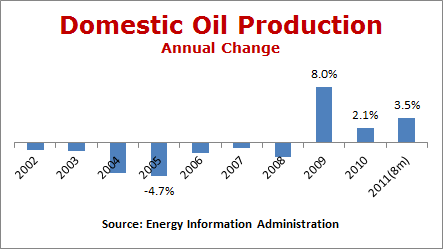
Wednesday, January 11, 2012
Ron Johnson unveils another Doomed Initiative called "America's Choice"
Oh, Lord. Fresh off the heels of a disastrous first year in the U.S. Senate, Ron Johnson decided to kick off his second year in office with a plan to transform Congress into a partisan Thunderdome spectacle designed solely to "highlight the differences" between the two parties. Seriously, those are his exact words.
Here he is in today's Wall Street Journal:
 And on taxes, Obama's lowered those too.
The problem with the green jobs initiative has been the recent oil boom in North Dakota, which has kept oil prices down in the U.S. below the point where spending on green tech -- much of which is still in the expensive R&D phase -- is profitale. Last year the U.S. became an oil exporting country for the first time in over 60 years. The fact is that we are developing our oil resources here in the United States, as fast as humanly possible. Johnson is still speaking the coded GOP language calling for drilling in ANWR and off the shore of Florida even though, at the moment and like the green tech industry, neither of those are necessary.
The next part just rags on Obamacare:
This op-ed just continues to drive home what a lousy Senator Johnson is. This plan is nothing more than branding, an empty catch phrase that has no details to consider carefully, no support from his colleagues and nothing to offer his constituents. There's a complete lack of focus on the issues -- Johnson mentions about eight of them during the course of his word limit and they seem to roll of the pen like poll-tested talking point rather than actionable items.
Expect "America's Choice" to wither on the vine until being blown away by a stiff autumn wind. This will be yet another one of Johnson's fail attempts to do his job.
MORE: It's been about 36 hours since Johnson's op-ed dropped and so far it's gotten very little traction. Only one of Johnson's senate colleagues has publicly signed on to the program and largely because it "was his idea first." Jennifer Rubin, WaPo's conservative blogger had this to say about the proposal:
Here he is in today's Wall Street Journal:
Americans are frustrated over Washington's inability to address our nation's economic and fiscal problems. That's why I have been working with a growing group of senators and House members to develop a plan that can build public support for solutions. It's called "America's Choice."One quickly discovers that Johnson and his team spent more time working on the branding of this "plan" than on the plan itself.
America's Choice seeks to highlight the differences between the Republican Party and the Democratic Party led by President Obama.If the entire piece can be reduced to one sentence, here it is. This plan does not appear to advance an policy goals, has no ambitions to put people back to work and is not supported by any data, but is designed to embarrass the President during a re-election. The only good thing about this plan so far is the brazen transparency of it all.
It could do so over the coming months by presenting to the country, through a series of votes in the House of Representatives, the battle between those who believe in broadest terms in limited government and freedom and those who promote government control and dependency.Could do so? It doesn't sound like Johnson thinks enough of his niftily-named plan to actually think it will have any hope of doing so, but then again his plan calls for votes in a House of Congress to which he does not belong. Why Johnson is asking the House of Representative to carry the water when he is a member of the Senate is a bit ridiculous, but not entirely inconsistent with Johnson's M.O. Johnson does subscribe to the inane belief that a supermajority is required to get anything done in the Senate, a tenet that runs counter to his consistent whining that the Senate never gets enough done and this very plan. Go figure.
What are the choices these votes could present? Growing government spending and debt or growing the private sector and reducing government. Limiting energy development or using America's energy resources. Punishing success or pro-growth tax reform. A government takeover of health care or repealing ObamaCare and replacing it with patient-centered, free-market reforms.Blah blah blah... We've heard this all before: the Manichean worldview of government coming from Johnson is as unproductive as it is tiresome.
The alternatives are stark. President Obama's faith in government is so strong that he has increased its size to 24% of gross domestic product from 21%, and increased our nation's debt by over $4 trillion. Republicans, on the other hand, believe long-term self-sustaining jobs are created in the private sector—that government cannot tax, spend and borrow our nation to prosperity.Just because Johnson and his Republican cohorts keep saying it, doesn't mean it's true:
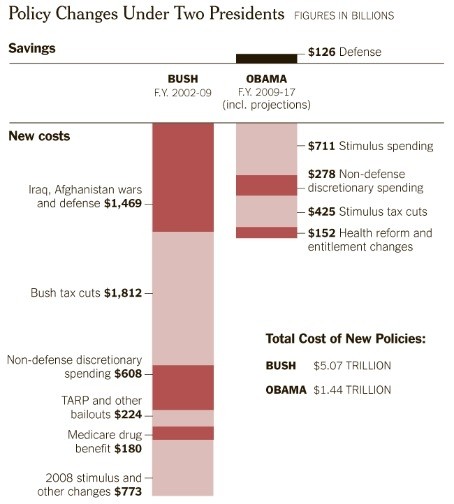
Will green energy power America's future? The administration has squandered billions of dollars on politically connected, green-energy boondoggle projects, while at the same time maintaining a de facto moratorium on off-shore drilling, and dragging its feet on granting permits for other energy utilization projects such as the Keystone XL Pipeline and restricting and limiting leases for offshore energy production. Republicans could propose a plan to utilize crucial domestic resources, including oil, natural gas and coal, to produce energy and create jobs.To be fair, the green jobs initiative has been something of a bust, but it should be noted that it does conform to Johnson earlier demand for "using America's energy resources." Clearly, Johnson was only talking about fossil fuels.
The problem with the green jobs initiative has been the recent oil boom in North Dakota, which has kept oil prices down in the U.S. below the point where spending on green tech -- much of which is still in the expensive R&D phase -- is profitale. Last year the U.S. became an oil exporting country for the first time in over 60 years. The fact is that we are developing our oil resources here in the United States, as fast as humanly possible. Johnson is still speaking the coded GOP language calling for drilling in ANWR and off the shore of Florida even though, at the moment and like the green tech industry, neither of those are necessary.
Regulatory overreach in this administration has been breathtaking. Executive agencies such as the Environmental Protection Agency and the Department of Labor have been in hyper-drive, adding to the already job-crushing $1.75 trillion annual cost, according to the Small Business Administration, of federal regulatory compliance. Republicans could propose a regulatory moratorium to give businesses a chance to recover, and then enact real reform to achieve common-sense regulatory balance.Another series of rote talking points Johnson includes in everything he does...
President Obama has launched a divisive campaign pitting one group of Americans against another.Which is exactly what this "America's Choice" plan seems to aspire to do. You remember that "plan," don't you? The one Johnson opened up his op-ed piece discussing, but hasn't talked about since, even though we're now half way through the piece? Yeah, that one.
Yet 10% of Americans already pay 70% of all income taxes.And here's Ron Johnson, once again, valiantly sticking his neck out for the upper marginal income earners. This is a mathematical reality of a progressive tax system. We've discussed this before here and here.
Increasing the tax burden on that group is counterproductive. Sowing class division is an act of political cynicism producing terrible economic consequences. Significant pro-growth tax reform is the better path to build our economy and create jobs.It'd be great if Johnson used this incredibly value space in a national newspaper to outline such a tax plan, but instead we get an electioneering strategy.
The next part just rags on Obamacare:
Government takeover of our health-care system has been a liberal-progressive dream for decades. President Obama and Democrats in Congress passed the partisan Patient Protection and Affordable Care Act. It neither protects patients, nor does it make health care more affordable. But it will lead to a government takeover of one-sixth of our economy, and it will blow a hole in an already horribly broken budget.Now back to "America's Choice:"
Republicans are united in our commitment to repeal ObamaCare and replace it with patient-centered reforms. Malpractice tort reform, health savings account expansion, insurance purchase across state lines, reduction of government mandates, and equalized tax treatment of insurance premiums are some of the key changes we will propose to the country.
America's Choice would clearly present two different visions of the country's future—one represented by the Republican Party and the other represented by the Democratic Party and its leader, President Obama. Once Congress returns from recess later this month, the Republican majority in the House could focus on one major area of domestic policy at a time. For example, February could be used to debate, craft and pass an energy utilization policy.It should be clear by now that Johnson is using his word count to propose a plan that he has not discussed with any other members of Congress. Johnson doesn't offer much in the way of detail because Johnson is completely oblivious to the fact that this is an election year for everyone in Washington except for himself (and 65 colleagues in the Senate). It's every man for himself.
When the House debates and passes an agenda item, Republican senators, candidates and conservative groups could concentrate on the same issue, using the same powerful facts and figures to inform and persuade the American public. Coordinating our focused efforts improves our ability to compete with the presidential bully pulpit and counteract media outlets that often work to marginalize us.This would have been sage advice ... about 20 years ago. This is actually what the conservative movement does extremely well. The only thing this paragraph goes to show is that Johnson doesn't get invited to the important meetings.
In 2011, President Obama stopped running the country and started running his re-election campaign. In his cynical attempt to divert attention away from his record by dividing us, Republicans have been put on defense. The America's Choice agenda would put us on offense.Again, in the end it's all about politics.
If done well, we just might put enough pressure on Senate Democrats and the president to actually pass legislation that will begin to solve our problems. If not, Republicans will have provided Americans with a clear choice in November.
This op-ed just continues to drive home what a lousy Senator Johnson is. This plan is nothing more than branding, an empty catch phrase that has no details to consider carefully, no support from his colleagues and nothing to offer his constituents. There's a complete lack of focus on the issues -- Johnson mentions about eight of them during the course of his word limit and they seem to roll of the pen like poll-tested talking point rather than actionable items.
Expect "America's Choice" to wither on the vine until being blown away by a stiff autumn wind. This will be yet another one of Johnson's fail attempts to do his job.
MORE: It's been about 36 hours since Johnson's op-ed dropped and so far it's gotten very little traction. Only one of Johnson's senate colleagues has publicly signed on to the program and largely because it "was his idea first." Jennifer Rubin, WaPo's conservative blogger had this to say about the proposal:
Johnson’s very public style of marketing legislation, he conceded, is not how government usually operates. To someone coming from the private sector, however, as he did, “it is obvious” that lawmakers have to development a coherent message and sell their ideas to the public. At the very least, Johnson’s goal is to line up with that of Rep. Paul Ryan (R-Wis.): Lay out a vision, explain it to voters and contrast it with the president’s.That's about as delicate a way a sympathetic journalist can possibly say, "this guy doesn't know what the hell's going on in Washington."
Tuesday, January 10, 2012
Does Tommy Thompson work for a Private Equity Firm that uses an Off Shore Tax Shelter?
Wow, could we possibly hear any more about private equity than we have this last week?
Of course, we can!
It probably will come as little surprise that Tommy Thompson has dabbled in the Private Equity business. He joined the Boston-based Peak Ridge Capital Group in 2010. It looks like PRCG was so happy to have Thompson aboard that they created an office in Madison, but the Wisconsin branch office isn't nearly as interesting as the one in Hamilton, Bermuda, which is well-known as a popular tax haven.
Unfortunately, PE firms are notorious for their lack of transparency. They are, after all, private firms and don't usually have to file SEC papers and what have you (there are exceptions). I actually had a monster of a time just trying to find which companies were in Peak Ridge's portfolio and no luck trying to find where they are incorporated. They seem to have registered with the Massachusetts Secretary of Commonwealth, but did so in 2007, seven years after they were founded.
Anyway, most Caribbean tax shelters have a couple of rules for using their countries to hide revenue from Uncle Sam. The first is that the business has to establish a physical presence on the island, usually in the form of a P.O. Box. The second, and I'm told this rule varies from island to island, is that the company must hold at least one board of directors meeting on the island every year. Both are true of Bermuda. The take-away here is that firms don't set up offices in Bermuda unless they're doing business in Bermuda, and the only businesses in Bermuda are wearing kick-ass shorts once a year and sheltering taxes.
This is probably one of those things more respectable people should look into.
Of course, we can!
It probably will come as little surprise that Tommy Thompson has dabbled in the Private Equity business. He joined the Boston-based Peak Ridge Capital Group in 2010. It looks like PRCG was so happy to have Thompson aboard that they created an office in Madison, but the Wisconsin branch office isn't nearly as interesting as the one in Hamilton, Bermuda, which is well-known as a popular tax haven.
Unfortunately, PE firms are notorious for their lack of transparency. They are, after all, private firms and don't usually have to file SEC papers and what have you (there are exceptions). I actually had a monster of a time just trying to find which companies were in Peak Ridge's portfolio and no luck trying to find where they are incorporated. They seem to have registered with the Massachusetts Secretary of Commonwealth, but did so in 2007, seven years after they were founded.
Anyway, most Caribbean tax shelters have a couple of rules for using their countries to hide revenue from Uncle Sam. The first is that the business has to establish a physical presence on the island, usually in the form of a P.O. Box. The second, and I'm told this rule varies from island to island, is that the company must hold at least one board of directors meeting on the island every year. Both are true of Bermuda. The take-away here is that firms don't set up offices in Bermuda unless they're doing business in Bermuda, and the only businesses in Bermuda are wearing kick-ass shorts once a year and sheltering taxes.
This is probably one of those things more respectable people should look into.
Thursday, January 5, 2012
Walkergate Update
Bottom line: worst than anyone anticipated, even Walker's most vehement detractors.
Allow Jake and Zach to take of the details, but here are the take-away points from the allegations:
I recommend taking a look at Jake's very serious reading of the complaint. It's absolutely devastating. These are the kinds of allegations that keep high-rolling lawyers well-fed for years.
Allow Jake and Zach to take of the details, but here are the take-away points from the allegations:
- Veterans were (allegedly) defrauded for a very small amount of money (relatively speaking).
- Children were preyed upon by an (alleged) sexual predator.
- Scott Walker apparently never learned that "it's not the crime, it's the cover-up" and continues to twist his involvement in ways that would make a contortionist blush.
I recommend taking a look at Jake's very serious reading of the complaint. It's absolutely devastating. These are the kinds of allegations that keep high-rolling lawyers well-fed for years.
If Ever there were a Statement that Screamed "Fact Check Me!" -- it's this One
Before we end up with one of these "half true" rulings from the Journal-Sentinel, let's parse what was said:
But much of this is undoubtedly the cost of programs like BadgerCare, which could be expensive if the recipient is ill, but that isn't money a recipient is "receiving," per se: it's a service deemed to have a certain value. Johnson makes it sound like poor folks making $22,000 a year are being given an additional 200% pay raise -- in cash -- just for sitting on their assess. This is almost certainly not true.
Furthermore, I'm not sure where Johnson thinks his hypothetical family's initial $22,000 came from. He seems to think one can just acquire it by doing nothing. In actuality, if a person working for the federal minimum wage ($7.25 an hour) 40 hours a week all 52 weeks a year, the kind of real lazy bum who didn't take any vacation time, that person would make exactly $15,080. He'd have to work another 636 hours worth of overtime (at $10.88 an hour) to reach the $22,000 threshold.
That translates into just over a 52 hour work week every week of the year without any time off just so that they can reach an income Johnson seems to believe materializes out of nowhere.
Johnson said the United States has created a "very compassionate society," but in Wisconsin that same compassion has created a welfare state that encourages people not to work.This seems to suggest that a family of (no size given) is eligible for $62,000 worth of state aide. Notice how Johnson says "receive," not "earn" or "make" or ""acquire."
"A family unit can't survive on $22,000, but after they receive all of their government entitlements they receive more than $62,000," he said. "We have a safety net for the poor, but not for those who are out there working."
But much of this is undoubtedly the cost of programs like BadgerCare, which could be expensive if the recipient is ill, but that isn't money a recipient is "receiving," per se: it's a service deemed to have a certain value. Johnson makes it sound like poor folks making $22,000 a year are being given an additional 200% pay raise -- in cash -- just for sitting on their assess. This is almost certainly not true.
Furthermore, I'm not sure where Johnson thinks his hypothetical family's initial $22,000 came from. He seems to think one can just acquire it by doing nothing. In actuality, if a person working for the federal minimum wage ($7.25 an hour) 40 hours a week all 52 weeks a year, the kind of real lazy bum who didn't take any vacation time, that person would make exactly $15,080. He'd have to work another 636 hours worth of overtime (at $10.88 an hour) to reach the $22,000 threshold.
That translates into just over a 52 hour work week every week of the year without any time off just so that they can reach an income Johnson seems to believe materializes out of nowhere.
Levity (this Blog could use some)
First, the local/instant YouTube classic almost eight years in the making:
And secondly, action from the Texas 5A Division II high school championship at Cowboys Stadium:
There's actually another angle from which the above splendor can be seen. I encourage you all to check it out.
And secondly, action from the Texas 5A Division II high school championship at Cowboys Stadium:
There's actually another angle from which the above splendor can be seen. I encourage you all to check it out.
Wednesday, January 4, 2012
Don't Buy Scott Walker's Chest-Pounding over the New Shopko Merger Jobs
There's some good news for folks in Green Bay tonight, as giant area retailer Shopko is creating about 120 new job via a merger. The news is so good that Gov. Walker's team is all over it with a press release:
Why this merger is getting tax credits might be an interesting issue to discuss. Shopko has twice the revenues of Pamida and it's almost always the case that the smaller guy has to pack his bags and move to the bigger kid's backyard during a merger. I'm not sure how floating $2 million Shopko's way does anything to create jobs that weren't already coming here. $2 million is 0.1% of Shopko's annual revenue, so it's really nothing to them; in fact, it's such a negligible pittance that Shopko didn't even mention WEDC's involvement in their press release on the merger. The $2 million Walker gave Shopko is little more than a gift basket from the neighborhood association's welcome wagon.
Without knowing much more about the deal itself or WEDC's involvement, I can only comment on what it looks like from the outside and, frankly, it looks pretty weak. The tax credits appear to be something WEDC floated Shopko's way solely for the sake of being able to claim that they are involved in job growth here in Wisconsin even though the state probably did absolutely nothing to bring those jobs here. That's one expensive press release.
If that's the case, then Walker et al. are incompetent at either 1.) messaging that they missed a golden opportunity to tell everyone that the economy is looking up and that jobs are coming back to Wisconsin without state government involvement (something I'm routinely told conservatives are quite fond of); or 2.) job creation that they can't count on private businesses to extol the Administration's leadership and/or policies without having to pay them.
Taking credit for something he had nothing to do with is quickly becoming a Scott Walker calling card. Lately we've had his heroic "expansion" of Family Care and now his fiat creation of jobs in Green Bay -- Walker truly seems adept at nothing than his own self-promotion.
It's a good thing that good jobs are coming to Green Bay and, yes, those jobs should be counted toward Walker's promise of 250,000 new jobs in the state by the end of his term; but Walker shouldn't pound his chest too much because he likely didn't do much -- if anything -- to bring them here.
MORE: Jake reminds us all of the eerily similar Spectrum Brands incident from not too long ago.
MADISON—Governor Scott Walker today announced that Shopko will commence a corporate expansion project with assistance from the Wisconsin Economic Development Corporation (WEDC) that will result in the creation of more than 120 new positions at its corporate headquarters in Green Bay.That's lovely. $2 million can pay salary and benefits to between 15-20 low to mid-level executives for about a year. But, really, how did those jobs end up here? Here's a more plausible explanation:
"My number one priority is helping Wisconsin businesses create jobs," Governor Walker said. "I am pleased we were able to work with Shopko to support their expansion and ensure it will take place in Wisconsin."
“We appreciate the WEDC working with us to support our growth and bring new, good paying jobs to Wisconsin,” commented Paul Jones, President and CEO of Shopko.
Founded in 1963 and headquartered in Green Bay, Wisconsin, Shopko is a $2 billion retailer that operates 149 stores in 13 states throughout the Midwest, Mountain and Pacific Northwest regions. The company announced today a merger that will result in a significant investment in Wisconsin and creation of new positions at its corporate headquarters in Green Bay. The creation of more than 120 new jobs will be assisted with an award of up to $2 million in Economic Development Tax Credits administered by the WEDC.
Over the past two years, Shopko has purchased seven stores from Pamida and successfully transitioned them to the Shopko Hometown format. These locations have delivered an improved customer experience and have seen a significant increase in store traffic, sales and profitability, the release stated.Pamida has been owned by Shopko since 1999, and for the last six years they have both been owned by the same private equity firm who finally decided to reduce redundancies, increase shareholder value and all that jazz. Actually, Sun Cap looks like they started the merger process, or at least investigating the viability of a merger, two years ago, before Walker was in office or WEDC even existed.
Once Pamida’s chain-wide conversions are complete, the company plans to accelerate the addition of new Shopko Hometown stores in the second half of 2012 and into 2013, Burns said.
Both companies are owned by affiliates of Sun Capital Partners, Inc. a private investment firm focused on leverage buyouts, equity, debt, and other investments in market-leading companies.
Why this merger is getting tax credits might be an interesting issue to discuss. Shopko has twice the revenues of Pamida and it's almost always the case that the smaller guy has to pack his bags and move to the bigger kid's backyard during a merger. I'm not sure how floating $2 million Shopko's way does anything to create jobs that weren't already coming here. $2 million is 0.1% of Shopko's annual revenue, so it's really nothing to them; in fact, it's such a negligible pittance that Shopko didn't even mention WEDC's involvement in their press release on the merger. The $2 million Walker gave Shopko is little more than a gift basket from the neighborhood association's welcome wagon.
Without knowing much more about the deal itself or WEDC's involvement, I can only comment on what it looks like from the outside and, frankly, it looks pretty weak. The tax credits appear to be something WEDC floated Shopko's way solely for the sake of being able to claim that they are involved in job growth here in Wisconsin even though the state probably did absolutely nothing to bring those jobs here. That's one expensive press release.
If that's the case, then Walker et al. are incompetent at either 1.) messaging that they missed a golden opportunity to tell everyone that the economy is looking up and that jobs are coming back to Wisconsin without state government involvement (something I'm routinely told conservatives are quite fond of); or 2.) job creation that they can't count on private businesses to extol the Administration's leadership and/or policies without having to pay them.
Taking credit for something he had nothing to do with is quickly becoming a Scott Walker calling card. Lately we've had his heroic "expansion" of Family Care and now his fiat creation of jobs in Green Bay -- Walker truly seems adept at nothing than his own self-promotion.
It's a good thing that good jobs are coming to Green Bay and, yes, those jobs should be counted toward Walker's promise of 250,000 new jobs in the state by the end of his term; but Walker shouldn't pound his chest too much because he likely didn't do much -- if anything -- to bring them here.
MORE: Jake reminds us all of the eerily similar Spectrum Brands incident from not too long ago.
Subscribe to:
Posts (Atom)


 Posts
Posts


