Wednesday, January 23, 2013
Ron Johnson's Telling Conversation with Hillary Clinton
Before we get in the weeds of this post, let's first recall a helpful PR tip: Men in power can never appear to lose their temper or become frustrated with women in power. They just can't. They will never fail to walk away from the exchange appearing condescending and arrogant. It may not be fair, but "them's the breaks." This is why Joe Biden was all sweetness and light during his Vice Presidential debate with Sarah Palin in 2008; but glib, dismissive and downright surly during his debate with Paul Ryan last fall. If a man in power raises his voice or loses his cool during a conversation with a woman in power he will come off looking like a bully. Maybe worse.
Someone forgot to remind Ron Johnson of this principle before he met Hillary Clinton this morning. I don't necessarily think that Johnson crossed a line here during his line of questioning, but he certainly did take enough steps toward that line; enough to trigger the alarms of not just Clinton, but more than a few viewers too. The optics were not great for Johnson. To be sure, the garbled initial part of Clinton's answer wasn't very impressive either, but I would guess that more people will connect with her display of emotion than will try and parse her words anyway.
Which brings us back to the substance of Johnson's interrogation. Since almost the end of last September, Johnson's been pounding the Benghazi beat pretty hard, just about as hard as any other issue he's bothered touching during his short time in office. That's fine: there are some big issues to discuss over the incident, like the whether US involvement in Libya is appropriate in the first place? Is the security of our diplomatic missions being adequately addressed? Was the CIA's role in Benghazi compromised and were they the target of the terrorists? What, if any, was Al-Qaeda's involvement in the incident? Is there any connection between Benghazi to the recent events in Mali or the hostage crisis in Algeria; and, if so, does this make North Africa the new hotbed for Islamist extremism? Even a simple walk-through the tick-tock of events on the ground in Benghazi on September 11th would have been helpful. Instead, Johnson decided to focus on the process by which "taking points" were made and disseminated in Washington. This has been Johnson's singular focus from the very beginning, and it hasn't changed regardless of how often his questions have been answered.
(To be perfectly honest, the basic gist of Johnson's questions was so predictable that I'm a little disappointed Clinton didn't have a prepared response. The folks at State should have seen this coming. But that's another issue.)
So let's answer Johnson's question: Why didn't Clinton call up the rescued State Department employees as they were being evacuated from the consulate? Because victims of terrorist attacks need to be debriefed by people who are trained to do that sort of thing, hopefully while the event is still fresh in their memories, precisely so that the intelligence community can reconstruct the incident and determine what the hell actually happened. The end.
But Johnson already knows this ... or at least he should. There are a number of reasons while the official Benghazi story was slow to evolve and they start with CIA's involvement in the consulate and the attack. The White House -- and not just the Obama Administration, but any White House -- should be understandably reticent to reveal aspects of intelligence operations and procedures.
But Johnson already knows this, too (or at least he should); and that's what makes whacking the Benghazi pinata so appealing to him: the White House likely can't provide an adequate public explanation of events without revealing a national security secret or two. Johnson's opponents may not think he's too bright, but it does not take much to realize when you've backed someone into a lose-lose situation. No wonder Johnson's been trying to squeeze blood from the Benghazi stone, even if it means essentially accusing the administration of a cover-up ... something that's already been thoroughly debunked.
Now let's return to the optics of this morning one more time. We've talked about how Johnson's been going out of his way to alienate women voters before (see section #4, waaaaaay at the bottom), but it doesn't look like the Senator's done much to correct the problem. Whatever one may think about the exchange at the hearing this morning, following it up with an interview with Charlie Sykes during which Johnson basically dismissed Clinton's testimony as premeditated "emotional" evasiveness -- as if women aren't accused of being too emotional enough as it is -- will probably not endear him to ovarian electorate.
Sharper readers will notice that even though we just criticized Johnson for his "emotional" theory we praised Clinton for her use of emotion earlier in this post. Does that mean I'm talking out of both sides our my mouth? Nope, and here's why: most women will interpret Johnson's dismissal of Clinton as evoking female "emotional volatility" in general, but that's very clearly not what Clinton was trying to convey with her answer to Johnson's question. She was angry, angry that two dudes like Johnson and Sen. Rand Paul, a pair of men who cumulatively have as much experience in elected office as Clinton does solely at the State Department, were telling her how to do her job ... and in hindsight, no less. (She wasn't the only one.) No one needed to parse her words for Clinton to get that point across.
Except for Johnson, apparently.

Friday, January 18, 2013
Read the Federalist Papers with The Chief because You have nothing Better to Do
So we're going to try something new here at the Chief. In order to get infuse some regularity into the posts here, we're going to start something of a book club. Every week we'll read a small chunk and write up a post about it in hopes of generating some conversation. Since this blog mostly focuses on politics we decided to kick things off with The Federalist Papers.
If you don't have a copy, don't worry: the book is in the public domain, which means you can find a copy of the full text any number of places online (like here).
Here's the first reading assignment:
MORE: We're adding the good old Articles of Confederation into the mix just provide some context.
If you don't have a copy, don't worry: the book is in the public domain, which means you can find a copy of the full text any number of places online (like here).
Here's the first reading assignment:
The Articles of Confederation and Federalist No. 1 for next Friday.It's like four pages. Everyone's welcome. To be perfectly honest, I have no idea how long we're going to sustain this project, but readers being into it will certainly encourage to us carry on.
MORE: We're adding the good old Articles of Confederation into the mix just provide some context.
Wednesday, January 16, 2013
Rig the Vote!
You may have heard that Kenosha-native, RNC Chair, and newly bespectacled Reince Priebus has come out in support for a plan that would divvy up various (traditional Democratic) states' electoral college votes by congressional district. Republicans in the state of Pennsylvania have already introduced one such measure. There are any number of reasons why this is a dubious proposition (at best), but let's ignore all of them for a brief moment and suppose the opposite: that electoral college vote allocation by congressional district is what the people want.
There's still a fairly massive problem that must needs be addressed: when such a major change in the voting scheme should be implemented.
What I mean is this: typically, changes to laws that effect elected officials don't go live until the next change-over in government. Take the XXVII Amendment to the Constitution, for example, which rather succinctly states "No law, varying the compensation for the services of the Senators and Representatives, shall take effect, until an election of Representatives shall have intervened." This principle tends to guide a lot of in-house rules.
And just like congressional elections, the redistricting thereof is set on a regular schedule: immediately following the census that begins every decade. In other words, if the people of Wisconsin really want to divvy up their electoral college votes, it would appear that they would have to wait after the next redistricting to do so, or 2022 at the earliest. This is what both Maine and Nebraska did when they went to their current split formats: Maine changing from the all-in approach in 1972 and Nebraska doing so in 1992.
This would seem only fair because splitting electoral college votes by congressional district would increase the importance of the redistricting process immensely. Allowing voters the chance to offer input into the new districts would seem reasonable, if not essential, to the legitimacy of any change to the apportionment of EC votes. Changing the rules of the game so soon after the last census and redistricting process would mean two entire presidential elections in Wisconsin would pass under a cloud of illegitimacy.
But this is probably not going to happen in Wisconsin, not because the state GOP isn't looking for for any way to cling to power they can find -- they most certainly are -- but because the Governor's short term ambitions will likely interfere with the GOP long-term designs to "reform" the electoral college.
Scott Walker is running for President in 2016. We're fairly confident of this. Should he manage to become the GOP's nominee -- we're not confident about that at all -- he'll need to win Wisconsin in order to have an hope at winning the White House, especially if the Democrats are able to keep their current coalition of minority voters active (and you can bet a lame duck President Obama with little else left on his plate will be campaigning madly to do just that). Furthermore, he'll need to win all of Wisconsin's 10 electoral college votes -- not 5, not 7, but all of them -- to have any prayer at the White House. Even losing just three EC votes, which he would be sure to do under a plan to divvy up the state's EC votes by congressional district, represents a significant obstacle to winning the presidency for Walker.
Take, for example, the follow hypothetical scenario: Imagine that the states of Florida, Ohio, Michigan, Pennsylvania, Virginia and Wisconsin will all allocate their electoral college votes by congressional district in 2016. Since there's probably not going to be much change in the geography of the electorate between last November and 2016, we already know a lot about how a 2016 election would play itself out. Had 2012 been swing state congressional district electoral college vote free-for-all, Mitt Romney would have still lost 271-267, according to my admittedly very quick count. It should be clear just how important those extra three EC votes become under circumstances that can only be considered improbable, but presumably favorable to the GOP, for 2016: they literally mean the difference between a 4-point loss and a 2-point victory. Possible 2016 GOP Presidential nominee Scott Walker would be giving away the White House because he gave away three of his home state's electoral college votes. *
Now, there are undoubtedly a million scenario's wherein Walker's quick sacrifice of a trio of lowly pawns allows him to yell "Mate!" at the end of the game, but each of those hypotheticals ignore ignore a giant looming cloud that would hoover over the chess board ominously, and that's this: retreating to a congressional district EC vote strategy would be another phase in the GOP's march to irrelevance. It would represent a retrenchment to a bunker made up of aging, rural, white male voters at a time when it should be transforming itself for the future to compete with the Democrats multicultural coalition. Catering its messages and policies toward only those areas of the countries where it has a decent chance of winning isn't growing the party, it's shrinking it; and while it may help make Presidential races more competitive in the short term, the long-term consequences can only be considered catastrophic for the GOP.
* To be fair, and even under the very far-fetched fantasy described above, that's assuming the most competitive districts in these six states would have been treated no differently than any other district. In Wisconsin, Romney won the 7th and 8th CDs by a mere 3 and 4 points, respectively; and there were at least 15 other districts that Obama was within 5% of winning: two in Virginia (CD-4, CD-10), at least three in Pennsylvania (CD-3, CD-8, CD-15), at least three in Ohio (CD-10, CD-14, CD-15), three in Michigan (CD-6, CD-7, CD-8), and two in Florida (CD-7 and CD-25). Each of those districts would have been given even more special attention they likely already received during the actual 2012 campaign because they each represent opportunities for any GOP nominee to lose ground to a Democratic rival, but that's a topic for a future post.
Monday, January 14, 2013
Crappy Advice on Student Loans
Here's a pretty reliable rule of thumb: when Jonathan Krause says he has a "simple solution," the problem is almost certainly more complicated than Krause is capable of fathoming and his proposal will have negligible impact. Case in point: his laughable suggestion that cutting down on take-out and, I don't know, choosing to stay home and masturbate instead of going to the movies will solve the expanding student loan problem in this country.


To begin with he seems to be under the impression that college student are so flush with cash that they have the financial means to buy cars that "will make [one's] co-workers jealous" and spring for lavish long weekends in Vegas, which is patently absurd for the typical college student. It's patently absurd for most recent college grads precisely because they're working off student loan debt. Usually this gets worse during downturns in the economy when hiring is frozen and underemployment is rampant.
What Krause doesn't understand is that the profligate extracurricular spending of students actually has little to do with the explosion in student loans during the last decade, as the chart below explains:

The problem isn't video games, cheeseburgers and orgies in Vegas, as Krause seems to think. It's the cost of tuition, which has been exploding at a rate that's far outpacing wages:

So why is this happening? First off, more people than ever are going to college these days. That's a good thing, but it does come unintended consequences, and one of those is that there's a lot of demand for "good" schools. That means colleges and universities are free to hike up the cost, which is important because most public schools are not getting the funding they once enjoyed, but which are still under immense pressure to demonstrate value for tax-payers' investment.
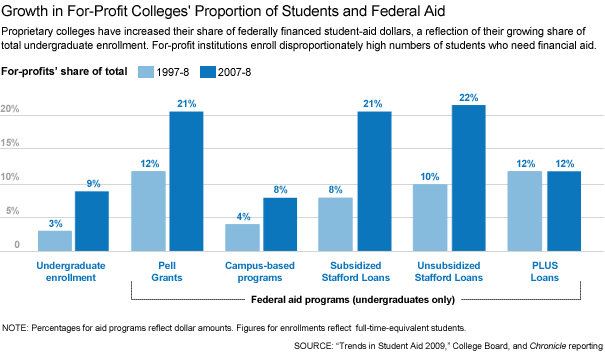
Part of demonstrating that value is attracting top-notch students and most college administrators have determined that 18 years kids are fairly susceptible to bells and whistles like flashy new buildings. We've seen that here at UW-O, which seems to have constructed more new buildings in the last ten years than it had in many decades prior. Then there's the phenomenon one author calls the "prestige racket," wherein "good" schools try to enter the ranks of "elite" schools simply by increasing the cost of their education product. Yet another element is the growth of for-profit schools which increasingly gobbling up a good chunk of the total student loan pie:
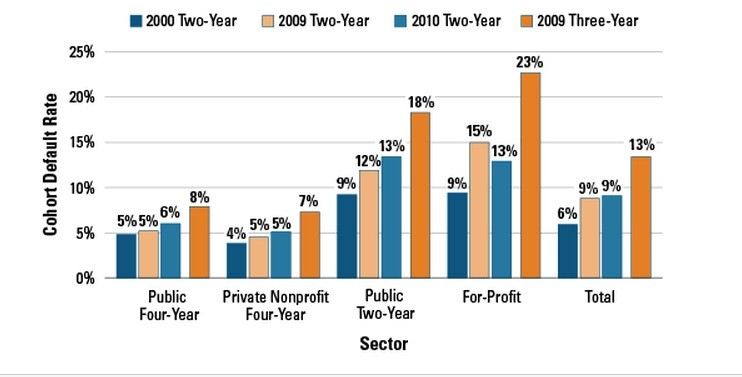
Unfortunately, these for-profit institutions also incur higher loan default rates:
We could on and on with examples -- the fact of the matter is that the student loan bubble is anything but a problem with a "simple solution." The fact of the matter is that a college education is not what it used to be. The value of a college degree has declined while the cost of a diploma has blown up. This is a systemic problem that calls for solutions far more comprehensive and complex than "find a roommate on Craigslist."
People who went to college in the 60's, 70's and 80's enjoyed a far less expensive education than college students do today, and by just about every measure. It's not unreasonable for the kids who are picking up the bill today to be a bit resentful of older generations that got inexpensive degrees, but now don't want to pass on the savings to their kids. To condescendingly demand people with outstanding student loans continue a diet of Ramen noodles for sometimes decades after they leave school betrays an utter lack of understanding of the problem altogether.
Thursday, January 3, 2013
The Ron Johnson Senate Committee Shuffle
The Senator stays on the Senate Homeland Security and Governmental Affairs and Budget committees. Neither are especially sexy these days, but nor are they unimportant. (To read about the the massive faux pas Johnson committed whilst on the Homeland Security panel last fall, go here.)
Johnson also moves from the Aging clique to the Small Business huddle. While this seems like a much more logical place for Johnson, the Aging committee does periodicity meddle in Medicare and Social Security affairs -- precisely the kind of entitlement spending Johnson has expressed on numerous occasions he wishes to reform. The Small Business committee -- which, to be perfectly honest, I only found out existed this afternoon -- seems like a kind of Senate Island of Misfits Toys. I gather Mitch McConnell must have been listening all those times Johnson reminded his colleagues that he's really just a small businessman from the Midwest, etc., etc. and finally did something about it when it came to draw up committee assignments.
Johnson was also given a spot on the Foreign Relations committee ... for some reason. International affairs is something Johnson has avoided like the plague in most cases -- save his conspiracy mongering over Benghazi -- and is an area that is clearly out of his wheelhouse. Then again, the entire GOP side of the committee looks like a knee-jerk anti-Model United Nations team.
Foreign Relations is an odd fit for Johnson, especially since it comes at the expense of his seat on the Appropriations Committee, which is usually considered to be the most powerful committee in the Senate. This is a clear step int he wrong direction given Johnson's skill set. Yes, there is a good deal of prestige being on the FR committee, but simply sitting on the committee does not a Washington Greybeard one make. Usually the prestige comes with making dozens of diplomatic and "fact-finding" trips abroad, meeting with hundreds of foreign leaders and befriending them. Johnson seems to have a hard enough time doing that with members of his own party. A seat on the Appropriations committee guarantees the holder a certain measure of power; one can still be ignored on the FR committee, especially since there really isn't much along the lines of high profile diplomacy on the radar during the next congress.
It's difficult to look at these new committee assignments, at least in aggregate, as anything other than a disappointment. They either mark demotions or deployments to places where Johnson can be supervised by GOP Senators who know what they're doing. Senator is being put in his place and that place is on the back bench.
MORE: Forgot one: Commerce, Science and Transportation ... cue the rocket scientist jokes.
Tuesday, January 1, 2013
What in God's Name was Ron Johnson doing voting for the Fiscal Cliff Deal?
So, Senator Johnson went on CNBC yesterday to sing yet another refrain of his hit single "Washington is broken!" Here's a sample, backed by the world's smallest violin:
So Johnson is basically admitting on national TV that he has no input or pull into the "fiscal cliff" negotiations whatsoever.
Much of the trick to using power effectively is creating the perception that one actually has power. For a sitting United States Senator to go on national television and say "I'm utterly irrelevant" is pretty extraordinary. I'd call it a rookie mistake, but Johnson is no longer a rookie and doesn't show any signs of correcting this issue any time soon.
By the way, Johnson ended up voting for the deal, which makes all the whining he did on cable TV earlier in the day look utterly absurd. It's very difficult to understate just how much this vote undermines Johnson's entire self-stated purpose for being in the Senate. It only took Johnson a matter of 12 hours between complaining about a problem to becoming part of it, at least according to his own estimation.
“It’s an alternate universe. No, this — this place is a joke. I mean, bottom line, this is an absurd process,” Johnson said on CNBC. “It certainly proves the genius of our founding fathers that government should be limited. I mean, the fact that we have this place having such an enormous effect on our economy, on people’s livelihood, is wrong. It’s simply wrong.”Unfortunately, Johnson continued to keep talking and eventually said:
The senator also decried the shady negotiations. “We’re here at the end of the year, a couple of elected officials with their unelected staffs, are doing these deals behind closed doors,” he said. “I don’t know what’s happening behind there. Am I all of a sudden going to get a product sometime in the middle of the day and say, ‘you’ve got to vote on it right away’? I mean, that is an absurd process.”
So Johnson is basically admitting on national TV that he has no input or pull into the "fiscal cliff" negotiations whatsoever.
Much of the trick to using power effectively is creating the perception that one actually has power. For a sitting United States Senator to go on national television and say "I'm utterly irrelevant" is pretty extraordinary. I'd call it a rookie mistake, but Johnson is no longer a rookie and doesn't show any signs of correcting this issue any time soon.
By the way, Johnson ended up voting for the deal, which makes all the whining he did on cable TV earlier in the day look utterly absurd. It's very difficult to understate just how much this vote undermines Johnson's entire self-stated purpose for being in the Senate. It only took Johnson a matter of 12 hours between complaining about a problem to becoming part of it, at least according to his own estimation.
Monday, December 31, 2012
Glenn Grothman's Epistle to the Bigots
I bet most of you didn't know we here at the Chief are amateur archaeologists?
As it happens, we were in the Holy Land during this winter break digging through some dirt when we found a clay jar containing this centuries old letter from a Roman Senator to a group of bureaucratic functionaries in Judea. Below is a rough translation from the original Latin. Judging by the syntax and ancientness of the author's ideas, we've determined it was written in the third or forth century.
****
Why Must We Still Hear About the Christ-mas?
Why are hard-core religious fanatics still trying to talk about the Christ-mas -- the supposed post-Jewish holiday celebration between the Saturnalia and the Aesculapio?
As has been well publicized, the Christ-mas is not some Roman tradition. It was invented in the third year of the reign of the Emperor Trajan to celebrate Jesus of Nazareth, a filthy Jew of peasant birth who wasn't even from Nazareth, but was actually born in Bethlehem (and we all know what kind of filth comes from that corner of the Empire!) who founded something called "Christianity" for reasons I don't care to concern myself with any further. This group, often referred to as the "Christians" is even more radical than the Jews which have troubled our Empire from the top of Mount Mossada! Some Christians have even been imprisoned and eventually put to death in Rome, Alexandria, Patras and Jerusalem for inciting the populace against the Empire with their message of cultural and social revolution. Jesus himself is said to have advocated armed insurrection when he proclaimed: "Think not that I am come to send peace on earth: I came not to send peace, but a sword."
Jesus of "Nazareth" was a racist who believed he was somehow the culmination of Judaism, so he founded a religion his followers claimed to "perfect" the "Word of God" as passed down in the scriptures of the Jews. He also hated having to buy oil to refill his menorah every winter -- hence Christ-mas.
Of course, almost no true Roman in the Judean Provence today cares about the Christ-mas -- just those sympathetic to the false counselors of the Emperor Constantine who try to shove this false holiday down the throats of Roman citizens in an effort to divide the Empire. Irresponsible public school districts such as Thessalonia and Rhodes (and who knows how many others!) try to tell a new generation that Christians can have a separate holiday than Romans.
A renegade Roman, formerly known as Saul and the chief spokesman for the Christians, though long since put to the sword for his crimes against the Empire, encouraged people to learn more about the Christ-mas in letters written during the reign of Emperor Vespasian. Fortunately, almost all Romans ignore Saul and his ilk and their efforts to divide the Empire.
But why do they do it? They don't like the Empire and seek to destroy it by pretending that its values as dictated by the Emperor and his appointed prelates don't apply to everyone. Mainstream Romans must be more outspoken on this issue. It's time the Christ-mas is slapped down once and for all! With tens of millions of honorable Romans in our country's past, we should not let a violent nut like Jesus of Nazareth to speak for them. The temples ought to be particularly appalled since Jesus of Nazareth taught that all men were welcome to join him in the afterlife, a brazen attempt to steal away Romans from the gods of our fathers!
Be on the lookout for anyone who tries to tell your children or grandchildren the Christ-mas is a real holiday!
Strength and Honor,
Glenmarius Homonomicus Grothmanicus
[via]
Thursday, December 27, 2012
Gun Laws in the UK
For obvious reasons, there are few statistics more obscured, obfuscated and truncated than gun crime number, particularly those of countries with strict gun control laws. Take this display from today's Wall Street Journal:
The author is correctish. I haven't been able to find specific numbers for only handguns, but "gun crime" as a whole did double between the implementation of the handgun ban in 1998 and its peak in 2006. However, it's been declining ever since:

It's also important to understand that every new crime law usually labels certain kinds of behavior "criminal" that weren't necessarily considered such before, and Britain does not screw around in terms of enforcement of their gun laws. Behavior that wouldn't get people arrested in most jurisdictions in the United States receives the unapologetic wrath of the Queen's justice. Take the following recent case, for example:
The justness of the verdict aside, this case illustrates the size of the chasm between what constitutes a "gun crime" in the UK versus the American definition of same. If you prefer an even more extreme example, try this one on for size:
But there is also something very interesting to the British approach to "gun control." Take a look at the chart below:
 Ignoring "air weapons," which could include certain kinds of paintball guns (seriously), the most frequent kind of gun offense is due to handguns, but look at how radically different in "% used as" handgun crimes are in relation to other kinds of guns are: almost 80% are threats like the ones described above. In other words, the British approach to violent crime prevent has a lot to do with locking up potential violent criminals at the very first sign that they're headed in the direction of violence.
Why are we here at the Chief so intrigued by this statistic? Because the #1 motive for known causes of homicides in the United States is ... argument. Depending on how you define "arguments" for statistical purposes, they're responsible for between 33-50% of murders in America. The British treat arguments -- or threats -- involving guns, or even the perceived appearance of guns, with deathly seriousness. Here in the United States we all too often do not.
[The] Dunblane [massacre of 1996] had a more dramatic impact. Hamilton had a firearm certificate, although according to the rules he should not have been granted one. A media frenzy coupled with an emotional campaign by parents of Dunblane resulted in the Firearms Act of 1998, which instituted a nearly complete ban on handguns. Owners of pistols were required to turn them in. The penalty for illegal possession of a pistol is up to 10 years in prison.
The results have not been what proponents of the act wanted. Within a decade of the handgun ban and the confiscation of handguns from registered owners, crime with handguns had doubled according to British government crime reports. Gun crime, not a serious problem in the past, now is. Armed street gangs have some British police carrying guns for the first time. Moreover, another massacre occurred in June 2010. Derrick Bird, a taxi driver in Cumbria, shot his brother and a colleague then drove off through rural villages killing 12 people and injuring 11 more before killing himself.
The author is correctish. I haven't been able to find specific numbers for only handguns, but "gun crime" as a whole did double between the implementation of the handgun ban in 1998 and its peak in 2006. However, it's been declining ever since:

It's also important to understand that every new crime law usually labels certain kinds of behavior "criminal" that weren't necessarily considered such before, and Britain does not screw around in terms of enforcement of their gun laws. Behavior that wouldn't get people arrested in most jurisdictions in the United States receives the unapologetic wrath of the Queen's justice. Take the following recent case, for example:
An armed robber was caught out when he threatened a group of 'drug dealers' only to find out they were actually undercover police officers.
David Nestoruk was dishing out his own brand of 'street justice' when he used an imitation firearm to threaten a gang of what he thought were drug pushers completing a deal on the streets of Penwortham, Preston, Lancashire.
The 23-year-old convict cycled past the group flashing an imitation handgun and warned: 'You've got five minutes to get out or I'm going to blast you.'I just want to point out that identifying the man as an "armed robber" is something of a cross between a sensationalist touch indicative of the British press and a convention used to describe a man with a long rap sheet and a thin employment history. He was actually not robbing anyone during the incident in question. What's more:
He also said the imitation gun, which was a gas powered BB gun, was in effect a 'toy gun.'
Police say the imitation firearm still has not been recovered.
Judge Jonathan Gibson, in handing out a 22-month prison sentence, said: 'These police officers believed this gun to be real, leaving them scared and shaken.'A case like this might not even reach the point of arrest depending on the neighborhood and race of the offender in the United States, where it would likely be resolved as a misunderstanding. In Britain, the man was sentenced to two years in prison.
The justness of the verdict aside, this case illustrates the size of the chasm between what constitutes a "gun crime" in the UK versus the American definition of same. If you prefer an even more extreme example, try this one on for size:
Ian Poulton, 33, was arrested after more than 15 armed officers wearing bullet-proof vests and aiming machine guns at him swooped on a quiet street in Telford, Shrops, in May this year.
Police were alerted after residents reported seeing a man with a weapon tucked into the waistband of his trousers. He was said to have been threatening Jose Luis Candelaria, his neighbour.
But the operation took an unusual turn when officers discovered Poulton was actually in possession of a sexual appliance.
Poulton was jailed for five years after he admitted possessing an item which had the appearance of a handgun with intent to cause fear of violence at Shrewsbury Crown Court.
He also admitted assaulting Mr Candelaria, causing him actual bodily harm.
Jailing Poulton on Wednesday, Judge Robin Onions told him: "It was clearly not a gun, be it imitation or real. It was an entirely innocent object. It was the defendant's intention to deceive. Witnesses thought it was a firearm so he has to take the consequences."Even the most rabid gun control advocate in the United States would consider 5 years for battery with a deadly dildo to be a bit extreme.
But there is also something very interesting to the British approach to "gun control." Take a look at the chart below:

Why are we here at the Chief so intrigued by this statistic? Because the #1 motive for known causes of homicides in the United States is ... argument. Depending on how you define "arguments" for statistical purposes, they're responsible for between 33-50% of murders in America. The British treat arguments -- or threats -- involving guns, or even the perceived appearance of guns, with deathly seriousness. Here in the United States we all too often do not.
Thursday, December 13, 2012
Jonathan Krause Really Should Learn How to Read
It's been a while since we've taken a whack at the Jonathan Krause pinata, but since today's edition of his drivel is such low-hanging fruit, we thought we'd bring out ye ole' Ugly Stick and take some batting practice. (Mixed metaphors -- we love 'em!)
Here are the first two graphs of JK's post:
This graph deserves a line-by-line examination.
More importantly, however, is the fact that Krause completely misrepresents what he is trying to report. He reports that One Wisconsin found that "the average college graduate takes 19-years to pay off their student loans--at monthly payments of $388." Except this is not what One Wisconsin is claiming. Here is OWN's finding, emphasis added:
Moving on:
But there are a number of legitimate reasons for the discrepancy that Krause appears oblivious to. The first is that the $88,000+ is total paid by Wisconsin graduates, some of whom have advanced degrees, over the lifetime of the loan, which includes accumulated interest; while the $26,000 is an average debt owed among national undergraduates on the day they leave school. It took us all of 15 seconds to discover the reason behind this discrepancy, but that doesn't Krause from ignoring possible root causes and proceeding directly to one of his trademark gross mischaracterizations of poorly interpreted information:
Here are the first two graphs of JK's post:
There is a Biblical verse that Dave Ramsey (2-5 weekdays on WOSH) likes to quote all of the time: "The borrower is slave to the lender." In Biblical times, that had very literal meaning, as those who owed someone could be forced into slavery to repay a debt. This week, the folks at the activist group One Wisconsin took it nearly that far, comparing student loan borrowers to "indentured servants".There's nothing to really add about the first graph, but do please note that Krause will be referring to the op-ed he himself links to above.
The group conducted a small amount of research and found that the average college graduate takes 19-years to pay off their student loans--at monthly payments of $388. My calculator tells me that is a total repayment of more than 88-thousand dollars over the life of the loans. The only problem is, that doesn't jibe with the national averages cited in dozens of other locations: that the average college debt is $26,600 dollars--and the average time to pay that off is 11-years. As the Left often likes to do, it appears One Wisconsin made sure to find as many people in the deepest possible holes to make the situation look as dire as possible.
This graph deserves a line-by-line examination.
The group conducted a small amount of research and found that the average college graduate takes 19-years to pay off their student loans--at monthly payments of $388.First, what Krause calls a "small amount of research" is actually a survey of 2,658 people in the state of Wisconsin. That's considerably larger than the sample size of most political opinion polls. The biennial St. Norbert's Wisconsin Survey typically only reaches about 400 respondents, while Charles Franklin's monthly polls for Marquette Law School contact upwards of 1200+.
More importantly, however, is the fact that Krause completely misrepresents what he is trying to report. He reports that One Wisconsin found that "the average college graduate takes 19-years to pay off their student loans--at monthly payments of $388." Except this is not what One Wisconsin is claiming. Here is OWN's finding, emphasis added:
Nearly one-third of those with a bachelor's or advanced degree are now making a student loan payments, and that payments average $388 per month.
The length of student loan debt was nearly 19 years for people with bachelor's degrees and over 22 years for those with graduate or professional degrees.
Moving on:
My calculator tells me that is a total repayment of more than 88-thousand dollars over the life of the loans.He's right -- it's $88,464 to be precise, but the problem here is that Krause is multiplying apples and oranges and arriving at just one convenient fruit. Remember, the $388/month figure includes loanees with "bachelor's or advanced degrees" while the 19 year number is just for "average college graduates," and since the "average" college graduate doesn't have a graduate degree, it's doubtful these numbers are commensurate.
The only problem is, that doesn't jibe with the national averages cited in dozens of other locations: that the average college debt is $26,600 dollars--and the average time to pay that off is 11-years."Dozens of other locations" and yet Krause can't even bring himself to link to one of them? It's make you wonder where he got the $26,000 figure in the first place. Well, if you followed the link he provides in the first paragraph you'll discover that he got it from something called the Institute for College Access and Success by way of ... One Wisconsin.
But there are a number of legitimate reasons for the discrepancy that Krause appears oblivious to. The first is that the $88,000+ is total paid by Wisconsin graduates, some of whom have advanced degrees, over the lifetime of the loan, which includes accumulated interest; while the $26,000 is an average debt owed among national undergraduates on the day they leave school. It took us all of 15 seconds to discover the reason behind this discrepancy, but that doesn't Krause from ignoring possible root causes and proceeding directly to one of his trademark gross mischaracterizations of poorly interpreted information:
As the Left often likes to do, it appears One Wisconsin made sure to find as many people in the deepest possible holes to make the situation look as dire as possible.Unfortunately, this episode is a much better example of an idiot radio news-reader who didn't take the time to, you know, read a story carefully and simply contorted the data to fit his worldview. The bulk of the post is Krause riding his "fuck you, you lazy fucks!" Though, I guess it reads a little hollow coming from such a very lazy reader as Krause.
Thursday, November 29, 2012
Ron Johnson's Second Year in Office all but Proves He won't be Serving a Second Term in the Senate
Last year we took a long look at Senator Ron Johnson's first year in office and the results weren't pretty. That meant Johnson really needed to come on strong during his second year in order to enhance his reputation and in Washington and back home in Wisconsin and if ever the political gods answered prayers, then this year was it: between the failed recall effort of Governor Walker and it's status as a hotly contested swing state, Wisconsin was a cauldron of political activity and the focus of nation-wide partisan rancor. Johnson didn't need to fight to grab the political press' attention: for once they were already looking at this corner of the country. It was the perfect time to seize the initiative and prove one's value as a leader.
And Johnson blew it. Massively.
Below are the five most significant issues that are sinking the U.S.S Ron Johnson. At times it seemed we could have extended the list ad infinitum. It includes incidents some readers undoubtedly are familiar with and at least one they probably aren't. (Admittedly, we really buried the lede on Johnson's reckless leaking of sensitive information as a member of the Homeland Security committee, an issue no one in Wisconsin seems to have discussed yet.) All of them have proved him to be an incompetent politician, clueless legislator and utterly out-of-touch elitist who is doing his best to alienate soft supporters and independents.
We've listed them in order of importance.
2011 ended for Johnson with a losing bid for the #5 position in the GOP Senate leadership. Apparently having not understood the hint, Johnson began 2012 by proposing a congressional campaign strategy called "America's Choice" that went exactly nowhere. The plan telegraphed Johnson's preference for eschewing policy-crafting in favor of inside baseball Beltway politics, but revealed a clumsy strategist unconcerned about the details. Yet despite a clear desire to enhance his profile as a political heavyweight Johnson curiously refrained from endorsing any of the GOP presidential candidates until April 1st, by which time Mitt Romney (clearly his preferred candidate from the get-go) had already essentially locked up the nomination. He did the same during the Wisconsin Senate GOP primary, even though most observers believed he felt more of a kinship with Eric Hovde and could have helped push him over the top during a very close election. Instead, he wound up campaigning for Tommy Thompson during the general, someone Johnson was, at best, "lukewarm" about.
Thompson, of course, lost to Tammy Baldwin, someone Johnson clearly has nothing but disdain for. Staying on the sidelines of the Senate race may have been the right move, considering Thompson's history in Wisconsin and the lifetime of allies and connections he's accrued -- we'll concede that. But if that was the case, he should have backed Thompson from the beginning and spared the GOP a contentious primary that did a great deal to diminish their eventually nominee and give Tammy Baldwin a wide berth to the Senate.
The most telling, and consequential, episode of the year for Johnson was a bizarre report in Roll Call describing the Senator's plans to "purge" his Washington, DC staff. The ensuing article did not paint a flattering portrait of life in Johnson's office or his ability to negotiate the Halls of Power. Worst of all, the subtext of the piece made it appear like Johnson got played by one of his subordinates -- clearly, someone working for him was not enthusiastic about the prospect of losing his or her job and leaked the story to buy some time on the government payroll while he or she explored options elsewhere -- a rather substantial humiliation for a member of "the world's most exclusive club."
How Johnson reacted to this episode is extraordinarily telling. First he denied any mass personnel changes as rumor (natch) and then cited his close loss in the Senate GOP leadership election as a indication of progress and stability. He then noted that Minority Leader Mitch McConnell had appointed him as a liaison between Mitt Romney's campaign and Senate conservative. Unfortunately, Roy Blunt, the man who beat Johnson for the #5 GOP leadership position in the Senate was given the exact same position. Meanwhile, in the House of Representatives, Team Romney selected Rep. Cathy McMorris Rodgers to Johnson's and/or Blunt's equivalent position, despite there being almost 200 more conspicuously unruly Republicans to keep in line. Why the Senate would require two people when the House only need one suggests that Johnson was simply given a title without any real responsibilities to placate the tea party faction of the party, while Blunt did the heavy lifting.
Johnson was largely absent from the Wisconsin political scene during the first six months of the year, it's most contentious period in living memory. For a time he made a number of appearances across the country at fundraisers, both for individual GOP candidates and state parties (including speaking engagements at the Texas and New York state GOP conventions, where deep-pocketed GOP donors can be met and cultivated), but during the weeks before Scott Walker's recall election he was little seen stumping for the governor, either in Wisconsin or on TV from Washington. Again, this may have been part of Walker's strategy to paint the recall effort as organized from Washington, but a more experienced politician would have insisted on playing some role during what was always very clearly going to be a Walker win so as to claim some portion, however tiny, of the victory.
By the time colleague Paul Ryan was chosen as the GOP VP nominee in August, Johnson was poised to find a promotion as a kind of campaign surrogate, a validator of Ryan's (and thereby Romney's) strong character, high morals, etc. But that never really happened. For the remainder of the presidential campaign, and especially during the all important month of October, Johnson was confined to stumping in Wisconsin and going on the kind of college campus tour usually left for celebrity surrogates and not elected officials. Granted, this might have had a large part to do with Ryan's diminishing role during the Romney campaign following the re-emergence of "Moderate Mitt" during the debates.
All of which begs the question: why couldn't Johnson book better gigs?
The answer likely goes back to Johnson's touch-and-go staff purge during the spring. At the time of the Roll Call article, Johnson categorically denied the reports, but as 2012 wore on most of the members of his senior staff quietly split under the din of the Presidential election. Just in October alone Johnson lost a policy adviser, his communications director and his chief of staff. In other words, Johnson did end up purging his staff, he just waited a few months for the dust to settle.
Johnson has no inside game. His relationship with Senate Minority Leader Mitch McConnell, who ostensibly functions as Johnson's boss, is clearly very weak. Again, it's important to point out one of the most damning indictments from the April Roll Call article on Johnson's staff upheaval:
When Johnson arrived in Washington two years ago he hired Don Kent to run his DC office:
Johnson's new chief of staff is Ken McKay, who once resigned as RNC chief of staff following a minor, but noteworthy, scandal involving party funds being spent at a Hollywood bondage club. McKay worked at the RNC at the same time that current chair Reince Priebus was general counsel and it would be reasonable to assume he received a recommendation from his former colleague. McKay was at least rumored to be taking over as Chief of Staff as long as a year ago (then again in April.) We've talked about the staffer death spiral before and this certainly seems like like another phase in that long downward trajectory of an employer who is quick to reward friends (or a least friends of friends) at the expense of merit.
Why is all of this important? Because Johnson's office has clearly been in the middle of a transitional period at least as far back as April and as a consequence missed a golden opportunity to enhance his profile and demonstrate leadership. A freshman member of the senate can't do that by himself. He needs a team that will promote him to the media and bring him into the important meetings. If your staff knows its not going to be around in a few months, they have no incentive to build you up. During the run-up to the Supreme Court's Obamacare hearing at the end of March, Johnson's team managed to get their boss all kinds media attention, but after the Roll Call article Johnson seemed to disappear and was left "wandering radio row ... doing interviews with right-wing hosts as someone who knows Paul Ryan" during the RNC.
Most politicians in DC would sell their children for the kind of fortune Ron Johnson enjoyed this year. Yet instead of capitalizing Johnson's just watched the pitch sail over the plate. It took him no less than six months to get his house in order and those six months just happened to be the single most important time of his political career. If Johnson can't manage his own staff then he doesn't have a prayer managing other members of the Senate.
That's already happening. Remember Johnson's close loss to Roy Blunt for a leadership position at the end of 2011? Well, the GOP have already held their leadership elections in the wake of their 2012 drubbing and once again Blunt will be the Senate's GOP conference vice chair. This time Johnson didn't even bother challenging him.
Nearly all of Johnson's significant issues in Washington revolve around his inability to surround himself with the right people and there was no better example of this than the Senator's foray into National Security issues this year.
Since Johnson never managed to become the authority on economic issues that he'd like to be, it was only a matter of time before the Senator wandered into national security, an area Johnson has never demonstrated much aptitude for. In February Johnson got his feet wet by using the tried and true Republican tactic of trying to make Democrats look weak by criticizing their proposed cuts to the DoD. Johnson wants to increase the defense budget. The problem with this stance is that it's completely incompatible to Johnson's hard line on every other aspect of government spending, which goes a long way to rendering Johnson's arguments on the matter utterly useless.
But that didn't stop Johnson from trying to wield the national security cudgel, especially for brazenly political purposes. With one notable exception, Johnson's forays into security issues have all centered around matters that conservatives clearly hoped to become scandals that would envelop the Obama administration.
As a member of the Homeland Security Committee, Johnson got in front of the Secret Service prostitution scandal in May. This was a delicate and sensitive issue that Johnson appeared to negotiate with a certain degree of skill, though a matter with which Johnson clearly sought to embarrass the White House. Unfortunately for Johnson the resolution of the scandal, as is wont to happen in Washington, was pushed back until after the election.
During the last week of September just as Chief of Staff Don Kent was leaving the office, Johnson signed on to a letter co-written by Senators McCain, Graham and Ayotte looking to clarify certain "inconsistencies" in the public record over the recent terrorist attack in Benghazi, Libya. The statement was made three days after the NY Times reported that what had been thought to be a State Department consulate was actually a CIA station, meaning that much of the details surrounding the attack were classified and not fodder for public consumption.
Nevertheless, these four senators continued to hammer the Administration over the public statements in the immediate aftermath of the incident through the remainder of the election -- which most observers saw as a transparent attempt to turn the issue into a kind of "October surprise." (Likely because public polling told them Obama was losing foreign policy cred on the matter.) The four senators continued to press the issue up until the election. Johnson even made a memorable, if not odd, TV appearance proclaiming Benghazi to be more important than abortion to Wisconsin voters.
Maybe here would be a good time to remind readers that Johnson insisted that the Senate not discuss Libya until the nation's budget issues were resolved during a 2011 floor speech.
Following Obama's victory, the Benghazi strategy morphed into a very personal, and apparently vindictive, attack on Susan Rice; but Johnson was curiously absent from Rice's itinerary when she went to Capitol Hill to call on her critics. It's likely that Johnson just didn't have the heart to keep playing a game that had lost its potential to cause immediate political damage to the Obama Administration/Campaign. Regardless of the reason, the episode has proved to foreshadow a far larger and much more consequential bungle by the Johnson office.
This matter has flown almost completely under the radar since it occurred just a few weeks before the election, but it's one that's certainly deserves a lot more attention as it suggests that Senator Johnson is willing to compromise classified information for political gain.
Recall last spring when Secret Service agents were busted patronizing prostitutes while off-duty during a Presidential visit to Cartegena. Well, one of the committees Senator Johnson sits on, the Homeland Security and Governmental Affairs committee, has oversight responsibilities over the Secret Service and Johnson was quick to call the various parties involved to account. He also looked into possible White House involvement into the scandal, though found none. Following hearing on Capitol Hill, and investigation by the office of the Inspector General was launched into the matter that was not due to be finished and released until summer of 2013.
The length of the investigation should surprise anyone whose followed IG reports, especially into issues that involve classified or sensitive information. The delay, however, apparently did not sit well with Johnson, especially after a September FOX News report that claimed the investigation "may" have uncovered participation by members of the White advance team and that the delay in the Inspector General's investigation
There was one significant problem: the details of Johnson's memo to the Homeland Security Committee were, very clearly, not yet vetted for public consumption. Sen. Joe Lieberman, who is as vigilant about Homeland security issues as anyone, was not happy:
In all likelihood this would not have happened had Don Kent, a seasoned professional in the homeland security community, would have still been Chief of Staff. Leaking distorted and sensitive information for political gain seems something more along the lines a career political operative, like Johnson's current Chief of Staff Ken McKay, would have signed-off on.
For Johnson, national security policy takes a backseat to national security politics. He really only seems interested in issues that can discredit his opponents to one degree or that can advance his own ideology in a tangentially related field.
The lone exception to this rule was Johnson's work on cybersecurity. Truth be told, this is one of the rare instances where Johnson actually looked like he had found some Senator-material in his being. He found an important, but largely unsexy, issue and appeared to be going through the steps of mastering the technicalities of the problems, arriving at a possible solution and selling a plan to his colleagues. Despite some reasonable privacy concerns, the bill Johnson co-sponsored seemed fairly reasonable answer (all things considering) to a serious problem. This is the kind of legislative blocking and tackling that Johnson should have been doing since his first day in office, but it remains to be seen to what extent Johnson will commit to the issue now that his principle homeland security adviser has left the office. It's a pity that Johnson all but abandoned the cybersecurity initiative to go on fishing expeditions on other national security issues.
Johnson has proclaimed on numerous occasions that his primary motivation for getting into politics was the outrage he felt over Obamacare. He has used apocalyptic language to describe the bill and was even at the Supreme Court building the day the ruling was handed down hoping, no doubt, to say "I told you so!" in front of as many TV cameras as he could, but after the Supreme Court's summer ruling that the Affordable Care Act was, in fact, constitutional, Johnson could only muster a a silly soundbite and a short statement in a press release.
For all practical purposes, Obamacare is now the law of the land and it's implementation will take years (if not decades). There's very little that Johnson can do about it now. This pretty much voids his raison d'etre in the Senate. Johnson has lost a great deal of face on the matter and coming up with causes to fight for hasn't been Johnson's forte (see above). Take for example, Johnson's cause du jour in January: domestic oil production. The Senator claimed American energy interests were being squandered at the alter of green energy. That view seems quaint now only ten months later when oil production stateside is projected to eclipse Saudi Arabia's by the end of the decade. (In all likelihood, oil production was just a talking point designed to segue-way into political attacks over Solyndra loans.) If Johnson's record as an oracle is reliable, then Obamacare might just be the gold standard of health care throughout the world by 2030.
We've talked at length about this issue here.
From a strictly electoral standpoint, Johnson did himself few favors with female voters this year. What's more, it's probably not going to get better. Here are some of the notable incidents that are all but certain to come back to haunt him during re-election bids in the future:
Take, for example, a presentation Johnson is known to give before various groups, ranging from college students to Rotary Clubs, when traveling around the state. Here's an account of one rendition delivered at Marquette University:
Did I mention this is a speech that Johnson gives frequently?
Any one of these examples, taken by themselves, may (and let us stress here may) not be a big deal; but when examined as a series of recurring events they start to paint a narrative of Johnson being anti-women. Given the important role that single women played during the 2012 election, that's a dangerous position for any politician to be in.
It's next to impossible to walk away from 2012 thinking the Johnson brand is anything but a sorry one. During an interview with the lavishly sympathetic Wall Street Journal two weeks before the election, Johnson came off as sullen, unhappy in Washington, morose, even a bit despondent. This was the lead:
Johnson's opponents are now openly mocking him as "dumb" -- a rather sophomoric insult that was until recently was something liberals were content to keep to themselves, suggesting that it might be a more common belief than it was two years ago. Whenever Johnson is in the news it's usually for reasons that make people wince. His approval ratings are down to 38% from as high as 45% 16 months ago. None of these are good signs.
But the worst sign was Johnson truly insipid analysis of the 2012 election:
Johnson has spent the last two years molding a reputation as a Senator who doesn't like the people he's working with, doesn't like the people working for him and, most importantly, doesn't like the people he's working for. Every time he is asked to explain a phenomenon that doesn't quiet conform to his expectations or worldview he comes off as frustrated, inconvenienced, irritable, incurious, insulting and in a state of complete denial that transcends mere spin. The Ron Johnson brand is a shambles.
This is what Wisconsin is stuck with for the next four years: an ineffective Senator who has little interest in crafting any -- not just good, but any -- legislation and whom is using his incredibly powerful position in Washington to merely air his personal grievances against Americans he seems to know little or care about.
We don't expect Johnson to bother running for re-election in 2016 and can even see him cutting his term in Washington short under certain circumstances. If there are any lessons to be learned from 2012 election it's that the tea party wave that washed Johnson on the shores of the Potomac is rapidly receding. Johnson still one of the low men on the Senate's seniority totem pole and his ideology is already ancient history, something the GOP is running away from as fast as it can these days. But don't expect any conversions from Johnson. That inability to adjust with the zeitgeist is going to continue to alienate Johnson among his colleagues and push him further to the fringes.
2013 should have been a break-out year for Johnson. Instead, he's simply going to be the Senator with the eighth-least seniority in the minority party. The GOP was supposed to build on the gains it made in 2010 and won back the Senate, which would have propelled tea party Senators like Johnson to places of influence in the Senate and party leadership. That didn't happen. Now the GOP is panicking about demographic shifts, a sizable technology gap, an unaccountable consultant class, and a fundamental changes to conservatism's core ideology. All of that is far, far removed from what Johnson's called "America's Choice" -- or what the Senator thought in January was going to be a successful plan to win over voters.
Johnson still has time to pull himself out of the death spiral which his career in the Senate. That's one of the benefits of being in the Upper House: time. But there is no evidence to suggest that Johnson has the ability, inclination or patience to use that time effectively. Don't expect 2013 to be much different from 2012 in Johnson's office, which is something we'll probably be repeating 12 months from now.
And Johnson blew it. Massively.
Below are the five most significant issues that are sinking the U.S.S Ron Johnson. At times it seemed we could have extended the list ad infinitum. It includes incidents some readers undoubtedly are familiar with and at least one they probably aren't. (Admittedly, we really buried the lede on Johnson's reckless leaking of sensitive information as a member of the Homeland Security committee, an issue no one in Wisconsin seems to have discussed yet.) All of them have proved him to be an incompetent politician, clueless legislator and utterly out-of-touch elitist who is doing his best to alienate soft supporters and independents.
We've listed them in order of importance.
Johnson has no inside game
2011 ended for Johnson with a losing bid for the #5 position in the GOP Senate leadership. Apparently having not understood the hint, Johnson began 2012 by proposing a congressional campaign strategy called "America's Choice" that went exactly nowhere. The plan telegraphed Johnson's preference for eschewing policy-crafting in favor of inside baseball Beltway politics, but revealed a clumsy strategist unconcerned about the details. Yet despite a clear desire to enhance his profile as a political heavyweight Johnson curiously refrained from endorsing any of the GOP presidential candidates until April 1st, by which time Mitt Romney (clearly his preferred candidate from the get-go) had already essentially locked up the nomination. He did the same during the Wisconsin Senate GOP primary, even though most observers believed he felt more of a kinship with Eric Hovde and could have helped push him over the top during a very close election. Instead, he wound up campaigning for Tommy Thompson during the general, someone Johnson was, at best, "lukewarm" about.
Thompson, of course, lost to Tammy Baldwin, someone Johnson clearly has nothing but disdain for. Staying on the sidelines of the Senate race may have been the right move, considering Thompson's history in Wisconsin and the lifetime of allies and connections he's accrued -- we'll concede that. But if that was the case, he should have backed Thompson from the beginning and spared the GOP a contentious primary that did a great deal to diminish their eventually nominee and give Tammy Baldwin a wide berth to the Senate.
The most telling, and consequential, episode of the year for Johnson was a bizarre report in Roll Call describing the Senator's plans to "purge" his Washington, DC staff. The ensuing article did not paint a flattering portrait of life in Johnson's office or his ability to negotiate the Halls of Power. Worst of all, the subtext of the piece made it appear like Johnson got played by one of his subordinates -- clearly, someone working for him was not enthusiastic about the prospect of losing his or her job and leaked the story to buy some time on the government payroll while he or she explored options elsewhere -- a rather substantial humiliation for a member of "the world's most exclusive club."
How Johnson reacted to this episode is extraordinarily telling. First he denied any mass personnel changes as rumor (natch) and then cited his close loss in the Senate GOP leadership election as a indication of progress and stability. He then noted that Minority Leader Mitch McConnell had appointed him as a liaison between Mitt Romney's campaign and Senate conservative. Unfortunately, Roy Blunt, the man who beat Johnson for the #5 GOP leadership position in the Senate was given the exact same position. Meanwhile, in the House of Representatives, Team Romney selected Rep. Cathy McMorris Rodgers to Johnson's and/or Blunt's equivalent position, despite there being almost 200 more conspicuously unruly Republicans to keep in line. Why the Senate would require two people when the House only need one suggests that Johnson was simply given a title without any real responsibilities to placate the tea party faction of the party, while Blunt did the heavy lifting.
Johnson was largely absent from the Wisconsin political scene during the first six months of the year, it's most contentious period in living memory. For a time he made a number of appearances across the country at fundraisers, both for individual GOP candidates and state parties (including speaking engagements at the Texas and New York state GOP conventions, where deep-pocketed GOP donors can be met and cultivated), but during the weeks before Scott Walker's recall election he was little seen stumping for the governor, either in Wisconsin or on TV from Washington. Again, this may have been part of Walker's strategy to paint the recall effort as organized from Washington, but a more experienced politician would have insisted on playing some role during what was always very clearly going to be a Walker win so as to claim some portion, however tiny, of the victory.
By the time colleague Paul Ryan was chosen as the GOP VP nominee in August, Johnson was poised to find a promotion as a kind of campaign surrogate, a validator of Ryan's (and thereby Romney's) strong character, high morals, etc. But that never really happened. For the remainder of the presidential campaign, and especially during the all important month of October, Johnson was confined to stumping in Wisconsin and going on the kind of college campus tour usually left for celebrity surrogates and not elected officials. Granted, this might have had a large part to do with Ryan's diminishing role during the Romney campaign following the re-emergence of "Moderate Mitt" during the debates.
All of which begs the question: why couldn't Johnson book better gigs?
The answer likely goes back to Johnson's touch-and-go staff purge during the spring. At the time of the Roll Call article, Johnson categorically denied the reports, but as 2012 wore on most of the members of his senior staff quietly split under the din of the Presidential election. Just in October alone Johnson lost a policy adviser, his communications director and his chief of staff. In other words, Johnson did end up purging his staff, he just waited a few months for the dust to settle.
Johnson has no inside game. His relationship with Senate Minority Leader Mitch McConnell, who ostensibly functions as Johnson's boss, is clearly very weak. Again, it's important to point out one of the most damning indictments from the April Roll Call article on Johnson's staff upheaval:
While top Republican sources expressed exasperation at the internal turmoil in Johnson’s office, they also noted that the Wisconsin freshman has not been diligent in building relationships with other Senators within the Conference and has alienated himself by not reaching out more frequently to colleagues.
“He’s an interesting case study of someone who has talked more than he has listened, lectured more than he has developed relationships with his colleagues, and now he’s having a tough time because of that behavior in advancing his policy goals,” one senior GOP aide said. “It’s kind of like watching a temper tantrum by a 2-year-old in the middle of the grocery store.”
“The Senate is still about relationships, and he doesn’t seem to get that,” the aide continued.Why is this important? Because it's indicative of someone whose slipped into a siege or bunker mentality. By failing to reach out to his colleagues and their staffs Johnson is depriving himself of top flight talent and blockading himself from possible points of access. No sign is more evident of this insularity than Johnson's recent change of his Chief of Staff.
When Johnson arrived in Washington two years ago he hired Don Kent to run his DC office:
Don Kent worked for five years in the U.S. Department of Homeland Security. His responsibilities included helping department officials prepare for Senate confirmations. He also served as the principal legislative advisor to then-Secretary Michael Chertoff.This was important because Johnson was appointed to the Homeland Security and Governmental Affairs Committee. But Kent left at the beginning of October and, as we'll see a little later on, took with him a good deal of the Johnson office's national security tact with him.
Johnson's new chief of staff is Ken McKay, who once resigned as RNC chief of staff following a minor, but noteworthy, scandal involving party funds being spent at a Hollywood bondage club. McKay worked at the RNC at the same time that current chair Reince Priebus was general counsel and it would be reasonable to assume he received a recommendation from his former colleague. McKay was at least rumored to be taking over as Chief of Staff as long as a year ago (then again in April.) We've talked about the staffer death spiral before and this certainly seems like like another phase in that long downward trajectory of an employer who is quick to reward friends (or a least friends of friends) at the expense of merit.
Why is all of this important? Because Johnson's office has clearly been in the middle of a transitional period at least as far back as April and as a consequence missed a golden opportunity to enhance his profile and demonstrate leadership. A freshman member of the senate can't do that by himself. He needs a team that will promote him to the media and bring him into the important meetings. If your staff knows its not going to be around in a few months, they have no incentive to build you up. During the run-up to the Supreme Court's Obamacare hearing at the end of March, Johnson's team managed to get their boss all kinds media attention, but after the Roll Call article Johnson seemed to disappear and was left "wandering radio row ... doing interviews with right-wing hosts as someone who knows Paul Ryan" during the RNC.
Most politicians in DC would sell their children for the kind of fortune Ron Johnson enjoyed this year. Yet instead of capitalizing Johnson's just watched the pitch sail over the plate. It took him no less than six months to get his house in order and those six months just happened to be the single most important time of his political career. If Johnson can't manage his own staff then he doesn't have a prayer managing other members of the Senate.
That's already happening. Remember Johnson's close loss to Roy Blunt for a leadership position at the end of 2011? Well, the GOP have already held their leadership elections in the wake of their 2012 drubbing and once again Blunt will be the Senate's GOP conference vice chair. This time Johnson didn't even bother challenging him.
Johnson's Enormous National Security Blunder
Since Johnson never managed to become the authority on economic issues that he'd like to be, it was only a matter of time before the Senator wandered into national security, an area Johnson has never demonstrated much aptitude for. In February Johnson got his feet wet by using the tried and true Republican tactic of trying to make Democrats look weak by criticizing their proposed cuts to the DoD. Johnson wants to increase the defense budget. The problem with this stance is that it's completely incompatible to Johnson's hard line on every other aspect of government spending, which goes a long way to rendering Johnson's arguments on the matter utterly useless.
But that didn't stop Johnson from trying to wield the national security cudgel, especially for brazenly political purposes. With one notable exception, Johnson's forays into security issues have all centered around matters that conservatives clearly hoped to become scandals that would envelop the Obama administration.
As a member of the Homeland Security Committee, Johnson got in front of the Secret Service prostitution scandal in May. This was a delicate and sensitive issue that Johnson appeared to negotiate with a certain degree of skill, though a matter with which Johnson clearly sought to embarrass the White House. Unfortunately for Johnson the resolution of the scandal, as is wont to happen in Washington, was pushed back until after the election.
During the last week of September just as Chief of Staff Don Kent was leaving the office, Johnson signed on to a letter co-written by Senators McCain, Graham and Ayotte looking to clarify certain "inconsistencies" in the public record over the recent terrorist attack in Benghazi, Libya. The statement was made three days after the NY Times reported that what had been thought to be a State Department consulate was actually a CIA station, meaning that much of the details surrounding the attack were classified and not fodder for public consumption.
Nevertheless, these four senators continued to hammer the Administration over the public statements in the immediate aftermath of the incident through the remainder of the election -- which most observers saw as a transparent attempt to turn the issue into a kind of "October surprise." (Likely because public polling told them Obama was losing foreign policy cred on the matter.) The four senators continued to press the issue up until the election. Johnson even made a memorable, if not odd, TV appearance proclaiming Benghazi to be more important than abortion to Wisconsin voters.
Maybe here would be a good time to remind readers that Johnson insisted that the Senate not discuss Libya until the nation's budget issues were resolved during a 2011 floor speech.
Following Obama's victory, the Benghazi strategy morphed into a very personal, and apparently vindictive, attack on Susan Rice; but Johnson was curiously absent from Rice's itinerary when she went to Capitol Hill to call on her critics. It's likely that Johnson just didn't have the heart to keep playing a game that had lost its potential to cause immediate political damage to the Obama Administration/Campaign. Regardless of the reason, the episode has proved to foreshadow a far larger and much more consequential bungle by the Johnson office.
This matter has flown almost completely under the radar since it occurred just a few weeks before the election, but it's one that's certainly deserves a lot more attention as it suggests that Senator Johnson is willing to compromise classified information for political gain.
Recall last spring when Secret Service agents were busted patronizing prostitutes while off-duty during a Presidential visit to Cartegena. Well, one of the committees Senator Johnson sits on, the Homeland Security and Governmental Affairs committee, has oversight responsibilities over the Secret Service and Johnson was quick to call the various parties involved to account. He also looked into possible White House involvement into the scandal, though found none. Following hearing on Capitol Hill, and investigation by the office of the Inspector General was launched into the matter that was not due to be finished and released until summer of 2013.
The length of the investigation should surprise anyone whose followed IG reports, especially into issues that involve classified or sensitive information. The delay, however, apparently did not sit well with Johnson, especially after a September FOX News report that claimed the investigation "may" have uncovered participation by members of the White advance team and that the delay in the Inspector General's investigation
sparked speculation the report was being altered or manipulated to conceal or minimize the roles of some of those involved, multiple Secret Service officials with senior leadership positions told FoxNews.com. Meanwhile, Senators Susan Collins of Maine and Joseph Lieberman of Connecticut, of the Senate Homeland Security Committee sent Edwards a letter on Sept. 14 asking for information about the status of the report.
A congressional source told FoxNews.com the Senate committee staff is particularly eager to see the report because it "includes information that two members of the White House advance team had prostitutes overnight."
"The Committee wants to know if White House staff engaged in improper conduct in Cartagena, which the White House previously denied," the source added.A month later Johnson's office released a memo outlining various "inconsistencies" -- remarkably similar to the one described in the initial September FOX report -- between sworn statements given by the Secret Service director to a congressional hearing and what was apparently IG's report and raised further questions about a cover-up of White House involvement in the scandal.
There was one significant problem: the details of Johnson's memo to the Homeland Security Committee were, very clearly, not yet vetted for public consumption. Sen. Joe Lieberman, who is as vigilant about Homeland security issues as anyone, was not happy:
In a memo to the full committee today, Sen. Ron Johnson (R-Wis.) laid out several points that he said are detailed in a report written by the Department of Homeland Security’s Office of the Inspector General.
The memo said the first phase of that report was completed late last month, and that subcommittee staff reviewed it at the inspector general’s office. Staffers were not allowed to keep a copy of the report, however, and the document has not been made public.
Lieberman (I-Conn.) blasted Johnson’s memo, calling it an “unauthorized leak of sensitive, selective information from the IG’s report” and saying Johnson’s assessment is unfair to the Secret Service and agency Director Mark Sullivan.
“Both have served our nation honorably and ably for a long time and deserve the benefit of a presumption of innocence unless real evidence leads to a different conclusion,” Lieberman said in a written statement. “I will await the inspector general’s finished report before making any judgments.”In other words, Johnson had not only cooked up a memo to embarrass the administration right before the election, but also one that apparently leaked sensitive information. Folks in the national security apparatus in Washington don't take kindly to either.
In all likelihood this would not have happened had Don Kent, a seasoned professional in the homeland security community, would have still been Chief of Staff. Leaking distorted and sensitive information for political gain seems something more along the lines a career political operative, like Johnson's current Chief of Staff Ken McKay, would have signed-off on.
For Johnson, national security policy takes a backseat to national security politics. He really only seems interested in issues that can discredit his opponents to one degree or that can advance his own ideology in a tangentially related field.
The lone exception to this rule was Johnson's work on cybersecurity. Truth be told, this is one of the rare instances where Johnson actually looked like he had found some Senator-material in his being. He found an important, but largely unsexy, issue and appeared to be going through the steps of mastering the technicalities of the problems, arriving at a possible solution and selling a plan to his colleagues. Despite some reasonable privacy concerns, the bill Johnson co-sponsored seemed fairly reasonable answer (all things considering) to a serious problem. This is the kind of legislative blocking and tackling that Johnson should have been doing since his first day in office, but it remains to be seen to what extent Johnson will commit to the issue now that his principle homeland security adviser has left the office. It's a pity that Johnson all but abandoned the cybersecurity initiative to go on fishing expeditions on other national security issues.
Obamacare
Johnson has proclaimed on numerous occasions that his primary motivation for getting into politics was the outrage he felt over Obamacare. He has used apocalyptic language to describe the bill and was even at the Supreme Court building the day the ruling was handed down hoping, no doubt, to say "I told you so!" in front of as many TV cameras as he could, but after the Supreme Court's summer ruling that the Affordable Care Act was, in fact, constitutional, Johnson could only muster a a silly soundbite and a short statement in a press release.
For all practical purposes, Obamacare is now the law of the land and it's implementation will take years (if not decades). There's very little that Johnson can do about it now. This pretty much voids his raison d'etre in the Senate. Johnson has lost a great deal of face on the matter and coming up with causes to fight for hasn't been Johnson's forte (see above). Take for example, Johnson's cause du jour in January: domestic oil production. The Senator claimed American energy interests were being squandered at the alter of green energy. That view seems quaint now only ten months later when oil production stateside is projected to eclipse Saudi Arabia's by the end of the decade. (In all likelihood, oil production was just a talking point designed to segue-way into political attacks over Solyndra loans.) If Johnson's record as an oracle is reliable, then Obamacare might just be the gold standard of health care throughout the world by 2030.
We've talked at length about this issue here.
Johnson is Alienating Women
From a strictly electoral standpoint, Johnson did himself few favors with female voters this year. What's more, it's probably not going to get better. Here are some of the notable incidents that are all but certain to come back to haunt him during re-election bids in the future:
- In March, when asked what women who can't afford birth control should do, Johnson referred them to Google.
- In April, Johnson voted against extending the Violence Against Women Act (even though 15 of his GOP colleagues in the Senate voted with the Dems to pass the bill).
- In June, outside the Supreme Court building following the the unveiling of Chief Justice Robert's decision upholding Obamacare, Johnson voiced his belief that employers should be able to refuse health coverage to cancer patients.
- In October, despite thousands of ads discussing reproductive issues airing in Wisconsin, two US Senate candidates embroiled in rape-related gaffes and Johnson himself withdrawing an endorsement of a Wisconsin assemblyman over another rape comment -- the Senator insists that abortion, and all the baggage that word carries with it, wasn't a campaign issue.
- In November Johnson actually went to Pennsylvania to campaign for GOP Senate candidate Tom Smith, who two months earlier had compared rape to childbirth out of wedlock. This was a few weeks after Johnson very reasonably withdrew his endorsement of state legislator Roger Rivard's "rape easy" comments and a couple of months after Johnson called on Todd Akin to leave the Missouri Senate race of his now notorious remarks. What made Smith's comments any more acceptable remains something of a mystery.
Take, for example, a presentation Johnson is known to give before various groups, ranging from college students to Rotary Clubs, when traveling around the state. Here's an account of one rendition delivered at Marquette University:
US Senator Ron Johnson let the numbers tell a lot of the story Tuesday during an “On the Issues with Mike Gousha” session at Marquette University Law School.
Numbers showing how the percentage of gross domestic product (GDP) that comes from federal spending, which has risen a lot with projections that it will keep rising. Numbers showing how the gap between projected federal revenue and spending has grown and is forecast to become much bigger. Numbers showing how, in the history of Social Security, the amount collected exceeded the amount spent every year until 2010 but now we’re at the start of a projected long run in which payments are greater than revenue. Numbers showing how steps such as increasing taxes on rich people would do very little to close the gaps in upcoming federal budgets if we stay on the course we’re on. He showed these and other matters as graphs on two large screens in Eckstein Hall’s Appellate Courtroom.
But Johnson also included numbers on some non-economic issues. A chart on the dramatic long-term climb of “births out of wedlock” appeared to spark the most reaction in the audience of about 200. The single-mother birth rate was 6.9% in 1964 and 41% in recent years, Johnson’s chart showed. He called the rise “a very graphic, very harmful unintended consequence of all of our good intentions” in the national War on Poverty, started in the 1960s. Among the factors Johnson said were behind the increase: Public benefits policies that provided unintended incentives for mothers not to get married. As “a compassionate society,” he said, government wanted to help those in need.
Asked by an audience member what could be done now to change the trend, Johnson said he didn’t know the answer, but he thought the facts were important to understand. He said he was not advocating for not helping people in need.It's not difficult to walk away from those two figures being juxtaposed as such and not conclude that Johnson is blaming the country's medical and financial problems on women having kids out of wedlock, as if it were solely responsible for their circumstances. Not proposing any solution to the problem only exasperates the matter by seeming callously unconcerned with the issue.
Did I mention this is a speech that Johnson gives frequently?
Any one of these examples, taken by themselves, may (and let us stress here may) not be a big deal; but when examined as a series of recurring events they start to paint a narrative of Johnson being anti-women. Given the important role that single women played during the 2012 election, that's a dangerous position for any politician to be in.
The Unhappy Warrior
It's next to impossible to walk away from 2012 thinking the Johnson brand is anything but a sorry one. During an interview with the lavishly sympathetic Wall Street Journal two weeks before the election, Johnson came off as sullen, unhappy in Washington, morose, even a bit despondent. This was the lead:
'I try to forget I had a good life," Wisconsin Sen. Ron Johnson wistfully quips about his career before being elected in 2010—or as good a life as could be had running a business in the midst of an unrelenting regulatory and rhetorical assault from Washington.It's hard not to read an angst-ridden sigh in between those lines -- and it's hard to imagine how Johnson's lot will improve given the political dynamic of the short-term future. Johnson seems to gravitate to polarizing figures within the GOP, whether it's winning the praise of Foster Frieze, singing the praises of David Horowitz or dining with a Koch brother Johnson seems at home on the extremes and after two years of fighting on the fringes. That's a very hard place to come back from.
Johnson's opponents are now openly mocking him as "dumb" -- a rather sophomoric insult that was until recently was something liberals were content to keep to themselves, suggesting that it might be a more common belief than it was two years ago. Whenever Johnson is in the news it's usually for reasons that make people wince. His approval ratings are down to 38% from as high as 45% 16 months ago. None of these are good signs.
But the worst sign was Johnson truly insipid analysis of the 2012 election:
Johnson attributed Obama's win on the heels of those Republican gains in Wisconsin to an uninformed electorate who voted in this election but not in the [Scott] Walker recall.
"If you aren't properly informed, if you don't understand the problems facing this nation, you are that much more prone to falling prey to demagoguing solutions. And the problem with demagoguing solutions is they don't work," Johnson said. "I am concerned about people who don't fully understand the very ugly math we are facing in this country."It's a wonder if Johnson learned anything from the election at all -- here he is essentially calling the 53% of Wisconsin voters who voted for Obama ignorant.
Johnson has spent the last two years molding a reputation as a Senator who doesn't like the people he's working with, doesn't like the people working for him and, most importantly, doesn't like the people he's working for. Every time he is asked to explain a phenomenon that doesn't quiet conform to his expectations or worldview he comes off as frustrated, inconvenienced, irritable, incurious, insulting and in a state of complete denial that transcends mere spin. The Ron Johnson brand is a shambles.
The Future
This is what Wisconsin is stuck with for the next four years: an ineffective Senator who has little interest in crafting any -- not just good, but any -- legislation and whom is using his incredibly powerful position in Washington to merely air his personal grievances against Americans he seems to know little or care about.
We don't expect Johnson to bother running for re-election in 2016 and can even see him cutting his term in Washington short under certain circumstances. If there are any lessons to be learned from 2012 election it's that the tea party wave that washed Johnson on the shores of the Potomac is rapidly receding. Johnson still one of the low men on the Senate's seniority totem pole and his ideology is already ancient history, something the GOP is running away from as fast as it can these days. But don't expect any conversions from Johnson. That inability to adjust with the zeitgeist is going to continue to alienate Johnson among his colleagues and push him further to the fringes.
2013 should have been a break-out year for Johnson. Instead, he's simply going to be the Senator with the eighth-least seniority in the minority party. The GOP was supposed to build on the gains it made in 2010 and won back the Senate, which would have propelled tea party Senators like Johnson to places of influence in the Senate and party leadership. That didn't happen. Now the GOP is panicking about demographic shifts, a sizable technology gap, an unaccountable consultant class, and a fundamental changes to conservatism's core ideology. All of that is far, far removed from what Johnson's called "America's Choice" -- or what the Senator thought in January was going to be a successful plan to win over voters.
Johnson still has time to pull himself out of the death spiral which his career in the Senate. That's one of the benefits of being in the Upper House: time. But there is no evidence to suggest that Johnson has the ability, inclination or patience to use that time effectively. Don't expect 2013 to be much different from 2012 in Johnson's office, which is something we'll probably be repeating 12 months from now.
Wednesday, November 28, 2012
How considerate of Wisconsin Republicans to Rely on Democrats to Place Minorities and Women on Important Legislative Committees
It's called "horse-trading" and Republicans do it too.
(The Wisconsin GOP has a lot to learn about playing the race card without looking like utter twats.)
(The Wisconsin GOP has a lot to learn about playing the race card without looking like utter twats.)
Sunday, November 4, 2012
A Quick One While He's Away
Well, folks, Wisconsin's two and a half year-long election cycle nightmare is almost over. Here are The Chief's Official Entirely Unscientific and Otherwise Useless Election 2012® predictions:
- Obama wins the national popular vote: 51.5-48.5%
- Obama wins the electoral college: 303-235
Obama losses the swing states of North Carolina and Florida; but wins Virginia, New Hampshire, Ohio, Iowa, New Mexico, Colorado, Nevada and ...
- Obama wins Wisconsin: 52-48%
- Tammy Baldwin is your next Senator from Wisconsin: 50.5-49.5%
We'll provide a quick round-up of preliminary thoughts and some of the things we'll be discussing in the weeks ahead on either Tuesday night or, more likely, Wednesday morning. Feel free to make any suggestions in the comments sections. We'll see what we can do.
Wednesday, September 19, 2012
How this Whole Election has Secretly been about Health Care Reform the Entire Time
Measuring "news cycles" is kind of a tricky business, largely because it's a pretty arbitrary exercise. We're constantly told that we live in a "24 hour news cycle" world, but if Mitt Romney's 11:00 PM press conference last night reminds us of anything it's that there are countless smaller epicycles within each news cycle which work symbiotically to power the revolutions around which human events turn.
But that's a rather poetic way of looking at news cycles. Let's face it: they exist so that others may use them to keep score. One thing that I've been constantly astonished by during this Presidential election is just how lop-sided the "news cycle contest" has been in favor of the President. I'm sure there are myriad reasons as to why this is that range from experience professionals on Obama's press team to dumb luck, but there also seems to be a singular moment in this campaign, one that's largely been overlooked since, that seems to have instigated a long string of news cycle "wins" for Obama.
So we decided to add up news cycles to help prove our point. This is hardly a scientifically sound, but one that suited our purposed. We decided to look at what we considered the largest evaluate-able "news cycles" to see who won each the over the course of the last six months or so. For these purposes we chose cycles that lasted a week in length.
It's kinda amusing to think about the state of the Presidential race as it existed three months ago. June was not a particularly good month for the Obama campaign. First, Scott Walker defeated his recall effort, an event that many claimed foretold bad news for Obama. This was followed by a series of ill-fated marketing and fund-raising gimmicks that seemed to fall flat. Then came the news that the rather substantial lead Obama had enjoyed over Romney had all but evaporated. Jobs and other assorted economic figures were not improving. Making matters worse was the fact that Romney was breaking all kinds of fund-raising records. Dems -- ever the electoral fatalists -- weren't quite pushing the panic button, but they definitely had their hands hovering over it.
If fact, the entire spring season had not gone particularly well for Chicago. As the campaign prepped for it's launch in April it seemed to have a hard time finding it's bearings. It was accused of being too dependent on celebrity money, a clumsy roll out of an ad touting the death of bin Laden, and seemed to get pinned with the blame after a confusing gaffe involving someone who really wasn't even involved with the campaign. The pre-kick-off was spotty enough to warrant some justifiable trash talk from Team Romney. Things did not get much better in May. There were outreach efforts that failed to connect, mixed messages from surrogates and perhaps a sense of listlessness and/or purposelessness.
In contrast, Team Romney seemed to have a much easier time transitioning from a primary to a general election campaign, and with the exception of a uncomfortable bullying story from Romney's youth, seemed buoyed by the prospect that what once looked like a suicide mission now looked like a potential path to the White House. To be sure, Boston also had its share of struggles, but for a lot of people there seemed to be little doubt that Romney "wanted it more."
That whole dynamic, however, changed literally overnight. On Thursday, June 28th the Supreme Court ruled to uphold Obamacare with Bush-appointed conservative Chief Justice John Roberts authoring the decision. The consensus among Court-watchers, at least since the oral arguments for the case in March, was that this was not going to happen. But it did, and really has come serve as the giant pivot point around which this election has turned. In the three months since the decision, Romney has lost news cycle after news cycle. It's actually worth going through a week by week tick-tock of the summer just to get a grasp of the magnitude of this devastating period for Romney.
June 29-July 8th
Health Care decision dominates discussion during the weekend following the announcement and of the following week as the Fourth of July holiday fell midweek.
July 9th-15th
Romney deals with questions about how long he worked at Bain Capital. This leads to questions about Bain outsourcing jobs, the validity of certain SEC filings and the virtue of keeping money in off-shore bank accounts -- all of which rather skillfully paint an unflattering portrait of Romney and lead up to the inevitable questions about...
July 16th-22nd
Romney's taxes. Mitt refuses to release his IRS filings to howls of just about everyone on both sides of the spectrum. By this time we start seeing articles titled "Mitt Romney's Painfully Bad Week" and "Mitt Romney's Long Hot Summer."
July 23rd-29th
Foreign Policy Fiasco week. Given how stunning Romney's first day in London was, it's easy to forget that the missteps started days before he even boarded his plane to Heathrow. First, he rather inartfully used the words of the Australian Foreign Minister Bob Carr to bolster a point he made at a fund-raiser; a mistake Romney could have avoided had he known Carr is a member of Australia's Labor Party and not an ideological bedfellow of the American Right. Then came an adviser's ill-advised "anglo-saxon heritage" comment. This was followed by an excruciatingly painful tour of London, which involved a minor kerfuffle over the hosts of a fund-raiser. Romney arrived in Israel to a minor controversy over allowing the press into a -- wait for it! -- high-dollar fund-raiser, during which he mused haphazardly on the nature of Palestinian culture ... and was latter rebuked for his comments by the very source from whence he claimed they came.
July 30th - August 5th
Romney closed out his European tour with a press aide losing his cool at reporters, only to return home to find Senate Majority Leader Harry Reid accusing him of not paying taxes for 10 years, reigniting a debate that had gone dormant only while commentators gawked at Romney awkwardness abroad. Reid's remarks conveniently occurred right around the same time think tanks and news outlets started giving Romney's tax policy some serious scrutiny and finding his positions wanting. While Romney was busy tending to the ongoing issue of his personal taxes, the Obama campaign had women all to themselves. Most of the positive press coverage of Romney revolved around his impending running mate selection.
August 6th-12th
The VP selection speculation continues through the next week while Dems continue to bring up the matter of Romney's personal taxes. Boston's plan appears to be just to ignore the calls for him to release his filings. Obama's campaign keeps appealing to women. Team Romney declines to fight back, but decides to change the topic to a brazenly untruthful attack on Obama's record on welfare reform, a crass strategy whose shameless appeal to the worst elements of the GOP base escapes no one. The effort is so ham-handed that it begins to cause Romney serious credibility problems. The only saving grace that this period allow Romney is his selection of Paul Ryan to be his running mate late on Friday, August 10th. The weekend is full of mostly soft and positive "getting to know you" press surrounding the decision, and most reporters seem to forget about Romney's taxes.
August 13th-19th
Romney is praised on the right for the Ryan pick, and numerous pundits on the left hope for a "serious" policy debate. As if to make these very hopes flesh, Romney speaks to a crowd at a rally on the 16th with the help of a white board. It doesn't work. But it's at this rally that Romney just can't seem to help himself and he announces that he looked through his records and hasn't paid lower than 13% each year for the last decade, thus reviving the issue of his tax returns which most of the media had gotten over in the wake of Paul Ryan joining the ticket. It's a moment that does a great deal to negate much of the good will Romney had earned from the Ryan pick. The next day, Chicago reaches out to make a "deal" with Romney, explaining that they'll be cool if he only releases 5 years worth of tax returns. Romney refuses. The issue persists. By the 19th, Team Romney has decided it will finally start talking about Mitt's faith and plans to put the matter front and center during the upcoming convention to combat growing "likeability" concerns.
August 20th-26th
The first part of the week is dominated by MO-Sen candidate Todd Akin's idiotic remarks on rape. Team Romney asks Akin to stand down, but is mostly overshadowed by the ensuing debate as only a few people bring up Mitt's alternating views on the topic. In a rare bit of good news, Romney announces a great summer of fund-raising and Dems start to worry about Obama's burn rate. But the Akin issue persists and rather than continue to sit on the sideline, Romney once again tries to change the conversation and spends a day talking about energy policy, but not without making a relatively small gaffe. As luck would have it, the conversation does change, but not how Romney envisioned it would, when Gawker posts a large dump of internal Bain files that ultimately don't yield much new information, but still arrive with a thud loud enough that Romney finally responds in an op-ed in the Wall Street Journal after seven weeks of being attacked on Bain.
Romney's article may have put out one fire, but later that day (August 24th) he started another one while delivering an otherwise innocuous "let me tell you about how I grew up" speech in his home state of Michigan, during which he made an errant birther joke. Later on in the day, Romney's convention speech is rescheduled amid concerns about Hurricane Isaac hitting the Tampa area.
The robust debate that Paul Ryan's presence on the ticket was supposed to bring doesn't materialize amid inconsistencies between statements Romney has made during the campaign and Ryan's voting record. Nor does the bounce the pick was supposed to bring happen. Over the course of the next few weeks, Ryan adopts Romney's policy ambiguity and evasiveness.
August 27th - September 3rd
Convention week. The Holy Mother of missed opportunities. The autopsies on the catastrophe are only now being conducted and the results appear to be total. If the goal of the RNC was to humanize Romney and elaborate for the American electorate how his policies would pull the country out of the current economic rut, it failed miserably -- both in and of itself and especially when compared to the DNC.
September 4th-9th
Team Romney is completely overshadowed by the DNC and the nostalgic warmth that followed Bill Clinton's speech.
September 10th-16th:
Romney drops the ball on the Libya embassy riots and the subsequent murder of four American diplomats with a response to the event that leaves even supporters on the right mystified at his callous tone and transparent opportunism. This leads to a number of GOP activists, old hats and at least one official to openly question the direction of the campaign in the press (what took them so long?), culminating in the ruthless Politico piece assigning a good deal of blame for the campaign's dismal performance on adviser Stuart Stevens. That Sunday afternoon blockbuster would have likely dominated the conversation this week were it not for...
September 17th-Today
The Secret Fundraiser Tape. This thing is bad news for Romney. This is exactly the kind of political voyeurism that people eat up -- a candid glimpse into an otherwise impenetrable dark, smokey room where movers and shakers share their true thoughts and feelings about those they seek power from. It's certainly a body blow, but one that could be recovered from had it been an isolated incident. Given all that we've just run through, it's obviously not, but rather yet another episode in a series of related missteps that seem to be converging at the worse of possible moments for Romney. These types of incidents hasten the rats from a sinking ship, who tend to create more trouble during their exit.
***
There. By my count Team Romney has lost the last 12 consecutive new cycles. That's almost three months of unrelenting bad news for the GOP nominee and no end in sight. It's certainly true that news cycles are weighted and that those close to Election Day are undoubtedly worth more than those further from it, but Team Romney have simply not demonstrated any evidence that they can pull out of the death spiral their campaign has become. There is simply too much inertia for them to overcome.
For Boston, that started when the Supreme Court handed down it's Obamacare decision, but what is easy to forget is that Team Obama also went through an extended rough patch earlier this year, as we mentioned at the very beginning of this post. And when did that slump begin? There's a strong case to be made for March 27th of this year. That was the second day of oral arguments at the Supreme Court and the scene of a largely derided performance by Solicitor General Donald Verrilli, one that earned him the scorn of Court-watchers everywhere (but one which may have won over Roberts in the end). Verrilli's performance was so criticized that "expert" opinion that initial believed the Court would uphold the law instantly did a U-turn and was now sure the Court would strike it down. The Obama campaign seemed to lose a lot of the wind in it's sails following oral arguments and just couldn't seem to find the mojo it had demonstrated in 2008 and for good reason: losing the President's signature piece of legislation, the very cause which came at such an enormous political price, looked to have been all for naught. Those types of moment's can cause an existential crisis in even the most cocksure of politicians. During the three months that followed, the White House was noticeably down in the proverbial dumps.
Largely thanks to Mitt Romney's past experience with health care reform, the issue hasn't really been front and center during this election, and yet it really does seem to be the metaphysical force, for lack of better phrase, driving the momentum behind each campaign, if only on some unseen astral plane. We can talk all day about strategies and demographics and fund-raising numbers and a million other things, but in any competition it's never wise to understate the importance of the fight -- that is: the confidence, the desire to win, the swagger -- of the combatants. It should be clear that Justice Roberts' judgment changed the dynamic of this race in profound, but largely unquantifiable ways; and that, even though health care reform has not been much of an issue for almost three months now, it's at the very heart of Election 2012: the prime mover that set this year's political world in motion.
That's an, admittedly, romantic explanation, but one that essentially attributes the causes of Romney's declining fortunes to political voodoo. A more humanistic account probably goes something like this: Team Romney bought into the prognosticators premonitions regarding the doom of Obamacare and just didn't bother to prepare a contingency plan for when the result didn't shake out their way. Caught flat-footed, they may have been initially pleasantly surprised by how the decision riled up the based and fed their campaign coffers, and this might have lulled them into a false sense of security since, hey, most things had been going their way for a while anyway. But what they didn't take into account was the extent to which the decision galvanized the Obama camp, who came back from the Fourth of July holiday ready to crack skulls. Chicago seized the moment, and unleashed a previous attack -- the Bain gambit -- with more spirit and vigor then earlier and this time it began to snowball.
There are yet larger issues at play here, specifically the role of government in the individual lives of Americans who have been told for the last generation that government "is the problem," but the health care reform debate rather tightly encompasses that whole discussion. That's a topic for another day, however.
Subscribe to:
Posts (Atom)


 Posts


